
How to Achieve the Perfect Bearded Dragon Basking Zone Setup
This post contains affiliate links. As an Amazon Associate, we earn from qualifying purchases.
A proper bearded dragon basking spot requires a surface temperature of 105–110°F (40.5–43.3°C), measured with an infrared gun, created by a halogen flood bulb, and fully overlapped by a T5 HO UVB tube. This setup replicates the infrared wavelengths and UV index of their native Australian sun, enabling digestion and Vitamin D3 synthesis.
Most owners measure the wrong thing. They trust a dial thermometer stuck to the wall and wonder why their dragon seems sluggish or won’t eat. The air six inches above the basking rock can be a comfortable 95°F while the rock itself is a useless 80°F. Your dragon feels the surface, not the air.
This guide walks through the four non-negotiable elements: the correct temperature and how to measure it, the right heat source, the mandatory UVB overlap, and the physical setup that makes it all work. We’ll also cover how to read your dragon’s behavior to know if you’ve got it right.
Key Takeaways
- Measure basking temperature at the surface with an infrared gun, not the air. A 108°F (42.2°C) surface is the research-backed target for adult dragons.
- Use a halogen flood bulb (PAR38/BR30) as your primary heat source. It produces the IR-A and IR-B wavelengths needed for deep tissue warming, which heat mats and ceramic emitters lack.
- UVB and heat must overlap completely. A T5 HO linear UVB tube (like the Arcadia 14%) must shine on the exact spot the dragon basks under the heat lamp.
- The basking surface material matters. Natural slate absorbs and radiates heat effectively, while sand or wood insulates and creates a false, cooler surface reading.
- Let the setup run for 48 hours before introducing your dragon. Temperatures and equipment stability take a full two days to settle.
What Is the Correct Bearded Dragon Basking Temperature?
The number is 108°F. That’s 42.2°C. Research into wild bearded dragon thermoregulation shows this surface temperature is their preferred optimum. In practice, a range of 105–110°F (40.5–43.3°C) is safe and effective for adults.
Hatchlings and juveniles need it slightly warmer, aiming for 105–115°F (40.5–46.1°C). Their faster metabolisms and growth demand more consistent, intense heat.
The basking spot temperature for a bearded dragon must be measured as surface temperature with an infrared thermometer. Ambient air temperature gauges can read 10–15°F (5.5–8.3°C) cooler than the actual surface the lizard contacts, leading to chronic underheating and digestive shutdown.
TL;DR: Aim for a 108°F surface temperature under the bulb, measured with an infrared gun, not an air thermometer.
Why Surface Temperature Is the Only Metric That Matters
Bearded dragons are heliothermic. They absorb radiant heat from above through their skin and dorsal surface. Their internal temperature rises when their back and the rock beneath them are hot. An air thermometer tells you the temperature of the empty space between the bulb and the dragon. It’s irrelevant.
The infrared temperature gun is non-negotiable. Point it at the exact spot where your dragon’s back will be. The reading you get is the only one that counts. I used stick-on gauges for my first dragon, Steve. He spent two weeks pressed against the glass under his bulb, barely moving. The air temp read a perfect 100°F. The gun showed his basking log was 82°F. He was cold.
The Critical Cool Side Gradient
The basking spot is useless without a proper cool retreat. The cool end’s floor surface should not exceed 88–90°F (31.1–32.2°C). The ambient air there can be 75–85°F (24–29°C). This dramatic gradient lets them self-regulate.
If the cool end floor is too warm, they have nowhere to cool down. This leads to heat stress, constant gaping, and refusal to bask. Always verify the cool side with the infrared gun too.
| Life Stage | Basking Surface Temp | Cool Side Floor Max | Nighttime Low |
|---|---|---|---|
| Hatchling/Juvenile | 105–115°F (40.5–46.1°C) | 88°F (31.1°C) | 70°F (21°C) |
| Adult | 105–110°F (40.5–43.3°C) | 88°F (31.1°C) | 65°F (18.3°C) |
| Sick/Recovering | 110–115°F (43.3–46.1°C) | 85°F (29.4°C) | 75°F (23.9°C) |
The Two Lights You Absolutely Need (And Two You Should Avoid)
Your dragon needs two separate, specialized bulbs. One provides heat. The other provides UVB. Their beams must merge into one zone.
The Heat Source: Halogen Flood Bulbs
Forget “basking bulbs” sold with reptile faces on the box. A standard halogen flood bulb from the hardware store is superior. Look for PAR38 or BR30 in a 75-watt or 100-watt rating. Why halogen? It emits a spectrum rich in Infrared-A and Infrared-B. These wavelengths penetrate tissue, warming your dragon’s core like the sun does. Ceramic heat emitters and heat mats only produce Infrared-C, which just warms the skin surface.
This bulb goes in a deep dome reflector. The dome focuses the heat downward, creating a tight, hot spot. You’ll control it with a dimming thermostat. Plug the dome into the thermostat, and place the thermostat’s probe on the basking surface. The thermostat varies the bulb’s power to hold your target 108°F, preventing overnight burns or daily cold spots.
Common mistake: Using an under-tank heater as a primary heat source — bearded dragons are overhead baskers. Belly heat from below doesn’t trigger their natural thermoregulation behaviors and can lead to thermal blocking where they can’t warm their core.
The UVB Source: T5 HO Linear Tubes
This is the most common fatal error. Your dragon needs UVB light to synthesize Vitamin D3, which allows it to absorb calcium. Without it, metabolic bone disease (MBD) is inevitable. The only acceptable UVB source is a T5 High Output linear fluorescent tube.
The two proven choices are the Arcadia ProT5 Dragon 14% and the Zoo Med ReptiSun T5 HO 10.0 UVB. These are designed for reptiles in Ferguson Zone 3-4, which is exactly where bearded dragons live. The tube should be mounted in a reflector fixture and span 50–75% of the enclosure’s length. Position it 12–16 inches above the basking surface.
Compact coil UVB bulbs are worthless for bearded dragons. Their UV output is too weak and covers too small an area. Using one is like feeding your dragon cardboard instead of greens. It looks like food, but it provides no nutrition.
The 4-Step Basking Zone Setup
Follow this sequence. Skipping steps leads to guesswork, frustration, and a cold dragon.
- Choose and Position the Basking Surface. Use a flat piece of natural slate. Its density absorbs heat and re-radiates it steadily. Place it directly under where the bulb will hang. Avoid porous wood or thick resin decorations—they insulate and won’t reach the right surface temperature.
- Mount the Lights. Install the UVB tube first, so it shines along the hot side. Then, hang the halogen dome so its hotspot lands dead center on the basking slate. Their beams must overlap completely. A dragon basking under heat but outside the UVB zone gets no D3.
- Wire the Thermostat. Connect the halogen dome to the dimming thermostat. Adhere the thermostat probe directly onto the slate surface with a dab of hot glue or a rock. This lets the thermostat read the actual temperature your dragon feels.
- Test for 48 Hours. Turn everything on. Let the system run for two full days. Take surface readings with your infrared gun at different times of day. Room temperature changes affect the output. Adjust the bulb height or thermostat setting until the slate holds 108°F consistently.
TL;DR: Set up slate, mount overlapping UVB and halogen lights, connect a thermostat, and test for two days before your dragon moves in.
How to Choose the Right Wattage (It’s Not Just the Bulb)
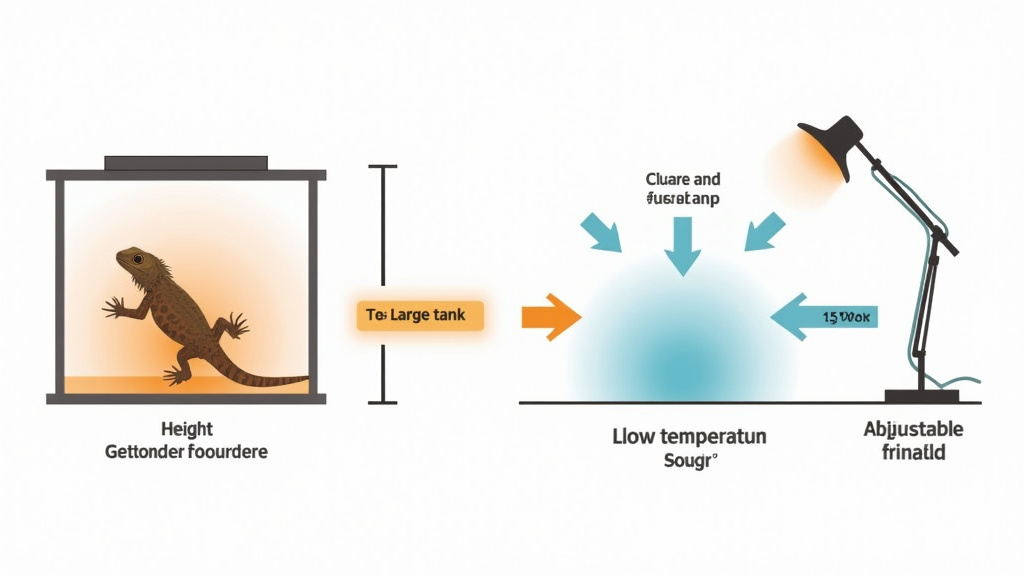
A 100-watt bulb in a 40-gallon tank in a cold basement will create a different temperature than the same bulb in a 120-gallon tank in a warm living room. Wattage selection depends on three factors: enclosure size, ambient room temperature, and bulb height.
For a standard 4x2x2 foot (120-gallon) enclosure in a room kept at 70-75°F, a 100-watt PAR38 halogen is usually correct. If the room is colder (65°F or below), you may need a 150-watt bulb or a secondary heat source on the cool side to maintain the gradient. In a small 40-gallon tank, a 75-watt bulb is often sufficient.
Start with the mid-range wattage. Use the thermostat and adjustable lamp stand to fine-tune. If the bulb is at its lowest point and the temperature is still too low, you need a higher wattage. If it’s at its highest and the spot is still too hot, you need a lower wattage. This is why a dimming thermostat is essential—it can manage a slightly overpowered bulb safely.
Reading Your Dragon’s Basking Behavior
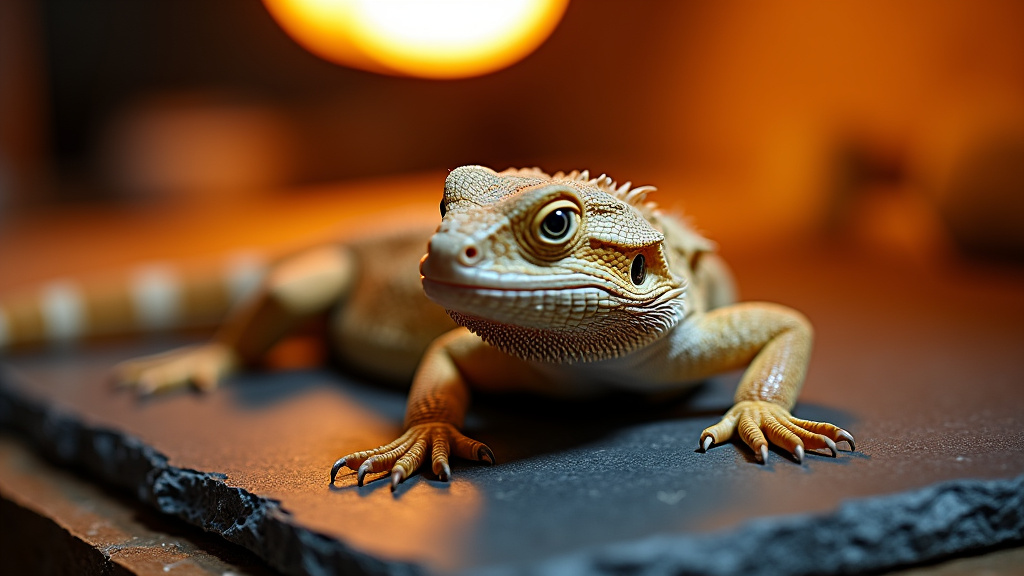
The equipment can be perfect on paper. Your dragon will tell you the truth. Watch for these signals.
- Proper Basking: The dragon sits on the hot spot, often flattening its body to maximize surface area. It may gape (hold its mouth open) periodically to release excess heat. After 15-45 minutes, it will move to the cool side to digest.
- Too Hot: Constant, frantic gaping without leaving the spot. Trying to climb the walls near the bulb. The dragon may sit next to the hot spot, not on it.
- Too Cold: Sitting directly on the spot for hours, often pressed flat, with eyes closed. Lack of appetite and general lethargy. Black beard (stress coloration) can occur from chronic discomfort.
A dragon that never basks might be sick, but first, check your temperatures. I had a juvenile that avoided her beautiful new slate platform. The gun said 110°F. I finally held my hand there. The heat was intense, but the slate felt oddly cool to the touch—it was a cheap composite material that didn’t conduct heat. She couldn’t feel it. Swapped to real slate, and she was on it in ten minutes.
Troubleshooting Common Basking Problems
Sometimes the setup seems right, but something’s off. Here are the frequent fixes.
Problem: The temperature fluctuates wildly during the day.
Solution: Your room temperature is changing drastically (e.g., AC kicks on). A dimming thermostat will compensate, but you may need to insulate the back and sides of the enclosure or move it away from vents.
Problem: The basking spot is correct, but the cool end is also too warm.
Solution: Your enclosure is too small, or your heat bulb is too powerful for the space. A 150-watt bulb in a 40-gallon tank will heat the entire thing. Downsize the wattage or upgrade to a larger tank. A proper temperature gradient requires space.
Problem: The UVB tube is over a year old.
Solution: Replace it immediately. T5 HO tubes degrade significantly after 12 months, even if they still glow. Your dragon stops getting usable UVB, which leads to early-stage MBD. Mark the replacement date on the fixture with a sticker.
Problem: Dragon only basks at night or under the cool side.
Solution: The basking spot is likely too hot or the wrong texture. Check for surface temperature spikes directly under the bulb’s filament—it could be 120°F+ in a tiny pinpoint. Raise the bulb or use a wider dome to diffuse the heat. Also, ensure the cool side is truly cool.
Seasonal and Life-Stage Adjustments
Your dragon’s needs aren’t static. A breeding female, a brumating adult, and a growing juvenile all have different requirements.
- Brumation (Winter Slowdown): If your dragon brumates, you can reduce the basking photoperiod to 8 hours and lower the spot temperature to 95-100°F. Keep UVB on a reduced schedule. They may not use it, but it should be available.
- Breeding/Gravid Females: Increase the basking spot to 110-115°F. They need extra heat for egg development. Ensure calcium and UVB are optimal.
- Juvenile to Adult Transition: As your dragon grows past 12-14 months, gradually lower the basking temperature from the juvenile range to the adult 105-110°F range over a few weeks.
These adjustments mimic natural cycles and prevent stress. Sticking rigidly to one setting year-round ignores their biology.
Frequently Asked Questions
Can I use a mercury vapor bulb for heat and UVB?
Mercury vapor bulbs (MVBs) produce both heat and UVB. In theory, they’re convenient. In practice, they’re problematic. The UVB and heat output degrade at different rates, making it hard to maintain both correctly. They also produce intense, localized heat that can easily create a burn spot over 120°F. For consistency and safety, using a separate halogen bulb and T5 HO UVB tube is the recommended, more controlled method.
How often should I replace my basking bulb?
Halogen bulbs lose their heat output over time. Even if the bulb still lights up, it may be emitting less IR-A/B. Replace your basking bulb every 6-9 months. A proper basking lamp setup includes budgeting for this regular replacement.
My dragon sits with its mouth open all day. Is this normal?
Periodic gaping is normal thermoregulation. Constant, frantic gaping is a sign of overheating. First, verify the basking surface temperature with your gun. If it’s over 115°F, raise the bulb or lower the wattage. Also, check that the cool side is genuinely below 88°F so it has a place to cool down.
What if my room gets very cold at night?
Bearded dragons can handle a nighttime drop to 65°F. If your room drops below 60°F, you need supplemental night heat. Use a ceramic heat emitter (CHE) connected to a thermostat. A CHE produces only heat, no light, so it won’t disrupt their day/night cycle. Never use colored “night” bulbs.
Is a 40-gallon tank enough for a bearded dragon’s basking zone?
No. A 40-gallon breeder tank is the absolute bare minimum for a juvenile. An adult requires a 75-120 gallon enclosure. The 4x2x2 foot (120-gallon) size is the gold standard because it provides the necessary length to create a true thermal gradient. In a small tank, the heat from the basking lamp warms the entire space, making it impossible to create a cool retreat.
The Bottom Line
Getting the basking spot right isn’t about buying the most expensive bulb. It’s about matching four elements: the correct surface temperature measured with an infrared gun, the right halogen heat spectrum, complete overlap with a quality T5 HO UVB tube, and a dense basking surface like slate. Set it up, test it for 48 hours, and then watch your dragon. Its behavior will tell you more than any thermometer. A dragon that thermoregulates properly is a dragon that eats, digests, and thrives. Skip a step, and you’re managing symptoms of poor health. Do it right the first time, and you build the foundation for a long, active life.