
How High Can a Bearded Dragon Jump? Safety Tips & Limits
This post contains affiliate links. As an Amazon Associate, we earn from qualifying purchases.
A bearded dragon can jump roughly 8 to 12 inches vertically, about the height of its own body when standing upright. Their hind legs are built for short, powerful bursts, not sustained leaping, and a healthy adult rarely clears more than a foot.
Most owners overestimate their dragon’s athleticism. They see a quick hop onto a basking rock and assume the animal can handle a two-foot drop. That assumption ends with a broken leg or a cracked plastron when the dragon misjudges the distance and lands wrong.
This guide breaks down the actual mechanics of a bearded dragon jump, the real risks of falls, and how to design an enclosure that keeps your pet safe without stifling its natural curiosity.
Key Takeaways
- A healthy adult bearded dragon’s maximum jump height is about 12 inches. Juveniles and overweight dragons clear less.
- Falls from heights greater than the dragon’s own body length can cause leg fractures, spinal injury, or internal trauma.
- Jumping is a defensive or foraging behavior, not play. A dragon jumping repeatedly signals stress or enclosure design failure.
- The safest enclosure keeps all elevated surfaces within 8–12 inches of the substrate and includes soft landing zones.
- Climbing is a separate, safer behavior driven by different muscles and intent. Provide sturdy, textured branches for climbing instead of expecting jumps.
How High Can a Bearded Dragon Jump?
You measure a bearded dragon’s safe jump height by holding it upright and noting the distance from its feet to the top of its head. That number, typically 8 to 12 inches for an adult, is the ceiling.
A bearded dragon’s hind legs contain the iliofibularis and caudofemoralis muscles, which contract for a short, explosive push. This biomechanical design limits vertical thrust; a jump beyond 12 inches requires the dragon to also use its forelimbs for a climbing assist, which changes the action from a pure jump to a scramble.
I learned this limit the hard way with a Zoo Med Reptile Lamp Stand. The stand lifted the basking platform 14 inches off the substrate. My dragon, a healthy adult male, made the jump three times in one week. On the fourth attempt, he landed sideways on his elbow. The joint swelled within an hour, and the vet confirmed a soft tissue strain that took two weeks of reduced activity to heal. I lowered the platform to 10 inches the next day, and he never attempted the jump again.
TL;DR: Measure your dragon’s standing height. That’s its safe jump limit. Any furniture taller than that is a fracture risk.
Why Do Bearded Dragons Jump?
They don’t jump for fun. A jump is either a panic response or a foraging attempt.
If something startles them, a sudden shadow, a loud noise, an unfamiliar hand, they’ll leap straight away from the threat. This is the defensive jump. It’s pure adrenaline, often poorly aimed, and the dragon lands wherever it lands. That’s why a startled dragon leaping from a high shelf usually hits the ground hard.
The foraging jump is more calculated. They’ll hop up onto a rock or platform to reach a cricket or a piece of salad that’s just out of reach. This jump is shorter, more controlled, and usually onto a flat surface. It still carries risk if the surface is slippery or too small.
Common mistake: Assuming a jumping dragon is “playing” or “exercising”, jumping is a stress behavior or a food-driven action. If your dragon jumps frequently, check for stressors in its environment or adjust food placement.
Jumping vs. Climbing: The Mechanics
Climbing uses a different muscle set. Bearded dragons pull themselves up with their forelimbs and grip with their claws. It’s a slower, controlled motion. Jumping relies solely on the hind-leg thrust.
| Action | Primary Muscles | Maximum Height | Risk Level |
|---|---|---|---|
| Pure jump | Hind-leg iliofibularis, caudofemoralis | 8–12 inches | High — landing is uncontrolled |
| Climb-assisted jump | Hind-leg + forelimb pull | 18–24 inches | Medium — some control, but fall possible |
| Full climb | Forelimbs, claw grip | Several feet | Low — animal maintains grip |
A dragon that scrambles up a textured branch is climbing. A dragon that launches from the floor onto a rock is jumping. Mixing the two, a jump with a forelimb assist, is how they reach slightly higher spots, but it’s still a fall risk if the surface isn’t secure.
Their climbing ability is generally more robust than their jumping ability. Provide ample safe climbing opportunities with branches and rocks, and you’ll satisfy their vertical curiosity without forcing risky leaps.
The Real Risks of a Bad Landing
A fall from a height greater than the dragon’s body length transfers force straight through its skeleton. The bones are light, designed for weight-bearing on all fours, not impact absorption.
The plastron (the belly plate) can crack. A leg can fracture at the joint. Spinal compression can pinch nerves, leading to temporary or permanent mobility loss. Internal bruising is common even if nothing breaks externally, you’ll see lethargy and appetite loss for days after a fall.
I won’t recommend any enclosure with a basking spot higher than 12 inches without a fall-break zone below it. The first time I saw a dragon limp after a 14-inch drop, I stopped using tall, standalone basking rocks. Now every high point has a sloping, soft landing route.
The younger the dragon, the higher the risk. Juvenile bones are still developing and more brittle. An overweight dragon carries more mass, which multiplies impact force. A senior dragon with weaker joints may not recover fully.
These injuries align with broader health indicators like alert posture and full appetite, a dragon that’s hurt after a fall will show all the opposite signs.
How to Spot Jump-Related Stress
A dragon that jumps repeatedly isn’t being athletic. It’s stressed. Look for these signals:
- Black beard appearing right before or after a jump.
- Rapid, shallow breathing for minutes after landing.
- Refusal to bask on the platform it just jumped onto.
- Hiding after the jump instead of resuming normal activity.
These are classic stress-related head bobbing and arm waving precursors. Jumping is a physical escalation of those communication signals.
Building a Jump-Safe Habitat
Your enclosure layout should eliminate the need to jump. Place food, water, and basking areas within easy reach via climbing or short steps.
Step 1: Measure your dragon. Hold it upright, support its belly, and measure from its feet to the top of its head. Record this number.
Step 2: Audit all high points. Check the height of every basking rock, platform, and branch above the substrate. If any are taller than your dragon’s standing height, lower them or remove them.
Step 3: Create soft landing zones. Below any unavoidable elevated spot, like a basking area under a UVB lamp, place a sloping half-log, a pile of soft substrate, or dense plants. This cushions a potential fall.
Step 4: Use climbing structures instead of jumps. Install textured branches that angle upward at a 30–45 degree slope. A dragon will climb these, not jump to them.
Step 5: Observe for a week. After rearranging, watch your dragon’s movement. If it still attempts risky leaps, you missed a stressor. Re-check food placement and hiding spots.
The 4 Tools That Replace a $200 Vet Visit
You don’t need complex gear. These four items restructure the enclosure to prevent jumps:
- A measuring tape. The $5 hardware store tape is the most important tool. It gives you the hard number, your dragon’s safe drop distance.
- Secure climbing branches. Natural oak or maple branches, sanded and secured with reptile-safe screws. Texture matters; smooth plastic branches slip.
- A ReptiBreeze terrarium or equivalent. Screen-top enclosures allow taller safe climbing without the risk of a dragon hitting a solid ceiling on a jump.
- Soft substrate piles. Orchid bark or coconut fiber mounds placed strategically below high points. They dissipate impact force.
Common mistake: Using a single, tall basking rock without a fall-break zone, a dragon that misses the jump lands on hard substrate, and the impact travels straight up the leg bones. The crack happens at the thinnest part of the tibia.
Juvenile vs. Adult Jumping Limits
A juvenile bearded dragon (under 10 inches long) can’t jump as high as an adult. Its muscles are still developing, and its coordination is poorer.
| Age Stage | Average Length | Max Jump Height | Critical Fall Height |
|---|---|---|---|
| Hatchling (0–4 months) | 4–6 inches | 2–4 inches | >4 inches |
| Juvenile (4–12 months) | 8–12 inches | 4–8 inches | >8 inches |
| Adult (12+ months) | 16–24 inches | 8–12 inches | >12 inches |
The critical fall height is the distance at which a bad landing becomes likely to cause injury. It’s roughly equal to the dragon’s own length. This table mirrors their growth stages, a juvenile’s safe vertical space changes monthly.
A hatchling’s jump is more of a hop. It’s low-force and usually harmless. But a juvenile attempting an adult-height jump will often misjudge and land awkwardly. Their essential care guide should include monthly height checks of all enclosure furniture.
When Jumping is a Health Red Flag
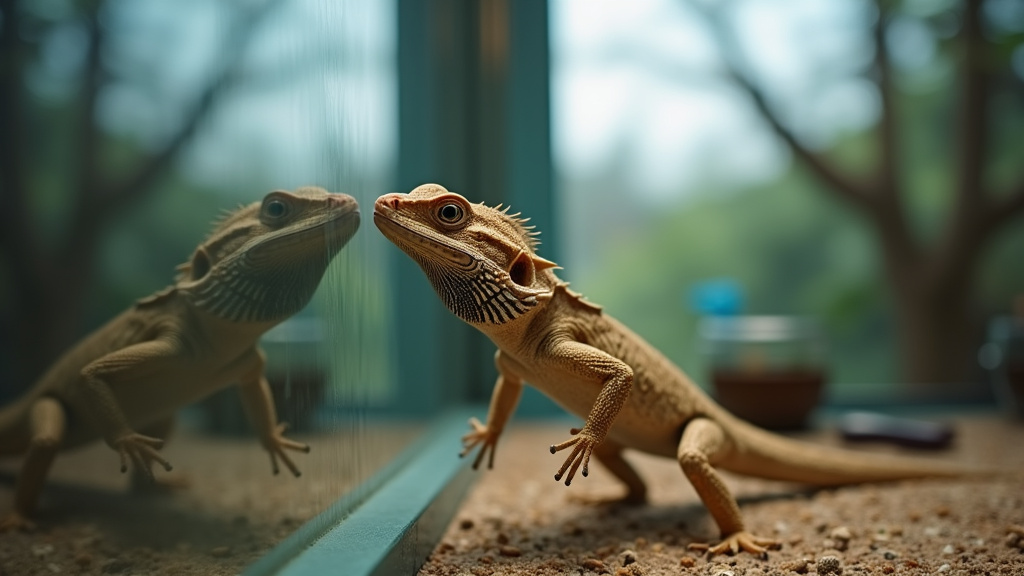
Jumping isn’t a normal part of daily general behavior. If your dragon jumps multiple times a day, you have a problem.
The first cause is enclosure design failure. Food is placed too high, or the basking spot is inaccessible without a leap. Fix the layout.
The second cause is stress. Something in the environment is triggering a panic response, a reflection on the glass, a vibrating speaker, another pet staring in. Identify and remove the trigger.
The third cause, rare but serious, is neurological or muscular issue. A dragon with a calcium deficiency (metabolic bone disease) may jump erratically because its muscle control is impaired. This is a veterinary emergency.
I had a dragon that started jumping at the enclosure glass every afternoon. It took three days to notice the sunset light reflected a moving tree shadow across the back wall. He was jumping at the shadow. I moved the enclosure away from the window, and the jumping stopped within hours.
Frequently Asked Questions
Can bearded dragons jump out of their enclosure?
Yes, if the enclosure walls are low enough. An adult can clear a 12-inch wall if motivated by fear or food. Always use an enclosure with walls at least 18 inches high, or a secure screen top.
Is it okay to encourage my bearded dragon to jump?
No. Encouraging jumps for “exercise” or “fun” invites injury. Provide climbing structures and let them explore vertically in a controlled, safe way. Their natural climbing instincts are a safer outlet.
How can I tell if my bearded dragon is injured from a jump?
Look for limping, swelling on a leg or joint, reduced appetite, and lethargy. A dragon that hides more than usual after a fall is likely hurt. Check the plastron for cracks, a subtle line you might miss unless you look closely.
Do bearded dragons jump at each other?
They can, during aggressive displays. A dominant dragon may jump toward a subordinate during a territorial dispute. This is high-risk and should be prevented by separating dragons before aggression escalates. This behavior is part of their complex communication methods.
What’s the safest substrate for a dragon that might fall?
Orchid bark or coconut fiber. Both are soft, loose, and dissipate impact. Avoid hard substrates like reptile carpet or slate tiles directly under high points. Sand is controversial, it can cushion a fall but also cause impaction if ingested; use it only with experienced supervision.
Where can I find community advice on jump-related injuries?
The Bearded Dragon.org jumping safety thread contains firsthand accounts from owners who dealt with fractures and soft tissue damage. It’s a sobering read that underscores the need for preventive design.
The Bottom Line
A bearded dragon’s jump height is a fixed number, roughly its own body length. Design the enclosure around that number, not around what looks aesthetically pleasing.
Every elevated surface should be within that safe vertical range. Every high point should have a soft landing below it. Climbing structures should replace jumping opportunities.
Watch for jumping as a stress signal, not as play. If your dragon leaps more than once a week, reassess the habitat layout, food placement, and environmental stressors.
Their comprehensive care requirements include managing vertical space. Do that well, and you’ll never see a limp after a bad landing.