
Bearded Dragon Food Dusting: The Right Way to Supplement
This post contains affiliate links. As an Amazon Associate, we earn from qualifying purchases.
Bearded dragon supplementation through food dusting requires three powdered supplements applied on a strict weekly schedule: plain calcium (calcium carbonate without D3) most often, calcium with D3 sparingly, and a reptile multivitamin once weekly. Dust a light coating onto feeder insects immediately before feeding, and always pair it with a robust gut-loading routine for the insects themselves.
Most owners dust with the wrong supplement, or they dust too heavily. They see a bag of “calcium with D3” at the pet store and use it at every single feeding. That mistake builds up vitamin D3 in the dragon’s liver over months, and the first sign of trouble is often a lethargic dragon that stops eating.
This guide walks through the exact powders, the proven weekly schedule, and the physical technique that keeps dragons healthy without guesswork. We’ll cover why gut loading isn’t optional, how your UVB light changes the D3 rules, and what happens when you get the dusting sequence wrong.
Key Takeaways
- Use three separate powders: plain calcium (no D3), calcium with D3, and a reptile-specific multivitamin. Never mix them together for a single dusting.
- Plain calcium is your workhorse. Dust with it at almost every insect feeding for juveniles (5-6x/week) and 3-4 times a week for adults to correct the poor calcium-to-phosphorus ratio in feeder insects.
- Vitamin D3 is fat-soluble and stored. If you use a proper linear UVB tube, you only need to dust with calcium with D3 once or twice a week. If you use a Mercury Vapor Bulb (MVB), eliminate dietary D3 completely to prevent toxic accumulation.
- Dust immediately before feeding. The powder starts falling off insects within 60 seconds, so dusting in advance is wasted effort.
- Gut loading is not a replacement for dusting. Gut loading improves the insect’s internal nutrition; dusting coats the exterior. You must do both for complete supplementation.
The 3 Supplements You Need (and What They Do)
You need three separate containers of powder. Buying a single “all-in-one” supplement or mixing your own blends leads to inconsistent dosing and nutrient imbalances. Each powder serves a distinct, non-negotiable purpose in preventing metabolic bone disease (MBD).
Plain calcium powder, specifically calcium carbonate without added D3, is the foundation. Brands like Rep-Cal plain calcium or Zoo Med Repti Calcium without D3 are standard. Feeder insects like crickets and dubia roaches have more phosphorus than calcium in their bodies. Dusting with plain calcium corrects this imbalance at the point of ingestion, making the calcium available for skeletal growth and nerve function. Your dragon cannot pull enough calcium from its diet without this external boost.
A light dusting of plain calcium carbonate provides the elemental calcium needed to offset the high phosphorus content in feeder insects. This direct correction is the primary defense against the demineralization of bone that characterizes metabolic bone disease.
Calcium powder with D3 is your conditional tool. Vitamin D3 is a hormone that allows calcium to be absorbed from the gut into the bloodstream. It is fat-soluble, meaning excess is stored in the liver and fatty tissues, not excreted in urine. This is why overuse is dangerous. Your dragon can also synthesize its own D3 when exposed to the correct wavelength of UVB light (290-315 nm). Therefore, dietary D3 is a supplement to, not a replacement for, proper lighting.
The reptile multivitamin fills in the micronutrient gaps. Look for a brand that specifies the source of vitamin A. Preformed vitamin A (listed as retinol or retinyl acetate) can reach toxic levels with over-supplementation. Multivitamins using beta-carotene, which the dragon converts to vitamin A only as needed, are safer for weekly use. This powder also provides trace minerals like zinc and manganese that are absent in a limited feeder insect diet.
TL;DR: Plain calcium fixes the Ca:P ratio at every meal, calcium with D3 aids absorption only when needed, and a multivitamin covers everything else once a week.
How Your UVB Setup Changes Everything
The type of UVB light you use dictates your schedule for calcium with D3. Getting this wrong is the single most common cause of long-term health issues in otherwise well-cared-for dragons.
If you use a linear fluorescent UVB tube (like the Zoo Med ReptiSun 10.0 T5 or Arcadia 12%) that covers at least half the enclosure and is mounted inside the screen or at the proper distance, your dragon can produce sufficient D3. In this setup, dietary D3 is only a backup. Dust with calcium with D3 just once a week. The rest of your calcium dustings should use the plain, D3-free powder.
If you use a Mercury Vapor Bulb (MVB) for both heat and UVB, the rules change completely. MVBs produce intense, full-spectrum UVB. A dragon under an MVB will synthesize ample D3 on its own. Adding dietary D3 on top of this leads to accumulation and the risk of hypercalcaemia—too much calcium in the blood, which damages soft tissues like the kidneys and heart. With an MVB, you must never use calcium powder with D3. Use only plain calcium and your multivitamin.
The table below outlines the direct implications of your lighting choice.
| UVB Light Type | Dietary D3 Rule | Risk If Ignored |
|---|---|---|
| Linear Fluorescent Tube (T5/T8) | Use calcium with D3 1x/week; plain calcium all other times. | Mild D3 deficiency over 6+ months can still weaken bones if the bulb is old or too far away. |
| Mercury Vapor Bulb (MVB) | Never use calcium with D3. Use plain calcium only. | D3 accumulation begins within 2-3 months; hypercalcaemia symptoms (lethargy, loss of appetite) follow. |
| Inadequate or No UVB | Requires calcium with D3 at almost every dusting (vet guidance essential). | Rapid onset of Metabolic Bone Disease (MBD) in juveniles within 4-8 weeks, presenting as tremors and soft jaw. |
TL;DR: Your light decides your D3. Tube UVB means little dietary D3. An MVB means zero dietary D3. No UVB is an emergency.
The Proven Weekly Dusting Schedule by Age
A juvenile bearded dragon growing bone at full speed has different needs than a maintenance-phase adult. This schedule assumes you are using a proper linear UVB tube. If using an MVB, remove the “Calcium with D3” column entirely.
| Age / Life Stage | Plain Calcium (No D3) | Calcium with D3 | Multivitamin | Insect Feeding Frequency |
|---|---|---|---|---|
| Hatchling to 5 months | At every insect feeding (2-3x/day) | 1x per week | 1x per week | 2-3 times daily |
| 5-12 months (Juvenile) | At every insect feeding (1-2x/day) | 1x-2x per week | 1x per week | 1-2 times daily |
| 12+ months (Adult) | 3-4x per week | 1x per week | 1x per week | 2-3 times per week |
For adults, the drastic reduction in insect feeding is critical. An adult dragon’s primary diet should be fresh salads. Daily insect feeding leads to gradual weight gain and fatty liver disease—it’s a slow-motion mistake. Their salad should include calcium-rich greens like turnip greens and dandelion greens. You can occasionally add variety with herbs like basil or cilantro.
The schedule is a framework, not a prison. If your adult dragon is especially active or breeding, you might add an extra insect day. If a juvenile seems to be growing unusually slowly, a vet check is better than arbitrarily increasing supplements. The one rigid rule is the separation of powders: never dust with calcium and multivitamin on the same insect. You can offer them on the same day, but in separate feedings.
TL;DR: Babies need calcium almost daily, adults need it 3-4 times a week. Always separate calcium and multivitamin dustings.
The Step-by-Step Dusting Process
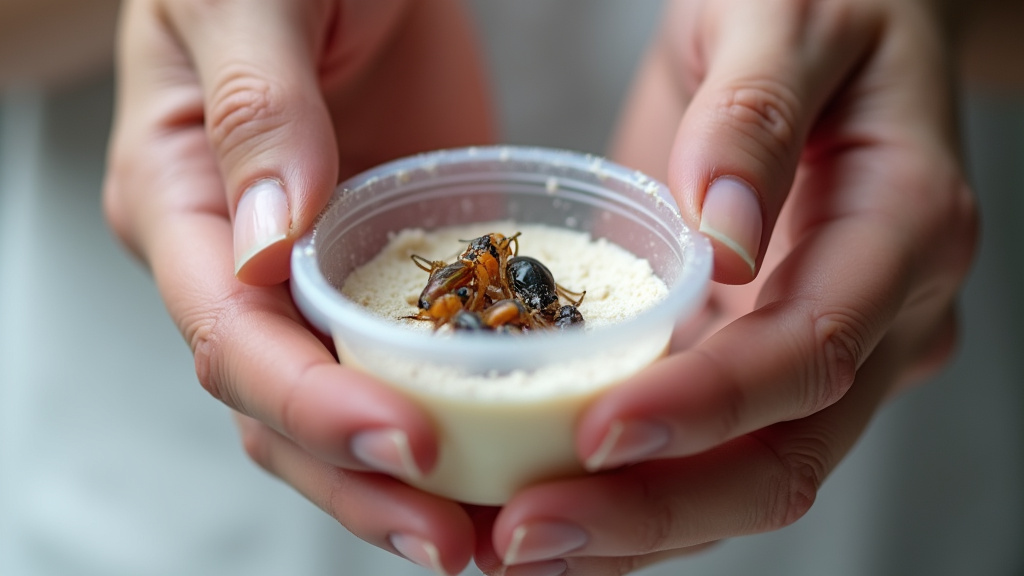
The technique matters as much as the schedule. A heavy, clumpy dusting will put your dragon off its food, and dusting too early makes the powder disappear before it’s eaten.
- Place feeders in a container. Put 5-10 feeder insects into a small zip-top bag or a deli cup with a lid. Do not overfill. You want them to have room to tumble.
- Add a pinch of powder. Add a small pinch of the correct supplement—literally the amount you can hold between your thumb and forefinger. This is enough for a dozen crickets. The common mistake is using a full teaspoon, which cakes the insects.
- Shake gently for 2-3 seconds. Seal the container and give it a few gentle shakes. The insects should have a faint, even white haze. If they look like they’ve been rolled in powdered sugar, you’ve used too much. Discard the excess powder and insects and start over.
- Feed immediately. Use tweezers or dump the insects directly into the enclosure within one minute. Powder falls off rapidly. If your dragon doesn’t eat them within a few minutes, the supplement is mostly gone.
For stubborn dragons that refuse dusted prey, do not resort to wet-dusting or smearing powder on their noses as a habit. Instead, ensure your dusting is light enough. A heavy coat smells and tastes strongly of chalk. If the issue persists, focus on gut loading the insects exceptionally well with nutritious veggies like bell peppers and butternut squash so the internal nutrition carries the load.
Why Gut Loading Isn’t Optional
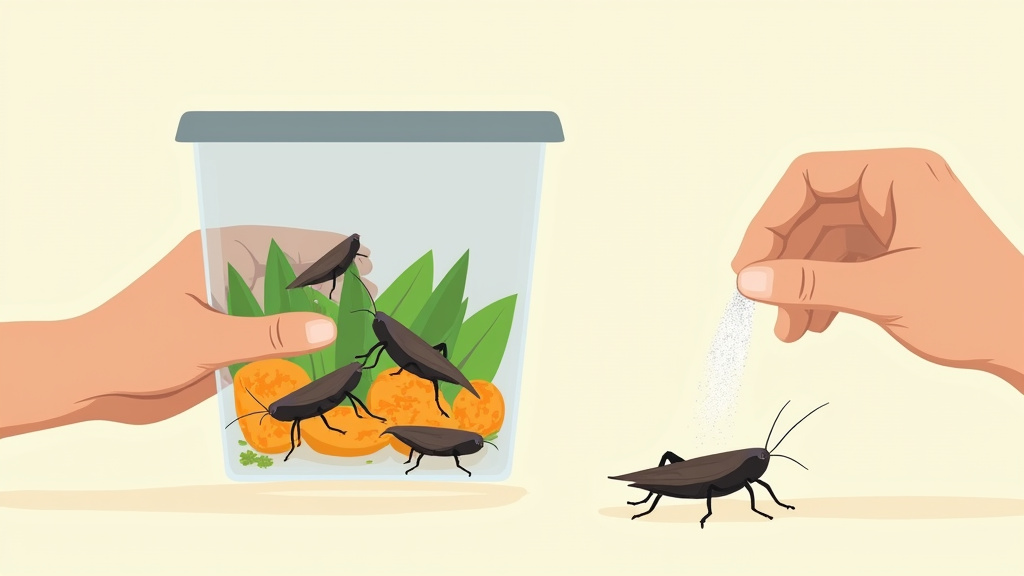
Dusting addresses the surface. Gut loading changes the insect from the inside out. An insect’s gut contents directly contribute to the nutrient profile your bearded dragon ingests. Feeding your crickets nothing but cardboard or cheap cereal for 24 hours before they become food is a missed opportunity.
Common mistake: Skipping gut loading because you dust — the insect’s internal calcium-to-phosphorus ratio remains skewed, so the dragon must rely entirely on the external dusting, which can rub off. The result is a marginal calcium intake that can still lead to mild MBD over a year.
Effective gut loading means feeding your feeder insects a high-calcium, nutrient-dense diet for 24-48 hours before feeding them to your dragon. Good choices include collard greens, mustard greens, dandelion greens, and grated sweet potato. Avoid spinach and beet tops, as they contain oxalates that bind calcium. The goal is to pack the insect’s gut with valuable nutrients that become part of your dragon’s meal. This is especially important for the calcium-rich kale you might feed, as the insect can help process its oxalates.
Think of gut loading as filling a nutrient capsule. Dusting is the protective coating. You need both for the full dose.
Common Dusting Mistakes to Avoid
These errors show up in vet clinics repeatedly. Knowing them in advance saves you the trip.
- Overusing D3. This is the big one. That jar of calcium with D3 is not your everyday powder. With a good UVB light, it’s a once-a-week tool.
- Dusting the salad. It doesn’t stick. Powder falls straight off leafy greens. Supplementation for salads happens via the insects that eat them (gut loading) or, in rare cases, via a vet-recommended liquid supplement added to food.
- Mixing powders. Combining a little calcium and a little multivitamin for one dusting dilutes both. The dragon gets a sub-dose of each, missing the full benefit. Use them on separate feedings.
- Dusting in advance. You might dust a batch of crickets in the morning for an evening feeding. By then, 95% of the powder is at the bottom of the container. Dust immediately.
- Using calcium gluconate. This form delivers less elemental calcium per gram than calcium carbonate. It’s fine as a liquid supplement for a sick dragon but inefficient as a dusting powder. Stick with calcium carbonate.
I used a mercury vapor bulb for years because I liked the combined heat and UV. I kept using the same calcium-with-D3 powder I always had. My oldest dragon, Mo, became lethargic and stopped basking after about four months. The blood test showed elevated calcium. We stopped the D3 powder, and he was back to normal in two weeks. The bulb was doing all the work.
TL;DR: D3 is the usual suspect. Dust right before feeding, never mix powders, and don’t bother dusting salads.
Choosing the Right Feeder Insects to Dust
Not all insects are equal nutritionally. Your dusting works on top of the base nutritional value of the feeder. Rotate between several types to provide a broad nutrient profile.
Dubia roaches are a superior staple. They have a better calcium-to-phosphorus ratio than crickets, are less likely to carry parasites, and don’t smell. They also hold dust well due to their slightly textured exoskeleton. Crickets are a classic choice but are more prone to gut-loading failure if not fed well themselves. Black soldier fly larvae (nutrigrubs, calciworms) are naturally high in calcium, so they require slightly less aggressive dusting.
Less nutritious feeders like mealworms and superworms are high in fat and chitin. They should be treats, not staples. When you do feed them, dust them thoroughly. For all feeders, a varied gut-loading diet is key. Feed them nutritious bell peppers, green beans, and arugula before they become food themselves.
| Feeder Insect | Best For | Dusting Priority | Notes |
|---|---|---|---|
| Dubia Roaches | Staple for all ages | High – dust at every feeding. | Excellent carrier for powder; superior base nutrition. |
| Crickets | Staple rotation | High – dust at every feeding. | Gut load intensively for 48 hours; dust falls off easily. |
| Black Soldier Fly Larvae | Juveniles, calcium boost | Moderate – can reduce plain calcium frequency slightly. | Naturally high in calcium; good for picky eaters. |
| Mealworms/Superworms | Occasional treat only | High – dust whenever fed. | Poor Ca:P ratio; high fat; do not rely on them. |
TL;DR: Dubia roaches and crickets are your dusting workhorses. Feed them well, then dust them right before they’re eaten.
Frequently Asked Questions
Can I dust my bearded dragon’s salad instead of insects?
No. Powder does not adhere to wet greens. It will fall to the bottom of the bowl. The primary method for supplementing a bearded dragon is through dusting feeder insects. For dragons that eat mostly salads, ensure those salads contain calcium-rich greens like collard greens and that the occasional insects are heavily gut-loaded and dusted.
What happens if I forget to dust for a week?
For an adult dragon, one week is not a crisis. Resume your normal schedule. The risk is cumulative deficiency over months, not a single missed dusting. For a rapidly growing juvenile, try to get back on track immediately. If you miss multiple weeks, do not “double dose” to catch up—just restart the schedule.
My dragon won’t eat dusted insects. What should I do?
First, make sure you are dusting lightly. A thick, chalky coating is unappetizing. Second, try a different feeder—dubia roaches often take powder better than crickets. Third, focus on impeccable gut loading so the insects are nutritious even without a perfect dust. As a last resort, you can very lightly mist the insects with water before dusting to help the powder stick, but this can clump if overdone.
How do I know if my dragon is getting too much or too little calcium?
Signs of deficiency (Metabolic Bone Disease) include tremors, a soft or rubbery jaw, lethargy, and swollen limbs. Signs of excess (hypercalcaemia) are similar: lethargy, loss of appetite, and increased thirst. Both are serious and require a reptile veterinarian. The best approach is preventative: follow a correct dusting and lighting schedule from the start.
Are there any vegetables that are bad for gut loading?
Yes. Avoid spinach, beet greens, and Swiss chard for gut loading because they are high in oxalates that bind calcium. Also avoid iceberg lettuce and celery, which are mostly water and provide little nutritional value to the feeder insect. Stick with dense, dark greens and vegetables like butternut squash and prepared brussel sprouts.
Can I use a vitamin spray instead of powder?
Vitamin sprays are generally not recommended for bearded dragons. They are difficult to dose accurately, often contain less stable forms of vitamins, and do not provide the concentrated calcium boost that powder does. Powdered supplementation through dusting is the established, reliable method.
The Bottom Line
Bearded dragon supplementation through food dusting is a simple, mechanical routine that prevents complex, painful diseases. Success hinges on three separate powders, a schedule dictated by your dragon’s age and your UVB light, and the discipline to dust immediately before feeding.
Remember that dusting is the exterior coating. The interior of the insect is changed by a strict 48-hour gut-loading protocol with vegetables like sweet potato and safe asparagus. Pair this with an adult feeding schedule that prioritizes salads over insects, and you provide a foundation for a long, healthy life. The goal isn’t perfection at every meal, but consistency across hundreds of them. Get the light right, keep the powders separate, and your dragon’s skeleton will thank you for years.