
Bearded Dragons and Kale: A Complete Guide to Safe Feeding
This post contains affiliate links. As an Amazon Associate, we earn from qualifying purchases.
Bearded dragons can eat kale. Feed it 1-2 times per week as part of a rotated salad, never as a daily staple. Its high calcium and low oxalate content are benefits, but its goitrogens and high Vitamin A levels require strict moderation.
Most owners get this wrong by treating kale like a daily green. They see the word “superfood” on human nutrition blogs and assume it’s a limitless staple. That assumption leads to thyroid issues within months.
This guide covers the exact weekly limit, the science behind the goitrogen warning, how to pick fresh kale at the store, and the symptoms you’ll see if you overdo it.
Key Takeaways
- Kale is safe but occasional, serve it 1-2 times weekly, never daily.
- Its high calcium-to-phosphorus ratio (2.4:1) helps prevent metabolic bone disease (MBD).
- Goitrogens in kale can suppress thyroid function if fed consistently without rotation.
- Always wash kale and chop it smaller than the space between your dragon’s eyes.
- Rotate kale with staple greens like collard greens, dandelion greens, and mustard greens.
The Nutritional Breakdown: Why Kale Is a “Sometimes” Food
Kale offers a strong nutritional profile for bearded dragons, but two components mandate its occasional status. The first is its calcium-to-phosphorus ratio. The second is its goitrogen content.
Kale provides a calcium-to-phosphorus ratio of approximately 2.4:1, a favorable balance for skeletal health. It contains lower levels of oxalate compounds than spinach, reducing interference with calcium absorption. However, kale also contains goitrogenic substances which can affect thyroid hormone production when consumed in large, consistent quantities.
The calcium boost is real. For a species prone to metabolic bone disease, a green that delivers more calcium than phosphorus is a useful tool. The low oxalate level means the calcium you’re offering is more likely to be absorbed. That’s the good news.
The goitrogens are the constraint. These compounds interfere with iodine uptake in the thyroid gland. Iodine is essential for producing hormones that regulate metabolism, growth, and energy. A dragon fed kale every day for six weeks might show no immediate symptoms. But over three months, you could see slowed growth, unexplained weight gain despite normal feeding, and lethargy that isn’t tied to enclosure temperature.
Common mistake: Treating kale as a daily staple because it’s “healthy”, consistent feeding without rotation lets goitrogens accumulate, and thyroid function drops within 2-3 months. The dragon becomes sluggish and may develop a thicker neck region.
Vitamin A is another quiet risk. Kale is high in preformed Vitamin A (retinol). While necessary, excess Vitamin A from supplements combined with daily kale can lead to toxicity. Symptoms include swelling around the eyes and mouth, skin shedding issues, and loss of appetite. That’s why we rotate.
TL;DR: Kale’s calcium is great, its oxalates are low, but its goitrogens and Vitamin A content demand a strict rotation schedule with other greens.
How Much Kale Can a Bearded Dragon Eat?
The answer isn’t a cup or a leaf count. It’s a frequency.
Adult bearded dragons should get kale 1-2 times per week. For a juvenile (under 12 months), keep it to once a week because their primary diet is still insect-based. A single serving should be a few chopped leaves mixed into a larger salad, never the salad’s base.
Here is a simple weekly schedule to visualize the rotation:
| Day | Primary Green | Kale Status |
|---|---|---|
| Monday | Collard greens | Not included |
| Tuesday | Mustard greens | Not included |
| Wednesday | Dandelion greens | Included (few leaves) |
| Thursday | Collard greens | Not included |
| Friday | Turnip greens | Not included |
| Saturday | Mustard greens | Included (few leaves) |
| Sunday | Mix of above | Not included |
This table ensures kale appears twice, on non-consecutive days, surrounded by safer staple greens. The portion is always “a few leaves”, about 10-15% of the total salad volume.
If you are building a bearded dragon’s diet from scratch, consult a safe vegetables list to identify other options. Variety protects against the slow build-up of any one compound.
What happens if you ignore the limit? The first sign is often a change in appetite around the sixth week. The dragon might seem less interested in its salad, even if insects still excite it. By the third month, you might notice a subtle puffiness around the throat area. That’s the thyroid responding. It’s not immediate, so owners miss the link.
TL;DR: Feed kale 1-2 times weekly, never daily. Mix a few leaves into a salad dominated by staple greens.
Selecting, Preparing, and Serving Kale Correctly
You can’t just grab any kale bunch and toss it in the bowl. Quality and preparation matter.
Start at the store. Look for bunches with deep green, crisp leaves. Avoid any with yellow spots or wilted edges. The stems should be firm, not rubbery. Organic isn’t mandatory, but it reduces pesticide residue you’ll need to wash off.
Once home, rinse each leaf under cold running water. Rub the surface gently with your fingers. Even organic kale carries dirt and potential microbes. Drying isn’t necessary, but shake off excess water.
Next, chop. Remove the thick central stem entirely, it’s fibrous and hard to digest. Cut the leafy parts into pieces no larger than the space between your dragon’s eyes. Larger pieces can cause impaction or simply be ignored.
Now, mix. Kale should never be served alone. Combine it with staple greens like collard greens or dandelion greens. You can also add a small amount of arugula or basil for flavor variety, but keep those as minor components too.
Finally, supplement. Lightly dust the kale pieces with a calcium powder supplement. If you are already using a multivitamin that contains Vitamin A, skip dusting the kale on those days to avoid double dosing. This step integrates with your overall salad feeding tips for balanced nutrition.
Common mistake: Serving whole kale leaves or large chunks, dragons often drag them around the enclosure uneaten, which dehydrates the leaves and wastes food. Chopping small ensures consumption.
Kale vs. Other Greens: Where It Fits in the Hierarchy
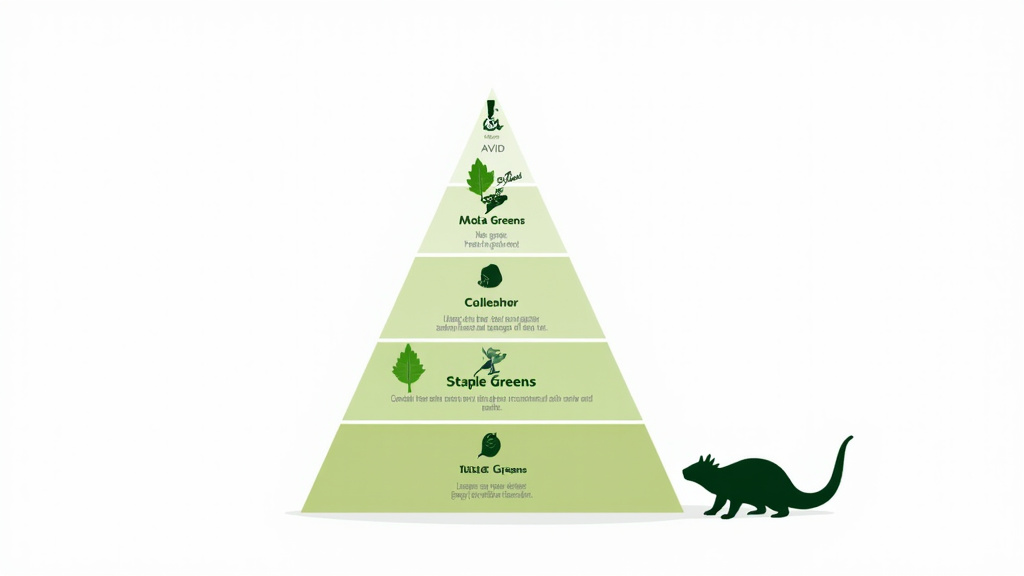
Not all greens are equal. Kale sits in the middle tier, below staple greens, above occasional treats, and far above avoidable greens like spinach.
This comparison table clarifies its position:
| Green Type | Frequency | Key Benefit | Key Risk | Example |
|---|---|---|---|---|
| Staple | Daily | High calcium, low risk | None when varied | Collard greens, dandelion greens |
| Occasional | 1-2 times/week | Specific nutrient boost | Compound buildup | Kale, turnip greens, arugula |
| Treat | 1-2 times/month | Variety, enrichment | High oxalates or goitrogens | Cabbage, basil |
| Avoid | Never | None | High oxalates blocks calcium | Spinach |
Kale’s “occasional” status is shared by turnip greens and arugula. These greens have strong attributes but also carry a limitation, goitrogens for kale, higher oxalates for turnip greens, strong flavors for arugula that might deter some dragons.
Spinach is the clear avoid. Its oxalate level is so high it binds calcium and can contribute to MBD even in occasional doses. If you’re comparing kale to spinach, kale wins. But it doesn’t beat the staples.
When designing healthy salad mixes, your base should always be a staple green. Then add one occasional green for a nutrient boost. Finally, include a small treat item for interest. Kale fits the “occasional boost” slot perfectly.
TL;DR: Kale is an occasional green, not a staple. Use it to supplement a salad built on collard or dandelion greens, not to replace them.
The Science Behind the Warnings: Goitrogens and Vitamin A
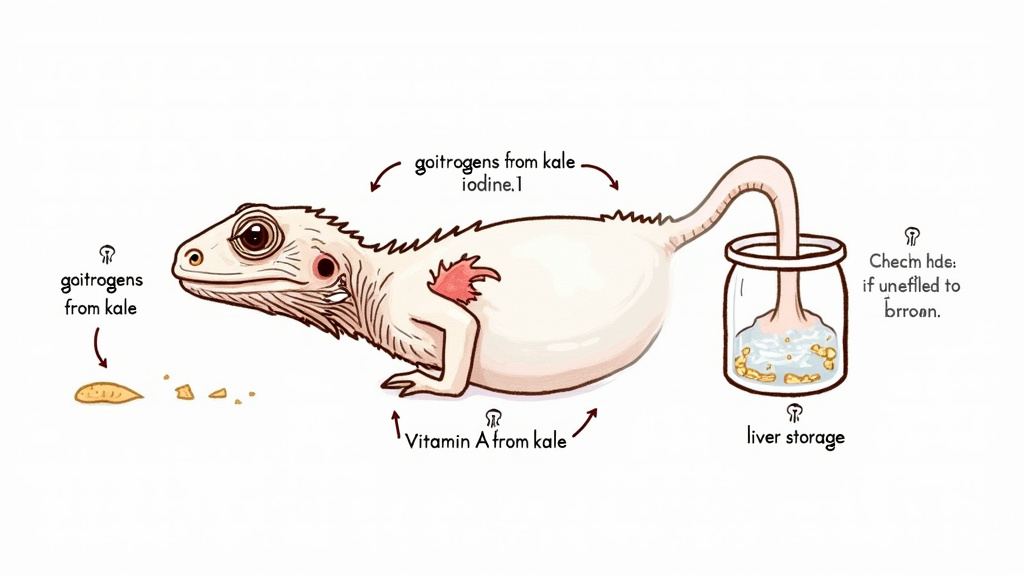
The words “goitrogen” and “Vitamin A toxicity” sound abstract. Here’s what they actually do inside your dragon.
Goitrogens are natural compounds found in certain cruciferous vegetables. They compete with iodine for uptake by the thyroid gland. Iodine is a raw material for thyroid hormones T3 and T4. When goitrogens block iodine, hormone production slows.
The result is hypothyroidism. In bearded dragons, this manifests as reduced metabolism. The dragon becomes lethargic, gains weight even on a controlled diet, and may show a thickened neck area (a goiter). Growth in juveniles stalls. These changes take months, so owners rarely connect them to the green they’ve been faithfully offering every morning.
Vitamin A toxicity is a different path. Kale contains preformed Vitamin A (retinol), which is immediately usable by the body. Dragons also get Vitamin A from supplements and other foods. Excess Vitamin A accumulates in tissues, particularly the liver and skin.
I once supplemented a dragon’s daily salad with a multivitamin powder while also feeding kale three times a week. After two months, the dragon developed swollen eyelids and began shedding patches of skin unevenly. The vet identified Vitamin A toxicity. We cut kale to once a week and switched to a calcium-only supplement on non-kale days. The swelling resolved within three weeks.
Symptoms of Vitamin A toxicity include swelling around eyes and mouth, difficulty shedding (the skin sticks in patches), and loss of appetite. It’s reversible if caught early, but it requires dietary adjustment.
Both risks are managed by the same strategy: rotation. Feeding kale twice a week, surrounded by different greens, prevents the cumulative dose of either compound from reaching a problematic threshold.
How to Spot a Problem: Symptoms of Overfeeding Kale
You won’t see a dramatic reaction after one kale meal. The issues are chronic, building over weeks.
Watch for these signs after 4-6 weeks of consistent kale feeding (more than twice weekly):
- Reduced appetite for salads. The dragon might still chase insects but ignores its greens.
- Lethargy unrelated to temperature. The basking spot is correct, but the dragon spends most of the day sleeping.
- Weight gain or stunted growth. Juveniles stop growing at the expected rate; adults gain weight without increased feeding.
- Swelling around the eyes or throat. Mild puffiness, especially in the morning.
- Patchy, difficult sheds. Skin comes off in small pieces instead of full-body sheds.
If you observe two or more of these symptoms, review your feeding schedule. Immediately remove kale from the diet for two weeks. Replace it with staple greens like collard greens and dandelion greens. Monitor for improvement. If symptoms persist, consult a reptile veterinarian. Thyroid issues require professional diagnosis.
This vigilance is part of responsible feeding cabbage or any other moderate-risk vegetable. Observation always beats assumption.
Frequently Asked Questions
Can bearded dragons eat kale every day?
No. Daily kale feeding introduces goitrogens and Vitamin A at a cumulative dose that can lead to hypothyroidism and Vitamin A toxicity within a few months. Limit it to 1-2 times per week.
Is kale better than spinach for bearded dragons?
Yes, significantly. Kale has a low oxalate content, while spinach’s high oxalate level binds calcium and can contribute to metabolic bone disease. Kale is a safer choice in the “occasional” category.
Do I need to cook kale for my bearded dragon?
No. Cooking can degrade some nutrients. Serve kale raw, washed thoroughly, and chopped into small pieces. Never add seasoning, oil, or salt.
Can baby bearded dragons eat kale?
Yes, but in smaller amounts and only once a week. Juvenile dragons require a diet focused on insects for protein. Kale can be a small part of their emerging vegetable intake.
What are the best greens to mix with kale?
Staple greens like collard greens, mustard greens, and dandelion greens are ideal. These form the base of the salad, with kale added as a supplemental ingredient. For variety, you can include small amounts of other safe greens like arugula or basil.
The Bottom Line
Kale is a useful, nutrient-rich green for bearded dragons when used correctly. Its high calcium and low oxalate profile offer real benefits. The constraints are real too, goitrogens and Vitamin A content demand a strict rotation schedule.
Feed it 1-2 times per week, always chopped and washed, always mixed into a salad built on staple greens. Watch for subtle symptoms of overfeeding: lethargy, swelling, poor sheds. If you see them, cut kale out for two weeks and reset.
This balanced approach lets you harness kale’s strengths without triggering its risks. Your dragon gets the calcium boost, you get another vegetable option, and both avoid the slow-building problems that catch unprepared owners.