
Can Bearded Dragons Eat Arugula? Safety & Feeding Guide
This post contains affiliate links. As an Amazon Associate, we earn from qualifying purchases.
Yes, bearded dragons can eat arugula, but only as an occasional part of a varied diet, no more than once or twice a week. It offers good calcium but also contains goitrogens and oxalates, compounds that can cause health issues like thyroid suppression and calcium deficiency if fed too often.
The mistake most owners make is seeing arugula as a daily staple green. It looks healthy, it’s dark and leafy, and dragons often gobble it up. That enthusiasm is the trap. You think you’ve found a winner, so you feed it every day. Within a few months, you’re dealing with a sluggish dragon or the early signs of metabolic bone disease, and you never connect it back to that “healthy” green.
This guide breaks down the exact nutritional trade-off, shows you how to spot trouble, and gives you a safe feeding routine. We’ll cover what makes arugula both useful and risky, how it compares to your other green options, and the step-by-step prep that keeps your dragon safe.
Key Takeaways
- Feed arugula no more than once weekly. Its goitrogens and oxalates accumulate.
- Arugula’s calcium-to-phosphorus ratio is often lower than the ideal 2:1, making it a supplemental calcium source, not a primary one.
- Always chop arugula finely and mix it with 3-4 staple greens like collard or mustard greens to dilute its compounds.
- Symptoms of overfeeding include lethargy, goiter (swelling in the neck), and weak bones, signs of thyroid or calcium issues.
- Baby arugula is safe, but the preparation and frequency rules are identical to mature leaves.
What’s in Arugula? The Nutritional Payoff
Arugula is not just a spicy lettuce. It’s a nutrient-dense leafy green that brings specific benefits to a bearded dragon’s salad bowl. The primary draw is its mineral content.
Calcium is the headline. Bearded dragons require a massive amount of dietary calcium to support their rapid bone growth and to prevent metabolic bone disease (MBD), a common and crippling condition in captive reptiles. Arugula provides a bioavailable source. It also contains a suite of supporting vitamins and minerals: vitamin C for immune function, vitamin K for blood clotting, magnesium for nerve and muscle function, and potassium for hydration balance. The antioxidants present can help combat cellular damage.
Arugula (Eruca sativa) is a cruciferous vegetable containing glucosinolates, which are sulfur-containing compounds that contribute to its peppery flavor. When broken down during digestion, these compounds can form goitrogens, which interfere with thyroid hormone production by inhibiting iodine uptake.
But here’s the critical nuance most care sheets miss. While arugula is often praised for a “good” calcium-to-phosphorus (Ca:P) ratio, the numbers are less stellar on closer inspection. The ideal ratio for bearded dragons is 2:1 or higher. Arugula’s ratio frequently falls closer to 1.5:1. This means that for every 1.5 parts of calcium, there’s 1 part of phosphorus binding to it. It’s positive, but it’s not the powerhouse ratio found in true staple greens like collard greens (14.5:1) or dandelion greens (2.8:1).
TL;DR: Arugula offers decent calcium and vitamins, but its calcium-to-phosphorus ratio is less ideal than true staple greens, making it a supplement, not a foundation.
The Arugula Risk Breakdown: Goitrogens & Oxalates
Two natural compounds in arugula demand respect: goitrogens and oxalates. Feeding arugula safely is entirely about managing these two.
Goitrogens suppress thyroid function. They do this by blocking the thyroid gland’s ability to absorb iodine, which is essential for producing metabolism-regulating hormones. The VCA Animal Hospitals feeding guide explicitly lists “goitrogenic greens” as items to be fed only occasionally for this reason. A dragon fed arugula daily can develop hypothyroidism. The first sign is often unexplained lethargy, a dragon that just wants to sleep all day, even with perfect basking temps. In advanced cases, you might see a visible swelling in the neck area, a goiter.
Oxalates, or oxalic acid, are the second concern. These molecules bind to minerals like calcium and iron in the digestive tract, forming insoluble crystals that pass through the body unused. This process is called chelation. The calcium in that nice arugula leaf gets locked up by the oxalates in the same leaf before your dragon can absorb it.
Common mistake: Feeding arugula 3-4 times a week because your dragon loves it, the goitrogens will suppress thyroid function within 6-8 weeks, leading to weight gain and profound lethargy even with a proper heat gradient.
The result is a double deficit. Not only are you not getting the full calcium benefit, but the oxalates are also stealing calcium from other foods in the same meal. Over time, this can directly contribute to metabolic bone disease. While arugula’s oxalate level is lower than spinach’s (a known no-no), it’s high enough to matter with frequent feeding.
| Compound | What It Does | Observable Symptom Timeline |
|---|---|---|
| Goitrogens | Blocks iodine uptake, suppresses thyroid | Lethargy within 6-8 weeks; potential neck swelling (goiter) after 3+ months. |
| Oxalates | Binds to calcium, prevents absorption | Contributes to Metabolic Bone Disease (MBD) over months; weak bones, tremors. |
How to Feed Arugula to Your Bearded Dragon
Safety is in the preparation and the mix. You never serve a bowl of just arugula.
First, selection. Organic arugula is the better choice. Conventional leafy greens often carry higher pesticide residues, and reptiles are sensitive to these chemicals. If organic isn’t available, washing is non-negotiable. Baby arugula, the smaller, tender leaves, is perfectly fine and often easier to chop.
The preparation sequence is simple but strict:
1. Wash. Rinse leaves under cool running water. I use a salad spinner; it gets them drier than a towel, which is better for preventing mold in the food dish.
2. Chop. Finely chop the leaves. Whole leaves are a choking hazard and are harder for juveniles to manage.
3. Mix. This is the most important step. Combine the chopped arugula with three or four other greens. Your goal is to make arugula less than 25% of the total salad volume.
4. Serve. Place the mix in a clean dish.
5. Remove. Pull uneaten salad, especially the arugula, within 10-15 minutes. It wilts fast and can grow bacteria in the warm tank.
That mixing step is your primary risk mitigation. By diluting arugula with staple greens, you dilute the goitrogen and oxalate load per bite. A good, varied salad for an adult dragon might include collard greens (a true staple), a small amount of shredded butternut squash, one or two edible flowers, and then the occasional arugula as the “spice.”
Arugula vs. Other Leafy Greens: Where It Ranks
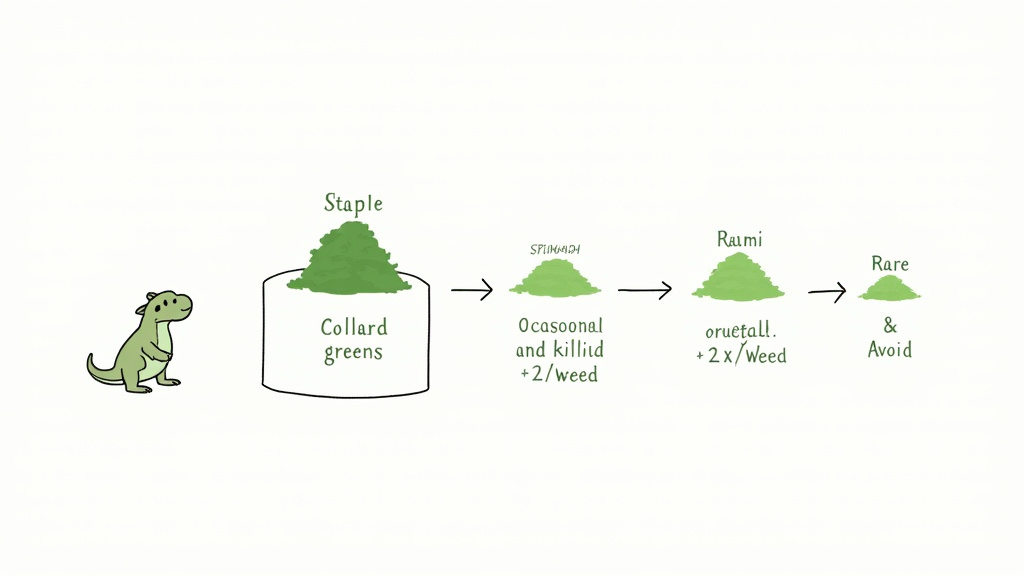
Knowing where arugula falls in the hierarchy of greens helps you build a better weekly meal plan. It’s not a staple. It’s a “sometimes” food, sitting in a different category than your daily drivers.
Staple greens can be fed daily. They have high Ca:P ratios and low oxalates. This group includes collard greens, dandelion greens, escarole, endive, and mustard greens. These should form the bulk of your dragon’s vegetable intake.
“Sometimes” greens have nutritional value but come with caveats, moderate oxalates, goitrogens, or other compounds. This is where arugula lives, alongside kale, turnip greens, and bok choy. They are nutritious but require rotation and limitation to once or twice a week.
| Green Type | Example | Feeding Frequency | Primary Concern | Best For |
|---|---|---|---|---|
| Staple | Collard Greens, Dandelion Greens | Daily | None when varied | Foundation of the diet |
| Occasional | Arugula, Kale, Turnip Greens | 1-2x per week | Goitrogens & Oxalates | Dietary variety, micronutrients |
| Rare Treat | Spinach, Beet Greens | Avoid or 1x monthly | Very High Oxalates | Not recommended |
Why does kale, often touted as a superfood, land in the same “sometimes” bucket as arugula? It also contains goitrogens. The old myth of kale being a perfect staple has been corrected by reptile nutritionists. It’s a fine part of a rotated diet, not a daily one. Parsley and cilantro are other herbs that fit an occasional rotation for flavor and variety without being staples.
TL;DR: Arugula is a “sometimes” green, not a staple. Rotate it weekly with other occasional greens like kale and turnip greens, while keeping daily salads based on collard or dandelion greens.
Spotting Trouble: Signs You’re Feeding Too Much
Dragons are stoic. They won’t cry out in pain from early-stage metabolic bone disease or whisper that their thyroid is underactive. You have to watch for subtle shifts.
The signs of goitrogen overconsumption are metabolic. Look for unexpected weight gain or difficulty shedding. The most telling sign is a change in energy levels. A dragon that used to be alert and active during the day now spends all its time sleeping in the cool hide, even with a properly functioning UVB lamp and a hot basking spot. This isn’t normal brumation behavior if it happens outside of winter.
Oxalate-related issues show up in bone health. Early signs of calcium deficiency include subtle tremors in the fingers or toes when walking, a softer lower jaw (the “rubber jaw” symptom), and a general reluctance to climb or jump due to weakness or pain. More advanced metabolic bone disease causes visible deformities in the spine, legs, and tail.
If you see these signs, stop feeding arugula and all other occasional greens immediately. Revert to a diet of pure staple greens and properly gut-loaded insects dusted with a high-quality calcium supplement without D3 for a few weeks. Consult a reptile veterinarian. They can perform blood tests to check calcium levels and thyroid function.
I learned this the hard way with a rescue dragon named Spud. His previous owner fed him arugula and kale salads almost exclusively because he’d eat them. When I got him, he was lethargic and his front legs had a slight bow. We switched to collard and dandelion greens, used a Repashy Calcium Plus supplement, and within two months his energy returned and the leg weakness improved. The bow remained, that’s permanent damage.
Frequently Asked Questions
Can baby bearded dragons eat arugula?
Yes, but in even smaller amounts and less frequently. Babies and juveniles need a diet focused on protein (insects) for growth. A tiny pinch of finely chopped arugula mixed into a salad once every two weeks is plenty. Their smaller bodies are more susceptible to the effects of goitrogens and oxalates.
Is wild arugula or rocket different from store-bought?
No, it’s the same plant (Eruca sativa). “Rocket” is just another common name, especially in Europe and Australia. The safety rules and nutritional profile are identical.
Can I feed arugula flowers to my bearded dragon?
Yes, the yellow flowers of the arugula plant are edible and safe. They can be offered as a rare treat. The same moderation principle applies, as the flowers contain the same plant compounds as the leaves.
My bearded dragon loves arugula and refuses other greens. What do I do?
This is a common behavioral issue. You must out-stubborn your dragon. Stop feeding arugula entirely. Offer a salad of staple greens like collard greens daily. It may take a week or two, but a healthy dragon will not starve itself. You can try “salad dressing” tricks like sprinkling bee pollen or rubbing a bit of strawberry on the greens to encourage tasting.
How does arugula compare to romaine or iceberg lettuce?
Arugula is vastly more nutritious. Iceberg and romaine lettuce are mostly water and fiber with minimal vitamins and a poor calcium ratio. They offer little nutritional value and can cause diarrhea. If you’re choosing between them, arugula wins, but you should be choosing from the staple greens list instead.
The Bottom Line
Arugula has a place in a thoughtful bearded dragon diet. That place is small, measured, and infrequent. Treat it like a potent supplement or a condiment, not a main course. Its value is in the variety of micronutrients it adds to a diet already built on solid, safe staple greens.
The routine is simple: wash it, chop it fine, mix it heavily with other greens, and serve it no more than once a week. Watch your dragon, not just its appetite. Energy levels and bone strength are your real report cards. When in doubt, lean on the staples, collard greens, dandelion greens, and escarole have earned their reputation for a reason. They keep dragons thriving for years without the hidden trade-offs.