Bearded Dragon Impaction Guide: Signs, Causes & Prevention
This post contains affiliate links. As an Amazon Associate, we earn from qualifying purchases.
A bearded dragon impaction is a physical blockage in the digestive tract, most often caused by ingesting loose substrate like sand or by poor digestion due to low basking temperatures. It is a veterinary emergency when accompanied by hind leg weakness, as the mass can press on the spinal nerves.
Most owners mistake simple constipation for a full impaction. They wait, hoping a warm bath will fix it, while the real blockage hardens and starts pressing on nerves. That delay turns a manageable problem into a surgical one.
This guide breaks down the exact symptoms that mean “vet now,” explains what happens during a diagnosis, and lays out the husbandry fixes that prevent blockages from happening in the first place.
Key Takeaways
- Hind leg weakness or dragging is the single most critical sign. It means the impaction is pressing on the spine and requires immediate veterinary care to prevent permanent nerve damage.
- Never administer mineral oil orally at home. A reptile’s glottis is at the base of the tongue, making aspiration into the lungs, causing fatal lipoid pneumonia, a high risk. This is a vet-only treatment.
- The basking surface temperature, measured with a probe thermometer, must be 38-42°C (100-108°F). Temperatures below 35°C (95°F) prevent proper digestion, allowing food to sit, dry out, and form a blockage.
- Loose substrates like sand, walnut shell, and coconut coir are the most common causes. Impaction usually happens from repeated tiny ingestions during feeding, not from one large mouthful.
- A true impaction rarely resolves with home care alone. While warm soaks can help mild constipation, a physical blockage typically needs veterinary intervention, which may include fluids, enemas, or surgery.
What is a Bearded Dragon Impaction?
An impaction is a physical roadblock. Indigestible material, sand, bark, a too-large cricket, forms a solid mass that the intestinal muscles cannot push forward. This is distinct from constipation, which is simply sluggish gut movement without a physical obstacle.
Impaction is a complete or partial obstruction of the gastrointestinal tract. It is a common emergency in captive bearded dragons, often resulting from the ingestion of loose particulate substrate, oversized prey items, or improper thermal gradients that inhibit digestion. Diagnosis typically involves radiography (X-rays) to visualize the blockage and assess intestinal distension.
The confusion between the two conditions costs dragons time. Constipation often corrects with a warm bath and a dietary adjustment for constipation. An impaction usually does not. The mass just sits there, dehydrating and compacting further. Understanding your dragon’s normal poop frequency provides your baseline. An adult might go 5-7 days without a bowel movement normally. Go longer than that while also refusing food, and you’re likely beyond simple constipation.
The Main Culprits: What Causes a Blockage?
The blockage has to come from somewhere. It’s almost always one of three things: what’s in the tank, what’s being fed, or how the tank is set up.
Substrate ingestion is the classic cause. Loose sands, calci-sand, walnut shell, bark chips, and coconut coir are the usual suspects. The dragon rarely eats a mouthful on purpose. It happens during feeding, they lunge for a cricket and get a beakful of sand. Do this a few times a week, and the gut slowly packs with indigestible grit. This is why a proper tank setup with safe substrate is non-negotiable.
Oversized prey is a physical plug. The old rule is sound: no insect wider than the space between your dragon’s eyes. A large hornworm or a superworm that’s molted into a beetle can literally get stuck. This disrupts the entire feeding frequency guide and can shock the system.
Faulty husbandry creates the conditions for a blockage to form. This is the silent partner to the other causes.
* Low Basking Temperature: Digestion is powered by external heat. If the basking surface (measured with a probe thermometer, not an ambient gauge) is below 35°C (95°F), digestion stalls. Food sits, fluids get absorbed back into the body, and what was a moist bolus becomes a dry, cement-like mass.
* Chronic Dehydration: This leads to urate plugs. The colon’s job is to reclaim water from waste. A dehydrated dragon pulls too much water out, leaving the urates (the white part of the poop) hard and chalky. They can form a plug that blocks everything behind it. This is a primary reason for the importance of bathing your bearded dragon and providing hydration.
* Insufficient UVB: While not a direct cause, poor UVB metabolism can contribute to overall weakness and poor gut motility.
Other, less common causes include ingested foreign objects (rubber bits, carpet fibers), internal masses, severe parasitic blockages from worms, or complications from atadenovirus.
The Critical Signs: When It’s a Vet-Now Emergency
Symptoms stack. One alone might be nothing. Three together are a red flag.
| Symptom | What to Look For | Why It Matters |
|---|---|---|
| No Appetite | Refusing all food, including favorites, for >3 days. | The gut is full; there’s no room for more. This is often the first sign of a problematic eating habit. |
| No Defecation | No stool, or only tiny, hard pellets, for >7 days in an adult. | Indicates a complete stoppage. Compare to your dragon’s healthy bowel movements baseline. |
| Lethargy | Remains pancaked after basking, doesn’t perk up for interaction. | Energy is diverted to a failing system. |
| Visible Lump | A firm, often oblong mass palpable along the spine or in the lower abdomen. | You are feeling the physical blockage. |
| Bloated/Tense Belly | The abdomen looks distended and feels drum-tight, not soft. | Gas and fluid are building up behind the obstruction. |
Common mistake: Waiting for a “no poop” sign alone to act, a healthy adult dragon can go a week without defecating, especially in cooler weather. By the time the poop schedule is clearly abnormal, other symptoms have been present for days.
The line between “watch closely” and “go to the vet now” is drawn by the nervous system.
Hind leg weakness is the non-negotiable emergency sign. This looks like:
– Dragging one or both back legs.
– Toes “knuckling under” instead of resting flat.
– Trembling in the hindquarters.
– Inability to support weight on the back legs.
This happens because a bearded dragon’s spine lacks intervertebral discs. A large mass in the lower abdomen or colon presses directly on the spinal nerves that control the legs. The pressure is physical and acute.
TL;DR: If your dragon is eating less and not pooping, investigate. If they are not eating, not pooping, and showing hind leg weakness, you are out of home-care territory. This is a veterinary emergency with a 24-48 hour window to prevent permanent damage.
How a Reptile Veterinarian Diagnoses Impaction
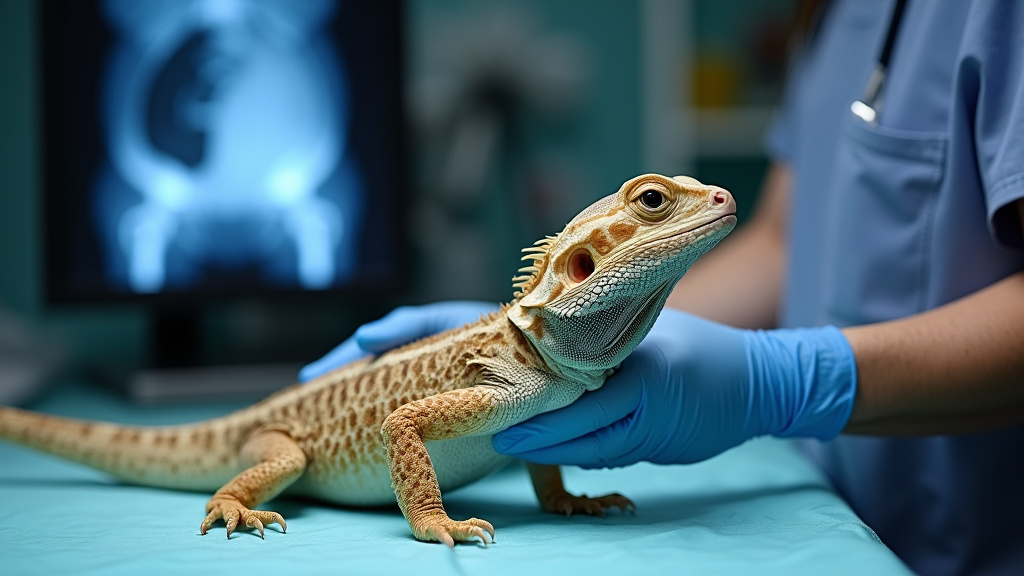
You walk into the exotic vet with a worried dragon. The diagnosis isn’t guesswork; it’s a process.
The first step is a detailed history. The vet will ask about diet, substrate, last normal stool, basking temps, and UVB setup. Your honest answers here are crucial. Then comes the physical exam. The vet will palpate the abdomen, feeling for that tell-tale firm mass.
The definitive tool is radiography. X-rays. A standard X-ray can show a dense mass of ingested material, a buildup of gas in the intestines (called ileus), or an abnormally distended gut loop. It can also rule out other causes of a swollen belly, like eggs in a female. Sometimes a contrast study is needed, where the dragon drinks a safe liquid that shows up on X-ray, tracing where the blockage stops it.
Blood work often accompanies the X-rays. A complete blood count and biochemistry panel can reveal dehydration, infection, or organ stress. It’s especially important to check kidney values and calcium levels, as long-term Metabolic Bone Disease can weaken overall health and complicate recovery.
This diagnostic suite also looks for underlying issues that mimic or cause impaction. A severe coccidia infection can cause inflammation and blockage. An ultrasound might be used to examine soft tissues if the X-ray isn’t conclusive.
Treatment: From Supportive Care to Surgery
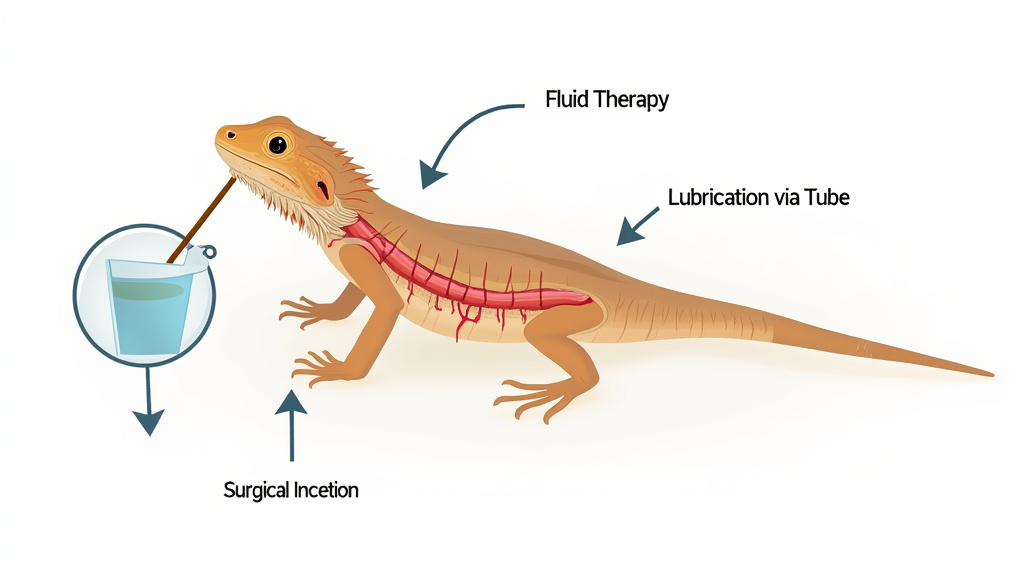
What happens next depends entirely on the severity and location of the blockage. The vet’s goal is to rehydrate the patient, lubricate the tract, and get things moving, without causing more harm.
For a partial or mild impaction where the dragon is still strong, medical management is the first line. This typically involves:
– Fluid Therapy: Subcutaneous (under the skin) or intravenous fluids to rehydrate the dragon and soften the gut contents.
– Lubrication: A vet may administer a lubricant like mineral oil or lactulose via a stomach tube while the dragon is sedated. This is the only safe way to do it.
– Enemas: A warm, soapy water enema can sometimes help mobilize a low colon blockage.
– Supportive Care: Injectable pain relief and gut motility drugs.
I won’t recommend mineral oil for home use. I’ve seen the X-rays of a dragon that aspirated it. The lungs, which should be black on film, were cloudy white. The owner was trying to help, but the dragon’s anatomy made it a fatal mistake. Vets use a tube past the glottis for a reason.
For a complete obstruction or any case with neurological signs (leg weakness), more aggressive intervention is needed. This often means surgery. The surgeon opens the abdomen, locates the blockage, and makes an incision in the intestine to remove it. It’s a major procedure, but for a severe impaction, it’s the only way to relieve the pressure on the spine.
The prognosis is good if treated early. Most dragons regain full leg function if surgery is performed within a day or two of symptoms appearing. Wait a week, and the nerve damage can be permanent. The recovery involves hospital stays, injectable antibiotics, and assisted feeding, a process that can easily cost over a thousand dollars.
Prevention: It’s Always Cheaper Than Treatment
Stopping an impaction is straightforward. It’s about managing risks you already know.
1. Ditch the Loose Substrate.
This is the single most effective prevention step. Use tile, paper towel, reptile carpet, or a non-particulate liner. If you are committed to a loose substrate for digging enrichment, use a very large, sterile play sand mixed with soil, and only with an adult dragon that is fed in a separate, bare-container “salad bowl.”
2. Master the Temperatures.
Your basking surface needs a probe thermometer reading of 38-42°C (100-108°F). The cool end should be 24-29°C (75-85°F). This gradient allows for proper digestion. Check it weekly.
3. Size the Prey.
The space-between-the-eyes rule is golden. For juveniles, this means small crickets and roaches. Even for adults, avoid giant superworms or hornworms that are wider than their head.
4. Promote Hydration.
Offer fresh greens (which have water content) daily. Provide a warm bath soak for 20-30 minutes, 2-3 times a week. This aids digestion, assists with shedding, and helps prevent those dehydrating urate plugs.
5. Maintain Overall Health.
A strong dragon is a resilient dragon. Proper UVB lighting (10.0 or equivalent, replaced every 6-12 months) prevents MBD and digestion issues. Regular fecal checks for parasites prevent internal parasite symptoms that can weaken the gut.
TL;DR: Tile substrate, a 100°F basking spot, prey smaller than the eye gap, and weekly baths. Do these four things, and you’ve eliminated 95% of impaction risk.
Frequently Asked Questions
Can a bearded dragon die from impaction?
Yes, absolutely. A complete impaction that presses on the spine can cause fatal nerve damage and systemic organ failure. Without veterinary treatment, death typically occurs within 7-14 days of a full blockage forming.
How can I tell impaction from constipation?
Constipation is infrequent, difficult defecation often resolved with a warm bath and massage. Impaction involves a physical lump, a complete lack of stool, and usually other symptoms like appetite loss and lethargy. If your dragon is still active and eating a bit, it’s likely constipation. If they’re refusing food and you feel a hard mass, suspect impaction.
Will olive oil or coconut oil help?
No, and they carry the same aspiration risk as mineral oil. Oils are not a safe or effective home remedy for a blockage. They can cause nutritional imbalances and pneumonia if inhaled. Supportive care means warm baths, proper heat, and a vet visit.
My dragon hasn’t pooped but is still eating. Is this impaction?
Not necessarily. This is a common scenario, especially with dietary changes. It can indicate the beginning of a slowdown. Increase bathing for shedding assistance and hydration, double-check your basking temperature is hot enough, and monitor closely. If no poop appears in another 3-4 days, or if eating stops, consult a vet.
What does an impaction feel like?
Gently run your fingers along your dragon’s lower belly, from the armpit down to the vent. A healthy gut feels soft, maybe with slight granular movement. An impaction feels like a firm, often sausage-shaped lump running along the spine. It does not move when pressed.
Can parasites cause impaction?
Yes. A heavy burden of worms like pinworms or tapeworms can physically clump and block the intestines. Protozoan parasites like coccidia cause severe inflammation that can also lead to a functional blockage. This is why a vet check for symptoms of coccidiosis is part of diagnosing stubborn impactions.
The Bottom Line
Impaction is a mechanical problem with a clear cause. You are not helpless against it. Your first job is vigilance: know the signs, especially that back-leg weakness. Your second job is prevention: control the substrate, the heat, and the prey size.
When in doubt, err on the side of the exotic vet. The cost of an X-ray and fluids is a fraction of emergency surgery. That dragon living 14 years in the Reddit story didn’t get there by accident. It got there because its owner learned the difference between a bad week and a real blockage, and didn’t wait to find out which it was.