
Are Bearded Dragons Friendly? The Honest Answer
This post contains affiliate links. As an Amazon Associate, we earn from qualifying purchases.
Bearded dragons are generally friendly, docile reptiles capable of forming a tolerant bond with their owners, but this is a learned trust built over months, not an innate affection. Their “friendliness” is a product of selective breeding for calm temperament, a lack of natural predators in captivity, and their curiosity as diurnal foragers. It manifests as tolerance for handling, recognition of their keeper, and a calm demeanor when their core needs for heat, light, and food are consistently met.
The universal mistake is expecting a puppy. You bring home a spiky, side-eyeing lizard and imagine immediate cuddles. What you get is a prehistoric-looking animal that might sit frozen in terror or scurry away. That disconnect between mammalian expectation and reptilian reality is where most new owners get frustrated and label their dragon “unfriendly.”
This guide strips away the pet-store hype. We’ll define what reptile friendliness actually looks like, outline the non-negotiable care that underpins a calm dragon, and give you a step-by-step protocol to build genuine trust. We’ll also cover the real risks, from Salmonella to stress signals, so you know exactly what you’re signing up for.
Key Takeaways
- Bearded dragon “friendliness” is tolerance and habituation, not emotional affection. It takes 3–4 months of daily, patient interaction to establish.
- Their calm nature is a direct result of correct husbandry. A dragon kept in a poorly lit, cold tank will be stressed and defensive, regardless of your handling technique.
- They are solitary and territorial. Housing two dragons together, even briefly, triggers aggression and chronic stress, destroying any chance of a friendly pet.
- Handling sessions must be kept short (5–10 minutes max) to prevent a drop in core body temperature and increased anxiety, as shown in behavioral studies.
- Always wash hands thoroughly after handling. Bearded dragons commonly carry Salmonella bacteria in their gut, posing a real zoonotic risk, especially to children and immunocompromised individuals.
What Does “Friendly” Actually Mean for a Reptile?
Reptile brains aren’t wired for social bonding like mammals. A bearded dragon doesn’t love you. It doesn’t miss you. What we interpret as friendliness is a combination of three measurable behaviors: habituation, food association, and a lack of perceived threat.
A 2021 study in the journal Animals found that even gentle handling for 5–15 minutes increased signs of anxiety in bearded dragons, specifically more frequent tongue flicks and less time spent near novel objects. The researchers concluded that while they tolerate handling, it is not inherently stress-free.
Habituation is simple learning. Your dragon stops seeing your giant hand as a predator after 100 non-threatening encounters. Food association is powerful. You control the cricket buffet. The dragon that scrambles to the front glass when you walk in isn’t saying hello; it’s responding to the reliable cue that you bring food. A lack of threat is the baseline. A dragon that doesn’t puff, hiss, or bite when you reach in is, by reptile standards, exceptionally friendly.
This is why their reputation is earned. Compared to other popular lizards like iguanas (which can be territorial and whip with their tails) or tokay geckos (notoriously bitey), bearded dragons are remarkably placid. Their docile nature is a product of decades of captive breeding. Breeders selected the calmest, most handleable animals, so that predisposition is now common in the pet trade. It’s a learned genetic trait, not wild instinct.
TL;DR: “Friendly” means a bearded dragon is habituated to your presence, associates you with positive outcomes (food), and does not perceive you as a danger. It is behavioral, not emotional.
The Non-Negotiables: Husbandry is the Foundation of Temperament
A “grumpy” dragon is usually a cold, uncomfortable, or hungry dragon. Their mood is a direct thermometer for their environment. You cannot expect tolerant behavior if their core physiological needs are unmet. This isn’t a matter of opinion; it’s reptile biology.
The most critical factor is thermoregulation. Bearded dragons are ectotherms. They must move between a hot basking zone (100-110°F) and a cool zone (75-85°F) to digest food, maintain immune function, and have the energy to be alert. A dragon stuck at 80°F is functionally sluggish and more likely to be defensive. The second non-negotiable is full-spectrum UVB lighting. Without it, they cannot synthesize vitamin D3 or properly metabolize calcium, leading to metabolic bone disease—a painful condition that makes movement agonizing and handling impossible.
Their enclosure setup directly impacts stress. A 40-gallon tank is the bare minimum for an adult, with 120 gallons being the modern recommended standard. The substrate matters. Loose sand or pebbles can cause impaction if ingested and harbor bacteria. Solid substrates like slate tile or reptile carpet are safer and easier to clean, contributing to a healthier, less-stressed animal.
| Husbandry Element | Ideal Specification | Consequence If Wrong |
|---|---|---|
| Basking Spot Temp | 100-110°F (38-43°C) | Poor digestion, lethargy, refusal to eat within 2-3 days. |
| UVB Light Type & Schedule | T5 HO tube, 10-12 hours/day | Onset of metabolic bone disease in 3-6 months, visible as soft jaw, tremors, limb deformities. |
| Minimum Enclosure Size (Adult) | 120-gallon (4’x2’x2′) | Chronic stress from lack of space, increased glass surfing, potential aggression. |
| Primary Substrate | Slate tile, reptile carpet | Impaction risk with sand, bacterial growth with moist carpet, leading to respiratory infections. |
Common mistake: Placing the UVB light on a mesh screen — the mesh filters out up to 40% of the crucial UVB rays, leaving the dragon functionally in the dark. Mount the fixture inside the enclosure or use a reflector.
If any of these pillars is shaky, your dragon’s behavior will be too. All the handling tips in the world won’t work on a sick, cold, or cramped animal. Your first step in assessing temperament of bearded dragons is always an audit of their habitat. A comprehensive resource for this is our essential care guide.
The 4-Step Trust-Building Protocol (Forget “Taming”)
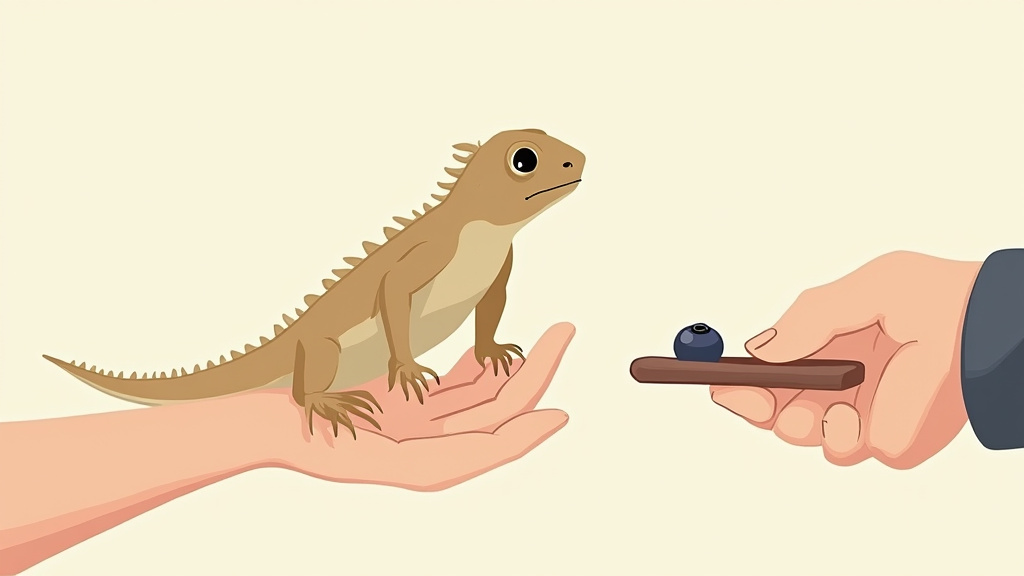
Building trust is a slow drip, not a flood. Rushing it reinforces fear. This protocol works because it respects the reptile’s pace.
- The Observation Week (Days 1-7). Do not attempt to handle. Your job is to become part of the scenery. Sit by the tank during the day for 10-15 minutes at a time, reading or working quietly. Move slowly. Let the dragon watch you. This step teaches it that your presence does not predict a scary event.
- Hand-Feeding Introductions (Week 2-3). Start offering favorite greens (like dandelion) or a tasty treat like a blueberry from your fingers or with tongs. Place the food near your resting hand inside the tank. The goal is to create a positive association. If the dragon flinches, back off and try again later.
- Short, Supported Handling (Week 4 onward). Initiate contact only when the dragon is awake, warm, and alert. Slide your hand under its chest and belly, lifting gently while fully supporting its legs and tail. Never grab from above. Keep the first sessions to 2-3 minutes, ending on a positive note with a treat. Gradually increase to 5-10 minutes over weeks.
- Reading and Respecting “No”. This is the step people skip. Your dragon will communicate. Rapid head bobbing, a puffed and blackened beard, or a gaping mouth are clear “stop” signals. Forcing interaction after these signs destroys trust. End the session immediately.
The timeline isn’t rigid. Some dragons from calm bloodlines might progress faster. Rescues with past trauma might need months at step one. The rule is to let the dragon’s comfort level set the speed.
Why this works: It uses classical conditioning (pairing your presence/contact with food) and desensitization (repeated, non-threatening exposure). The supported handling prevents the feeling of falling, a primal fear for a ground-dwelling animal. Understanding their behavioral communication is key to knowing when to push and when to pause.
Recognizing Stress vs. Contentment
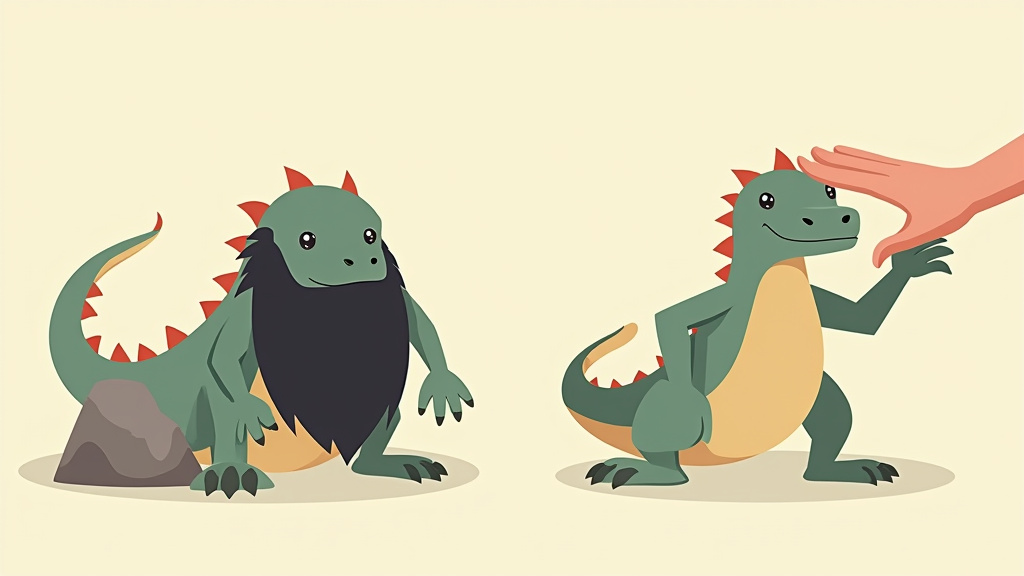
You need to speak a little “beardie.” Their body language is subtle but unambiguous.
Signs of Stress (Back Off Now):
- Black Beard: The spiny pouch under the chin darkens to jet black. This is a major stress, threat, or illness signal. It’s not just “moody.”
- Pancaking: Flattening the body against the ground to appear larger. In context, it’s defensive.
- Hissing: A low, raspy sound. It’s a direct warning that precedes a bite.
- Glass Surfing: Frantically scratching at the tank walls. This can indicate stress, but also a desire for more space or a reflection it perceives as a rival.
- Rapid Tongue Flicks: While tongue flicking is normal for smelling, a noticeable increase during handling, as noted in the NCBI PMC study on bearded dragon handling, correlates with higher anxiety.
Signs of Contentment (You’re on the Right Track):
- Arm Waving: A single arm lifted and rotated in a slow circle. This is a submissive waving gesture, often directed at you or other dragons. It’s like saying, “I see you, I’m no threat.”
- Closing Eyes When Petted: When stroked gently on the head or back, a dragon that closes its eyes is showing trust. In the wild, closing your eyes near a potential predator is suicidal. It means it feels safe.
- Sleeping on You: A dragon that falls asleep on your chest is the ultimate sign of trust. It’s warm, secure, and not in survival mode.
- Voluntary Approach: The dragon walks toward your hand when you open the tank, rather than fleeing.
One behavior often misunderstood is licking behavior. They flick their tongue to gather chemical information about their environment, including you. It’s not affection, but it is investigation—a neutral to positive sign.
The Real Risks and Responsibilities
The friendly reputation overshadows serious commitments. This is a 10-15 year pet with specific, ongoing costs.
The biggest hidden risk is Salmonella. It’s not a matter of if your dragon carries it, but that it’s a normal gut flora for them. It sheds in their feces. You can get infected by touching them or anything in their enclosure and then touching your mouth. The CDC has linked bearded dragons to multiple Salmonella outbreaks.
Before you start: Always wash your hands with soap and water immediately after handling your dragon or cleaning its tank. Never kiss or snuggle your bearded dragon. Young children, the elderly, and immunocompromised individuals are at highest risk of severe infection.
Beyond health, consider the drawbacks of ownership. The startup cost for a proper tank, lighting, and fixtures can easily surpass $500. Monthly costs for fresh greens and live insects (like crickets and dubia roach colonies) add up. They require daily spot-cleaning and weekly deep cleans. This is not a low-maintenance pet.
Finally, their solitary nature is absolute. Territorial aggression is triggered by the sight of another dragon, even in a separate tank across the room. Cohabitation leads to bullying, stress, missing limbs, and one dragon failing to thrive. They are friendly to you, but they are not social with their own kind. For a full breakdown of the challenges, our article on the potential challenges is essential.
Frequently Asked Questions
Are bearded dragons friendly with kids?
They can be, with strict supervision. Their docile nature makes them safer than many pets, but their skin is delicate and can be damaged by a tight grip. More importantly, children are less likely to wash their hands thoroughly, increasing Salmonella risk. Always supervise interactions and make handwashing non-negotiable.
How can I tell if my bearded dragon likes me?
Look for signs of trust, not affection. It willingly climbs onto your hand, falls asleep on you, closes its eyes when you pet it, and doesn’t consistently flee or show stress signals (black beard, hissing) during your presence. It may also recognize you as the food source and become alert when you enter the room.
Do bearded dragons get lonely?
No. They are solitary animals in the wild and in captivity. They do not experience loneliness. Providing another dragon as a “friend” is one of the most stressful things you can do, leading to competition for food, basking spots, and territory. Their social need is fulfilled by a consistent, predictable human caretaker.
Why is my bearded dragon suddenly not friendly?
Sudden behavioral changes are almost always health or husbandry-related. The first things to check are the temperatures (basking and cool side) and the UVB light (it loses strength every 6-12 months and needs replacement even if it still turns on). Next, consider illness. A dragon in pain from impaction, parasites, or metabolic bone disease will be irritable. A vet visit is warranted.
Can you train a bearded dragon to be friendlier?
You can habituate them to be more tolerant through the consistent, positive protocol outlined above. You can also target-train them to come to a specific spot for food. However, you cannot train away their fundamental reptile instincts or change their baseline personality. Some are naturally more bold, some more shy.
The Bottom Line
Bearded dragons are as friendly as a reptile can get. They are tolerant, curious, and capable of forming a recognizable bond of trust with their owner. But that bond is built on a foundation of flawless care, immense patience, and a clear understanding of what a reptile is—and isn’t.
They are not cuddly. They are not low-maintenance. They are a long-term commitment that requires daily attention and respect for their biological needs. If you can provide the correct habitat setup, commit to a months-long trust-building process, and always practice strict hygiene, you will be rewarded with a fascinating, placid companion that is genuinely friendly on its own terms.
The friendliness is real. It just looks different than you might think.