
Why Bearded Dragons Wave: Decoding Circumduction Behavior
This post contains affiliate links. As an Amazon Associate, we earn from qualifying purchases.
Bearded dragon arm waving, or circumduction, is a slow, circular motion of one forelimb used primarily as a submissive signal. It communicates “I am not a threat” to a perceived dominant being, which could be you, another pet, or their own reflection. It can also indicate mild stress or confusion, and in rare contexts, play a role in thermoregulation or mating.
Most owners misinterpret this gesture the first time they see it. They assume it’s a cute hello, a request for food, or a playful trick. That misunderstanding leads to the single biggest mistake people make: they wave back.
This guide breaks down the five specific contexts for circumduction, explains how to tell a submission wave from a stress signal, and gives you the right way to respond.
Key Takeaways
- Waving is submission, not greeting. Your dragon is acknowledging you as the larger, dominant creature in the room.
- Never wave back. Your dragon interprets human arm movement as a strange, repetitive threat display, which increases confusion and anxiety.
- Juveniles wave far more often than adults. As they mature and establish their own confidence, the frequency typically drops.
- A wave paired with a black beard or glass surfing means stress, not just submission. Address the environmental trigger.
- The thermoregulation theory suggests waving might help cool a limb on a hot basking spot, but it remains a secondary behavioral hypothesis.
What Does Bearded Dragon Arm Waving Look Like?
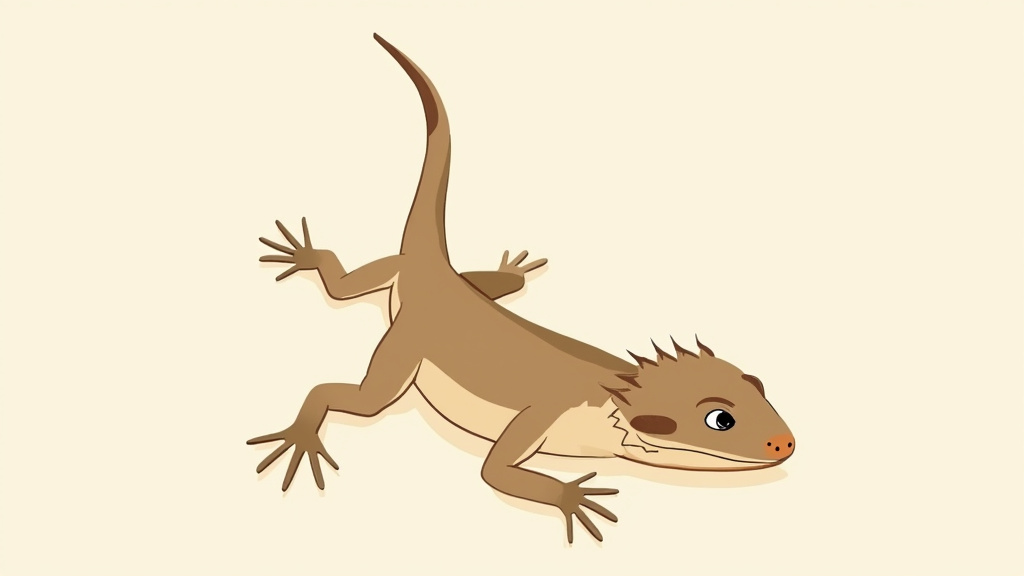
Circumduction is unmistakable once you know the pattern. The dragon, often while stationary, will lift one front arm off the ground. It then rotates that arm in a slow, deliberate circle, usually inward toward its body, before placing it back down. The motion is fluid, not jerky. They might repeat it several times with the same arm, or alternate between arms.
The technical term “circumduction” comes from the Latin for “leading around,” describing the circular limb path. In herpetology, it’s a documented submissive display in Pogona vitticeps and a few related agamid lizards, distinct from the defensive arm-raising seen in some other species.
This is not a frantic wave for attention. The pace is slow, almost hesitant. It contrasts sharply with the rapid, assertive up-and-down motion of head bobbing behavior, which is a dominance or territorial signal. Seeing both behaviors in sequence is a clear communication: one dragon bobs to claim space, the other waves to yield it.
The 5 Core Reasons Bearded Dragons Wave
The meaning depends entirely on context. A wave alone is just a signal; the environment gives it its specific meaning.
1. Submission and Acknowledgement
This is the most common reason by far. Your bearded dragon recognizes you, or another large animal like a dog, as a bigger creature in its territory. The wave translates to “I see you, and I am not challenging you.” It’s a peacekeeping gesture deeply ingrained in their social structure. You’ll see this often when you first approach the enclosure, or when they notice you watching them.
TL;DR: Your dragon waves when you approach because it sees you as the boss, not because it’s saying hello.
2. Fear, Stress, or Confusion
When the environment feels threatening, waving can be a stress response. Common triggers include sudden loud noises, the presence of a fast-moving pet like a cat, or an unfamiliar object placed in the enclosure. The key is to look for other stress behaviors paired with the wave. Is their beard turning black? Are they trying to hide or scratch at the glass? A stress wave is often quicker, more repetitive, and part of a larger cluster of anxious body language.
3. Territorial De-escalation
In multi-dragon setups (which are generally not recommended), waving is a critical social signal. A dominant dragon will assert itself with vigorous head bobbing behavior. The submissive dragon’s wave is a direct response, meaning “I back down, let’s not fight.” This is a healthy use of the behavior that prevents physical aggression. Chronic waving in a cohabitation situation, however, indicates the submissive dragon is under constant psychological pressure.
4. Mating Rituals
During breeding interactions, waving takes on a specific role. A receptive female may wave at a male as part of courtship rituals. This is still a form of submission, signaling her willingness to mate. It’s often accompanied by other behaviors like arm-raising and a specific, slow head bob from the female. If you’re not intentionally breeding, this is a rare context to witness.
5. Thermoregulation (The Working Theory)
This is the least understood reason. Some keepers and biologists observe that dragons sometimes wave a single arm while basking under a hot lamp. The hypothesis is that lifting the limb reduces contact with the hot substrate, allowing blood to cool slightly before recirculating. It’s a way to fine-tune body temperature without leaving the prime basking spot. While not the primary reason for circumduction, it’s a plausible secondary function observed by seasoned owners.
| Context for Waving | Primary Meaning | Typical Trigger | What to Look For |
|---|---|---|---|
| Owner Approach | Submission/Acknowledgement | You entering the room or looking at them | Solo wave, relaxed body posture |
| Environmental Stress | Fear/Anxiety | New pet, loud noise, unfamiliar object | Wave paired with black beard, hiding, or glass surfing |
| Multi-Dragon Interaction | Territorial De-escalation | Dominant dragon head bobbing | Wave is a direct response to another dragon’s display |
| Breeding Season | Receptive Submission | Presence of a male dragon | Female wave as part of a suite of mating behavior cues |
| During Basking | Possible Thermoregulation | High basking surface temperature | Wave occurs under heat lamp, often with extended limbs |
How to Respond (and What to Avoid)
Your reaction can either calm your dragon or add to its confusion. Follow this sequence.
- Pause and Assess. Don’t move suddenly. Look for the triggers listed above. Is the cat on the couch? Is their reflection visible in the glass? This five-second pause gives you the context you need.
- Acknowledge Verbally. Use a calm, low-pitched voice. A simple “I see you, buddy” works. This communicates you’ve received their signal without escalating.
- Remove Obvious Stressors. If the wave seems anxious, gently shoo the cat away or temporarily cover the side of the enclosure causing a reflection.
- Proceed Slowly. If you need to handle them, move your hand slowly from the side, not from above like a predator. Let them see it coming.
Common mistake: Waving back at your bearded dragon, they don’t understand human social gestures. Your rapid, whole-arm wave mimics a threat display in their language, which can spike stress levels within seconds.
What not to do is just as important.
- Do not wave back.
- Do not immediately pick them up if the wave seems stress-related. You become the threat.
- Do not dismiss frequent, context-less waving. It’s a data point that their environment needs adjustment.
When is Waving a Problem?

Circumduction is usually normal. It becomes a veterinary-level concern when it is a symptom of chronic stress, which has measurable health consequences.
I kept a young dragon in a glass tank with three exposed sides near a busy hallway. He waved every time someone walked past. I thought it was just him being polite. After two months, his appetite dropped and he developed a persistent, stress-related territorial behavior of glass surfing. Moving him to a quieter room with opaque side walls cut the waving by 80% in a week and his appetite returned.
Chronic stress suppresses the immune system. A dragon that waves constantly due to an unsuitable environment is at higher risk for parasitic infections, respiratory issues, and failure to thrive. The waving itself isn’t the disease; it’s the flashing check-engine light.
Red flags that pair with problematic waving:
- Loss of appetite or weight loss
- Lethargy or hiding all day
- Consistent black beard coloring
- Frantic glass surfing or enclosure scratching
- Abnormal bowel movements
If you see waving alongside any of these symptoms for more than 48 hours, a habitat review and a vet visit are in order. Start with the habitat. Often, fixing the environment fixes the behavior.
Waving vs. Other Common Behaviors
It’s easy to mix up communication signals. This table clarifies the major distinctions.
| Behavior | Physical Motion | Typical Meaning | Urgency Level |
|---|---|---|---|
| Arm Waving (Circumduction) | Slow, circular forelimb rotation | Submission, stress, de-escalation | Low (unless paired with stress signs) |
| Head Bobbing | Rapid, up-and-down head movement | Dominance, territoriality, mating | Monitor (can lead to aggression) |
| Black Bearding | Darkening of throat skin to near-black | Aggression, stress, illness | Medium to High (requires investigation) |
| Licking Behavior | Flicking tongue at air or objects | Sensory exploration, taste identification | Low (normal investigation) |
| Open Mouth Behavior | Holding mouth slightly agape | Thermoregulation (gaping) or respiratory distress | Low if basking, High if labored |
Juvenile vs. Adult Waving: Why Age Matters
Baby and juvenile bearded dragons wave significantly more than adults. In the wild, nearly everything is bigger and potentially predatory to a young dragon. Their default setting is submissive. Waving is a frequent, almost automatic response to movement.
As they mature, usually between 8 and 18 months, their personality asserts itself. They become more confident in their territory. The adult dragon that rarely waves isn’t broken; it’s secure. It has learned you are not a threat that requires constant appeasement. A sudden resurgence of frequent waving in a previously confident adult, however, is a backward step that signals a new stressor or health issue.
TL;DR: Expect lots of waves from a baby dragon. If your adult dragon suddenly starts waving like a juvenile again, check for changes in its world.
Optimizing Habitat to Reduce Stress-Based Waving
If waving seems frequent and anxious, look here first. Environmental tweaks are your most powerful tool.
- Minimize Reflections. Glass tanks are major culprits. Use background decals on three sides, or place the enclosure in a spot where room lighting doesn’t create a mirror effect.
- Control Sightlines. Can your dragon see other pets? A simple visual barrier, like a piece of cardboard on the outside of the tank facing the couch, can block the view of a cat or dog.
- Ensure Adequate Space. A cramped enclosure is a chronic stressor. The minimum for an adult is a 120-gallon (4x2x2 foot) enclosure. More space reduces feelings of vulnerability and territorial frustration.
- Provide Hiding Spots. Multiple hides, both on the warm and cool side, allow them to retreat and feel safe. This is non-negotiable for stress reduction.
- Review Lighting & Heat. Incorrect temperatures force unnatural behaviors. Use digital thermometers to verify basking surface temp is 100-110°F and the cool side is 75-85°F. Wrong temps can cause restless pacing that looks like stress.
Sometimes, the need to hide and feel secure is so strong it manifests as burrowing behavior. Providing a deep, diggable substrate layer in part of the enclosure can satisfy this instinct and reduce anxiety-driven waving.
Frequently Asked Questions
Why does my bearded dragon wave at me every time I look at him?
He is acknowledging your presence as the larger, dominant creature. It’s a submissive “I see you” gesture. It’s most common in juveniles or in dragons that haven’t fully settled into a confident relationship with you.
Should I wave back at my bearded dragon?
No. Do not wave back. Your dragon does not understand human greeting waves. Your arm movement is large and strange from their perspective, which can be interpreted as a threatening or confusing display, increasing their stress.
Is arm waving a sign of a happy bearded dragon?
Not exactly. It’s a sign of a communicative dragon. While submission isn’t negative, a truly relaxed, content dragon is more likely to be basking calmly, licking its surroundings, or sleeping. Frequent waving can indicate underlying mild anxiety.
My dragon waves and head bobs. What does that mean?
This sequence is common in social interactions. They may bob to assert themselves toward something (like their reflection) and then wave as if to de-escalate the situation they just created. It can indicate confusion or internal conflict about a perceived intruder.
How can I tell if my bearded dragon’s waving is due to stress?
Look for a cluster of signals. A single, slow wave is likely submission. A faster, repeated wave paired with a blackened beard, frantic movement, hiding, or loss of appetite points to stress. The trigger is often visible in the environment.
The Bottom Line
Arm waving is your bearded dragon’s primary way of saying “I submit” or “I’m uneasy.” It is a normal, healthy part of their communication methods. Your job is to read the context, submission, stress, or social ritual, and respond by providing a calm, secure environment. Speak softly, move slowly, and never wave back. If waving becomes a constant, frantic behavior, audit the habitat for stressors like reflections, predators, or cramped space. Understanding this fundamental gesture deepens your ability to care for them, long before more serious signs like brumation or illness appear. Watch the wave, learn its cause, and you’ll see your dragon’s world through its eyes.