
Bearded Dragon Lighting Guide: UVB, Basking & Photoperiod
This post contains affiliate links. As an Amazon Associate, we earn from qualifying purchases.
Bearded dragon lighting requires three components working together: a T5 HO UVB tube spanning two-thirds of the enclosure, a halogen basking bulb positioned to overlap the UVB zone, and a consistent 12-14 hour daily photoperiod managed by a timer. The UVB tube, like an Arcadia ProT5 14% or Zoo Med ReptiSun 10.0 T5 HO, must be mounted 12-16 inches from the basking spot and replaced every 6-12 months.
Most setups fail because the heat and UVB sources are separated. A dragon that basks for warmth but receives no UVB cannot synthesize vitamin D3. The result is metabolic bone disease, a slow, painful collapse of the skeletal system that starts with a wobbly walk.
This guide covers the specific products, distances, and schedules that replicate the Australian desert sun inside a glass box. We’ll get into the mechanics of Ferguson Zones, why screen tops sabotage your efforts, and how to fix a dragon that prefers the cool, dark corner over its $200 basking rig.
Key Takeaways
- Use only T5 HO linear UVB tubes (Arcadia 14% or Zoo Med 10.0). Compact coil bulbs cause metabolic bone disease.
- The UVB beam and the basking heat spot must overlap. Position the halogen dome within 6 inches of the UVB tube’s center.
- Measure the surface temperature of the basking spot with a probe thermometer. Aim for 100-110°F, not just warm air.
- A screen top blocks 30-50% of UVB. Mount the fixture inside the enclosure or use a stronger bulb (14%) if placed on top.
- Replace UVB tubes every 6-12 months. The UVB output degrades long before the visible light dims.
The Non-Negotiable UVB Specification
Bearded dragons are classified as Ferguson Zone 3-4 reptiles. This isn’t a marketing term. It’s a scientific categorization from herpetologist Dr. Gary Ferguson that measures the ultraviolet index (UVI) an animal is adapted to receive in its natural basking microhabitat. Zone 3-4 means a UVI range of 3.0 to 7.4. Your lighting setup must hit that target at the basking spot.
A T5 High Output (HO) fluorescent tube is the only commercially available light that reliably delivers Ferguson Zone 3-4 UVB at safe mounting distances. The tube must be paired with a reflector fixture to direct the UVB downward, and it should span 50-75% of the enclosure’s length to create a usable gradient.
The two proven brands are Arcadia and Zoo Med. The Arcadia ProT5 Dragon 14% UVB Kit and the Zoo Med ReptiSun T5 HO 10.0 UVB Lamp are the standards. The “14%” and “10.0” refer to the percentage of UVB output within the lamp’s total light spectrum. Which you need depends on your mounting distance and whether a screen is in the way.
| Mounting Scenario | Recommended UVB Tube | Target Distance to Basking Spot |
|---|---|---|
| Inside the enclosure (no screen) | Arcadia 12% or Zoo Med 10.0 | 12-16 inches |
| On top of a standard mesh screen | Arcadia 14% | 12-14 inches |
| On top of a fine mesh screen (e.g., Dubia.com enclosure) | Arcadia 14% mounted inside if possible | 9-12 inches |
TL;DR: Your dragon needs a UVI of 3.0-7.4. Get an Arcadia 14% or Zoo Med 10.0 T5 HO tube, use a reflector, and mount it based on your screen.
Basking Heat: It’s Not Just a Warm Bulb
The basking lamp has one job: create a localized hotspot with a surface temperature of 100-110°F. The surrounding air on the warm side should be 90-95°F. You achieve this with a halogen flood bulb—PAR38 or BR30 shapes work best—in a deep dome fixture with a ceramic socket. Halogen bulbs are superior because they emit infrared-A and infrared-B radiation, which penetrates the skin more effectively for thermoregulation than the deep heat from ceramic heat emitters.
Wattage is trial and error. A 75W bulb might be perfect in a 40-gallon breeder; a 100W or 150W might be needed for a 4x2x2 foot enclosure. You adjust wattage and fixture height to hit the temperature target.
Common mistake: Measuring only air temperature — the basking spot surface temperature is critical. A dragon heats its core by lying on a hot surface, not by sitting in warm air. An infrared temp gun or a digital probe thermometer placed directly on the basking log is non-negotiable.
The first time I used a cheap dome with a flat ceramic heat emitter, the air felt warm. My dragon basked. But after two months, she started hiding more and her appetite dipped. I finally checked the surface of her favorite basking rock with a probe. It was 87°F. She was thermoregulating poorly because the heat wasn’t penetrating. I swapped to a 90W PAR38 halogen in a deep dome, and the rock surface hit 105°F. Her behavior corrected within a week.
The Critical Overlap: UVB and Basking Heat
This is the rule most diagrams get wrong. The zone of highest UVB intensity and the zone of peak basking heat must overlap completely. In the wild, the sun provides both simultaneously. In captivity, if the heat lamp is on the left and the UVB tube is on the right, a dragon must choose between synthesizing vitamin D3 and warming its digestion. It will choose heat every time, leading to calcium absorption failure.
Position the dome for your halogen heat lamps directly above, or within 6 inches laterally, of the center point of your UVB tube. This creates a single, combined “sun” spot.
Your lighting setup guide should create three distinct zones:
1. The Overlap Zone: High UVB (UVI 3.0-7.4) + high heat (100-110°F surface).
2. The Warm Zone: Lower UVB + ambient warmth (90-95°F air).
3. The Cool Zone: Minimal to no UVB + cooler temps (80-85°F air).
This gradient allows for natural thermoregulation and UVB exposure.
Tools for Verification and Maintenance
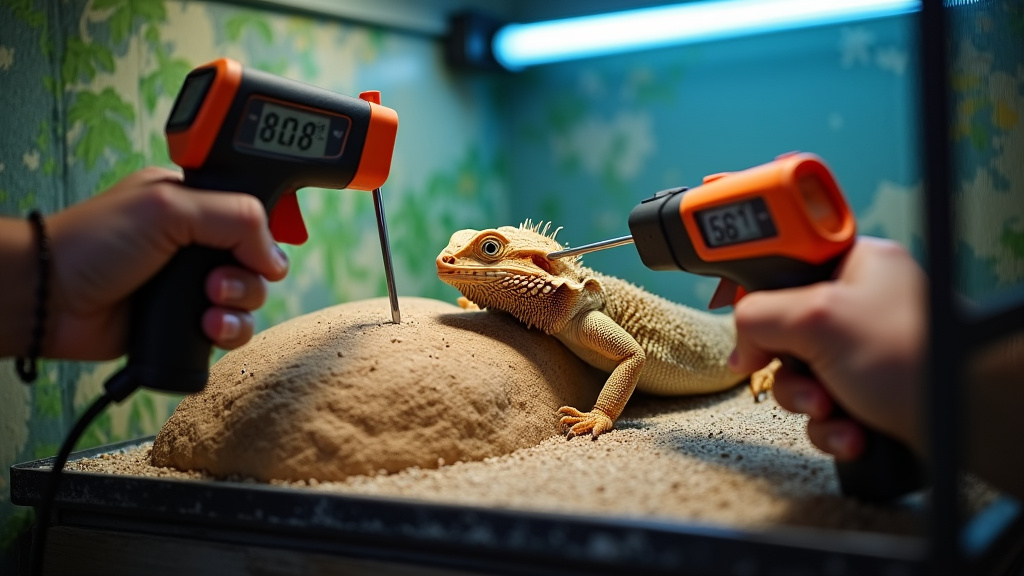
You cannot see UVB. You cannot accurately guess surface temperature. You need tools.
- Digital Thermometer with Probe: The $15 inkbird or zoo med models are fine. Tape the probe tip directly to the top of the basking log or rock.
- Infrared Temperature Gun: A quick way to spot-check surfaces around the enclosure. Less accurate than a fixed probe but great for diagnostics.
- Programmable Timer: Plug your UVB lighting and basking lights into one. A consistent photoperiod is as important as intensity.
- Solar Meter 6.5: The gold standard for measuring UVI. It’s a $250 investment, but it tells you definitively if your UVB bulb selection and placement are correct. For most keepers, following the distance guidelines for a fresh, name-brand bulb is sufficient.
The maintenance schedule is rigid. Mark your calendar.
– UVB Tube Replacement: Every 12 months for Arcadia, every 6 months for Zoo Med. This is not a suggestion. UVB output decays exponentially.
– Basking Bulb Check: Halogen bulbs can dim over time. Check surface temperatures monthly and replace the bulb if you can’t maintain 100°F without lowering the fixture excessively.
Seasonal Adjustments and Behavioral Cues
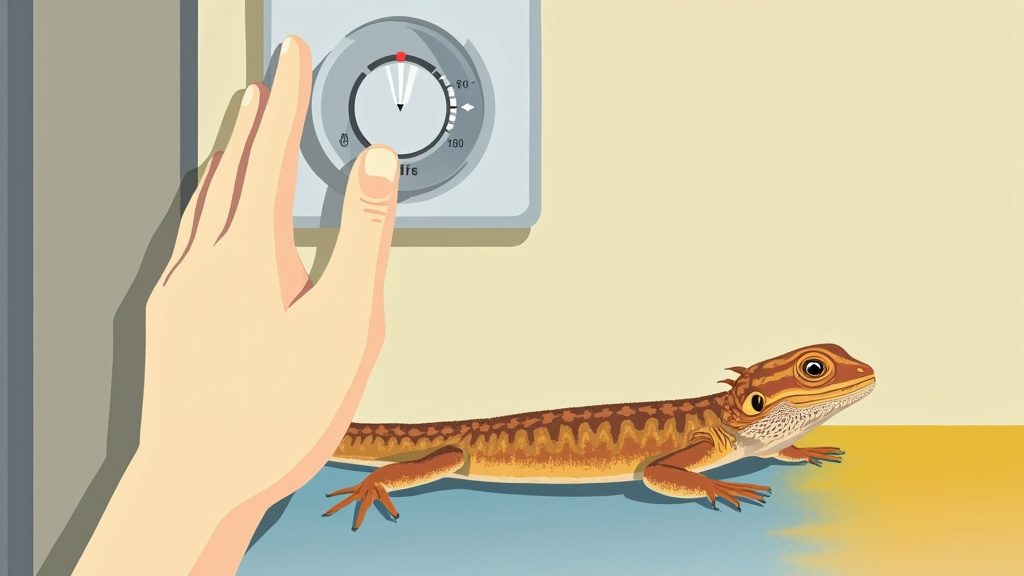
Bearded dragons experience seasonal shifts in the wild. Mimicking this supports natural hormonal and reproductive cycles. It’s not just about brumation.
- Summer Photoperiod: 12-14 hours of light. Use your programmable timers to turn lights on at dawn and off at dusk.
- Winter Photoperiod: 10-12 hours of light. You can also slightly lower the basking spot temperature by 5 degrees (to 95-105°F) if your dragon shows reduced activity.
Watch your dragon. It will tell you if the lighting is wrong.
– Avoiding the Basking Spot: The area is too hot, the UVB is too intense (causing photophobia), or the cool side isn’t cool enough. Check temperatures first.
– Pancaking in the Cool Corner: The basking spot isn’t hot enough, or the dragon is seeking security. Ensure the hot spot hits 105°F and there are adequate hides.
– Glass Surfing Under the Lights: Often a sign of frustration due to an inability to thermoregulate or get adequate UVB. Verify the overlap.
What Not to Do: The Quick-Kill List
Some mistakes have fast, irreversible consequences.
- Never use compact coil or CFL UVB bulbs. They produce a gradient of UVB that is too intense at close range and negligible inches away, often leading to photokeratitis (eye damage) and MBD.
- Never use colored bulbs (red, blue, black) for heat at night. Bearded dragons see color. These lights disrupt sleep and stress the animal. If nighttime temperatures drop below 65°F, use a ceramic heat emitter or a deep heat projector—lights that produce no visible light.
- Never place the UVB tube on the back wall of the enclosure. UVB does not reflect well off glass or plastic. It must shine downward from the top.
- Never forget the reflector. A T5 HO tube without a reflector loses over 40% of its usable UVB output to the sides and top of the fixture. Your UV fixture placement is wasted without one.
Frequently Asked Questions
Can I use a mercury vapor bulb for my bearded dragon?
Mercury vapor bulbs (MVBs) provide both heat and UVB. They can work in very large, open-topped enclosures where the minimum safe distance (often 18+ inches) can be maintained. However, they are a single point source, making it harder to create a perfect UVB gradient, and they generate intense heat. For most keepers, the separate T5 HO tube and halogen bulb system is more reliable and safer.
How do I know if my UVB light is still good?
You don’t, without a solar meter. The visible light will last for years while the UVB spectrum decays. This is why the calendar-based replacement schedule is mandatory. If you’ve missed the schedule, assume the bulb is bad and replace it. The cost of a new bulb is trivial compared to vet bills for metabolic bone disease.
My dragon never sits directly under the basking lamp. Is that okay?
It depends. Some dragons bask at an angle, preferring the fringe of the heat zone. As long as the surface temperature where it does sit is still above 95°F and within the UVB gradient, it’s fine. If it’s consistently in the cool corner, your temperatures are wrong. The cool side must be below 85°F to make the hot side attractive.
Is a screen top okay for my enclosure?
Screen tops are common, but they are a filter. Standard 1/4-inch mesh blocks 30-50% of UVB. You must compensate by using a stronger bulb (Arcadia 14% over 12%) and/or placing the basking spot higher to close the distance. Fine mesh like aluminum window screen blocks even more. The best practice is to mount the UVB fixture inside the enclosure, safely out of reach.
Do I need a night light?
No. Complete darkness is best. Bearded dragons benefit from a natural drop in temperature at night (down to 65-75°F). If your home gets colder than 65°F, use a heat source that emits no light, like a ceramic heat emitter, connected to a thermostat.
The Bottom Line
Bearded dragon lighting is a physics problem with a biological solution. The physics demands a T5 HO tube and a halogen bulb positioned to overlap. The biology demands this setup runs on a strict daily and seasonal timer. Skip the reflector, guess the temperature, or separate the lights, and you are slowly starving your dragon’s skeleton of calcium.
Invest in the right optimal light setup from the start: an Arcadia ProT5 14% kit, a deep dome with a PAR38 halogen, a digital probe thermometer, and a heavy-duty timer. Set a phone reminder to replace the UVB tube in 12 months. This routine isn’t expensive or complex. It’s just non-negotiable. Your dragon’s posture, appetite, and activity level over the next decade depend on it.