
Bearded Dragon Feeding: The Complete Diet & Schedule Guide
This post contains affiliate links. As an Amazon Associate, we earn from qualifying purchases.
A proper bearded dragon feeding plan matches three things: the dragon’s life stage (juvenile, subadult, or adult), the correct insect-to-plant ratio, and a consistent schedule of calcium and multivitamin dusting. Juveniles need live insects twice daily, adults need a large salad daily with insects 2-3 times a week, and every meal requires supplementation to prevent metabolic bone disease.
Most owners get the ratio backwards. They feed a growing juvenile too much lettuce and not enough protein, or they stuff an adult with daily crickets until it becomes obese. The salad isn’t a side dish. For an adult dragon, it’s the main course.
This guide walks through the exact percentages, schedules, and preparation steps that keep dragons growing strong as juveniles and lean as adults. We’ll cover staple insects, the shortlist of greens that actually matter, and the supplement routine that prevents vet visits.
Key Takeaways
- Flip the ratio at one year: Juvenile diets are 60-80% insects; adult diets must shift to 70-80% plant matter to prevent fatty liver disease.
- Dust with purpose: Use phosphorus-free calcium powder on all insects and salads for juveniles daily, and on all insects for adults. Add a multivitamin powder to salads 1-2 times per week.
- UVB enables digestion: Without a proper ReptiSun 10.0 or Arcadia 12% UVB tube bulb replaced every 6-12 months, your dragon cannot metabolize the calcium you’re feeding, leading to metabolic bone disease.
- Size the insects: Feeders should be no wider than the space between your dragon’s eyes. A too-large cricket can cause impaction or choking.
- Gut-loading is non-negotiable: Feed your crickets and roaches a high-quality gut-load diet like Repashy Bug Burger or fresh veggies for 24-48 hours before they become food. Empty insects are junk food.
The Juvenile vs. Adult Feeding Ratio Shift
Get this wrong and you’ll create long-term health problems. A baby bearded dragon is a protein machine. Its body demands insects for rapid skeletal and muscular growth. An adult dragon’s metabolism slows. Its primary need shifts to fibrous plant matter for digestion and weight maintenance.
The transition isn’t subtle. According to the NC State veterinary feeding guide, a juvenile under 12 months should consume a diet of 60-80% live insects and 20-40% plant matter. Offer insects twice a day, as many as they can eat in a 10-15 minute session. Always offer a fresh salad daily.
At around 12-18 months, they enter a subadult phase. Here, you shift to a 50/50 split. Offer insects once daily and a larger salad.
For an adult over 18 months, the diet inverts. The target is 70-80% plant matter and 20-30% insects. This means a large, varied salad every single morning, and insect feedings reduced to only 2-3 times per week.
Common mistake: Continuing twice-daily insect feedings for an adult dragon, this leads to obesity and hepatic lipidosis (fatty liver disease) within 6-12 months. You’ll see lethargy, a swollen abdomen, and fat pads on the head that bulge, not lie flat.
| Life Stage | Insect Ratio | Plant Matter Ratio | Feeding Frequency (Insects) | Primary Goal |
|---|---|---|---|---|
| Juvenile (0-12 mo) | 60-80% | 20-40% | 2x daily, 10-15 min sessions | Rapid growth |
| Subadult (12-18 mo) | ~50% | ~50% | 1x daily | Transition & steady growth |
| Adult (18+ mo) | 20-30% | 70-80% | 2-3x per week | Weight maintenance & longevity |
TL;DR: Flip the diet at one year: babies need bugs constantly, adults need salads as their main food.
What to Feed: The Staple Lists
Not all greens are equal. Iceberg lettuce is worthless cucumber water in leaf form. Spinach binds calcium. The staples are dark, leafy, and nutrient-dense.
The Daily Salad: Greens and Veggies
The salad base should be one or two staple greens. These are high in calcium and low in oxalates (which interfere with calcium absorption). Rotate them to provide variety.
– Collard greens
– Mustard greens
– Turnip greens
– Dandelion greens (leaves and flowers)
– Escarole
– Endive
Chop these greens into pieces smaller than the space between your dragon’s eyes. For an adult, a salad should be roughly the volume of its head, excluding the tail.
To this base, add a smaller amount of chopped vegetables for color, moisture, and extra vitamins. Safe options include:
– Bell peppers (all colors, high in Vitamin C)
– Broccoli florets (raw or lightly steamed, in moderation)
– Butternut squash (shredded)
– Snap peas
– Okra
Common mistake: Using kale or spinach as a daily green, both contain goitrogens or oxalates that can cause issues in large, frequent quantities. Kale is a fine occasional item, but never the only green.
Fruits are treats, not food. Their high sugar content can disrupt gut flora and lead to diarrhea. Offer a few pieces of mango, blueberries, raspberries, or blackberries no more than once every week or two.
The Live Insect Menu
Insects are protein and fat. Your goal is to maximize nutrition and minimize risk.
Staple Feeders (Use Daily for Juveniles, Weekly for Adults):
- Dubia roaches: The best all-around feeder. High protein, low fat, easy to gut-load, and they can’t climb or jump.
- Crickets: A classic, but they smell, die quickly, and can bite your dragon if left uneaten.
- Black soldier fly larvae (Nutrigrubs, Phoenix Worms): Excellent calcium-to-phosphorus ratio, often don’t require dusting.
Treat Feeders (Use Sparingly, 1-2x per Month):
- Waxworms: Very high fat. Good for underweight dragons or as a rare lure.
- Superworms: High fat and chitin. A few as a treat, not a staple.
- Hornworms: Mostly water. Great for hydration but little nutritional value.
All insects must be purchased from a reputable source or bred yourself. Never feed wild-caught insects. They carry parasites and pesticide residues.
The 3-Step Feeding Routine That Prevents MBD
Metabolic bone disease (MBD) is a crippling, preventable condition caused by poor calcium absorption. Your feeding routine is your primary defense.
Step 1: Assemble the Salad First Thing
Place the fresh salad in a shallow dish in the enclosure first thing in the morning. Bearded dragons are most active and hungry after basking. Offering the salad first encourages them to eat their greens before they fill up on bugs.
Lightly spritzing the salad with water adds hydration. For adults, dust the salad with calcium powder 5 days a week and with a reptile multivitamin powder (like Herptivite or Repashy SuperVite) the other 2 days.
Step 2: Offer Insects After the Bask
Wait 1-2 hours after lights come on. Your dragon needs to reach its proper core temperature (achieved by basking) to digest properly. Then, offer the dusted insects.
For juveniles, place a few insects in the enclosure at a time using tongs, or let them hunt from a deep, smooth-sided bowl to prevent escape. For adults on their insect days, offer a measured amount, perhaps 5-10 large roaches, to prevent overfeeding.
Always remove uneaten insects after 15 minutes. Crickets left overnight will harass and even bite your sleeping dragon.
Step 3: Gut-Load and Dust Everything
This step is non-negotiable. You are what your food eats.
Gut-loading means feeding your feeder insects a highly nutritious diet for 24-48 hours before they become food. A well-gut-loaded cricket is a vitamin capsule. A starving cricket is an empty shell.
– Use a commercial gut-load formula like Repashy SuperLoad or Bug Burger.
– Or, feed them fresh slices of sweet potato, carrots, collard greens, and oats.
Dusting is the final coating of supplements. The standard protocol, per the Washington State University husbandry guide, is:
– Hatchlings/Juveniles: Dust insects with phosphorus-free calcium powder at every feeding. Dust salads with calcium 5x/week and a multivitamin 2x/week.
– Adults: Dust all insects with calcium powder. Dust salads with a multivitamin powder once a week.
Shake insects in a bag or deli cup with a pinch of powder until lightly coated. It should look like a faint frost, not a powdered doughnut.
TL;DR: Morning salad, afternoon bugs, and every insect gets gut-loaded then calcium-dusted. Skip gut-loading and you’re feeding hollow calories.
The Husbandry That Makes the Food Work
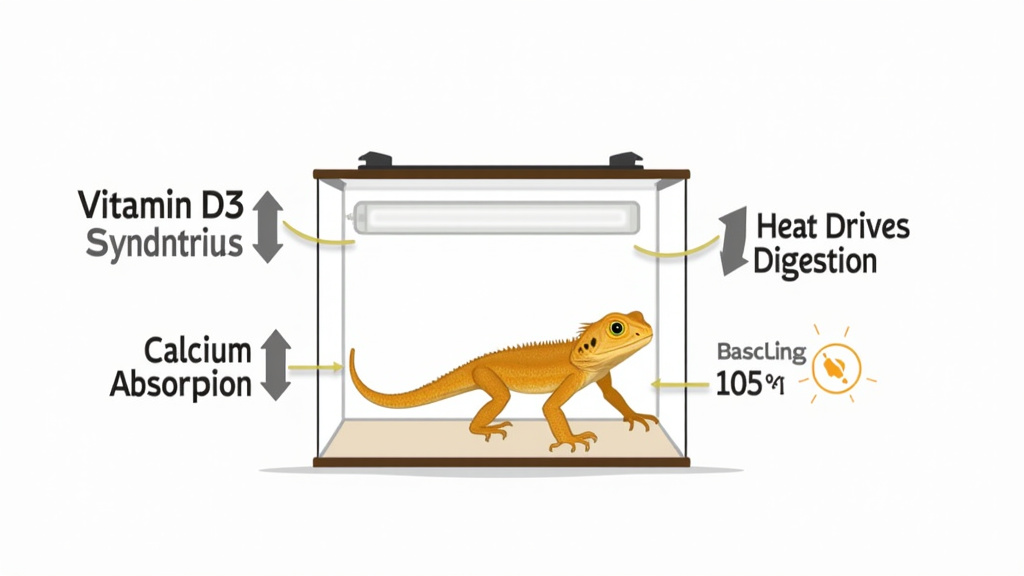
You can serve a perfect diet, but if the environment is wrong, your dragon can’t use it. This is where most online guides stop talking.
UVB Lighting is Your Silent Partner: Bearded dragons synthesize Vitamin D3 in their skin when exposed to UVB light. D3 is essential for absorbing calcium from their gut. No UVB = no calcium absorption = metabolic bone disease, even with perfect dusting.
– You need a linear fluorescent tube (like the Zoo Med ReptiSun 10.0 T5 or Arcadia 12%) that spans 1/2 to 2/3 of the enclosure length.
– Mount it inside the screen or use a reflector. Mesh screens block up to 40% of UVB.
– Replace the bulb every 6 months for T8 models, every 12 months for T5 models. The UV output decays long before the light burns out.
Heat Drives Digestion: Your dragon is a solar-powered processor. It needs a precise temperature gradient to metabolize food.
– Basking surface temperature: 100-110°F (38-43°C) for juveniles, 95-105°F (35-40°C) for adults.
– Warm side ambient: 85-90°F (29-32°C)
– Cool side ambient: 75-80°F (24-27°C)
– Nighttime temps can drop to 65-75°F (18-24°C). No colored heat lamps at night.
Without a basking spot over 100°F, a juvenile will sit on its full gut unable to digest, leading to fermentation, bloating, and loss of appetite. Measure temperatures with a digital infrared thermometer.
Special Cases and Troubleshooting
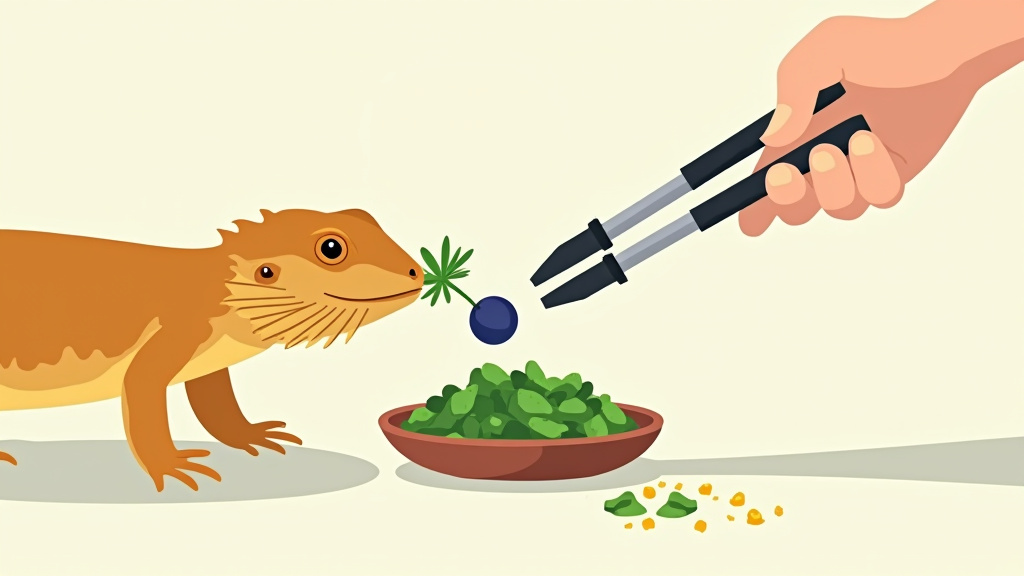
Sometimes the standard plan hits a snag. Here’s what to do.
The Dragon That Won’t Eat Greens: This is almost always a juvenile raised on insects-only. The fix is persistence and strategy.
1. Offer the salad first, every single morning.
2. Make the salad move. Use tongs to wiggle a piece of dandelion green or a blueberry in front of them.
3. Mix in very small, enticing treats like a single bee pollen granule or a piece of grated squash.
4. Reduce insect feedings slightly to encourage appetite for other foods. They won’t starve themselves to death.
The Overweight Adult: If your dragon’s belly drags, its limbs look pudgy, and the fat pads on its head are bulging, it’s time for a diet.
– Immediately reduce insects to once per week.
– Increase the salad size and variety, focusing on high-fiber greens.
– Encourage movement by placing food dishes across the enclosure.
– Consider offering fresh basil or other aromatic herbs to stimulate interest without calories.
The Gravid (Egg-Carrying) Female: She has immense calcium demands for eggshell production.
– Increase insect feedings (dust with calcium daily).
– Provide a constant supply of calcium-dusted greens.
– Offer a small amount of cooked, scrambled egg (with no oil or seasoning) once a week as a protein and calcium boost. The cooking deactivates avidin, a protein in raw egg whites that blocks biotin absorption.
– Ensure UVB lighting is brand new and temperatures are optimal.
Before you start: Wash all greens and vegetables thoroughly to remove pesticide residues. Never feed avocado, rhubarb, or fireflies, they are highly toxic. Always have a reptile-savvy exotics veterinarian identified before you need one.
Frequently Asked Questions
How many crickets should I feed my juvenile bearded dragon?
Feed as many appropriately-sized crickets as your juvenile can eat in two 10-15 minute sessions per day. This could be 20-50+ small crickets daily. The correct amount is “as many as they actively hunt until they stop.” Weigh your dragon weekly; steady growth means you’re on track.
Can bearded dragons eat fruit every day?
No. Fruit should be a rare treat, offered no more than once every week or two. The high sugar content can cause digestive upset, diarrhea, and contribute to obesity. Stick to berries like blackberries, mango, or papaya in tiny amounts.
Why is my bearded dragon not eating its salad?
The most common reasons are incorrect temperatures (too cold to digest), a diet history of insects-only, or simply offering the salad after the dragon is full from bugs. Always offer the salad first thing in the morning when they are hungry from their overnight fast. Make sure the basking spot is hot enough.
How often do I really need to replace my UVB bulb?
Mark your calendar. Replace T5 high-output UVB bulbs every 12 months. Replace T8 standard-output bulbs every 6 months. The UV radiation decays invisibly. Using an old bulb is like feeding calcium into a locked box, your dragon can’t access it.
Are superworms okay as a staple feeder?
No. Superworms are high in fat and have a tough chitin shell, making them harder to digest. They are a fine occasional treat, but relying on them can lead to obesity and impaction. Use Dubia roaches, crickets, or black soldier fly larvae as your primary protein sources.
What does gut-loading actually do?
Gut-loading transfers nutrients from the insect’s gut to your dragon. Feeding your crickets carrots loads them with beta-carotene (Vitamin A). Feeding them high-calcium greens loads them with calcium. A gut-loaded insect is significantly more nutritious than a starved one. It’s the difference between feeding your dragon a vitamin pill and a piece of cardboard.
The Bottom Line
Bearded dragon feeding isn’t about dumping a bowl of lettuce and a handful of crickets into a tank. It’s a calibrated system of life-stage ratios, scheduled supplementation, and environmental support. Get the ratio wrong and you stunt growth or cause obesity. Skip the UVB and the best diet in the world leads to metabolic bone disease.
The routine is simple once set: morning salad, afternoon bugs, every insect gut-loaded and dusted. Monitor their weight and body condition. A healthy adult dragon should have a firm body, flat fat pads on its head, and an appetite that eagerly tackles a pile of mustard greens before eyeing a roach. That’s the sign you’ve matched the food to the biology.