
Guide to the Southern Rock Agama (Bloukop Koggelmander) Care
This post contains affiliate links. As an Amazon Associate, we earn from qualifying purchases.
Southern Rock Agama care requires a spacious, heated rock enclosure mimicking their native habitat. They are insectivores needing live prey and UVB lighting. They are fast, observant pets unsuitable for frequent handling. Males display a seasonal blue head, but females and juveniles are brown.
To identify a Southern Rock Agama Bloukop Koggelmander, look for a medium-sized lizard with a plump body, a thin tail, and a distinct triangular head. During breeding season, mature males develop a brilliant cobalt-blue head, which is the origin of the “bloukop” name. They inhabit rocky terrains across Southern Africa and are known for their social, head-bobbing displays.
Most people get this wrong by assuming the bright blue head is permanent or that these are calm, handleable pets like Bearded Dragons. The blue is a seasonal flag for males, and their skittish speed makes them a poor choice for a first reptile.
This guide breaks down everything about Agama atra: where it lives, what it eats, why it bobs its head, and the hard truth about keeping one in captivity.
Key Takeaways
- The iconic blue head appears only on dominant males during breeding season; females and juveniles are a cryptic gray-brown.
- Their Afrikaans name, “koggelmander,” comes from their head-bobbing display, which looks like a person nodding or mocking.
- They are exceptionally fast and skittish, making them a challenging, observation-only pet compared to docile Bearded Dragons.
- Domestic cats are a significant introduced predator causing local population declines in suburban areas.
- While insectivorous, their survival strategy is shaped by intense predation pressure, favoring quick reproduction and social vigilance.
What Is a Bloukop Koggelmander?
The Southern Rock Agama (Agama atra) is a sun-loving lizard native to Southern Africa. Its Afrikaans common name, Bloukop Koggelmander, is a perfect descriptor. “Bloukop” means blue head, referring to the male’s stunning breeding coloration. “Koggelmander” translates to “mocking man,” a nod to the lizard’s characteristic head-bobbing display that resembles a person nodding.
You’ll find them on rock faces, mountainous slopes, and even brick walls in suburbs. They avoid sandy, open ground. An adult reaches about 25 centimeters from snout to tail tip. The body is sturdy, the tail is long and thin, and a subtle dorsal crest runs from the neck down the back.
The Southern Rock Agama (Agama atra) is a diurnal, insectivorous lizard distinguished by sexual dimorphism. Breeding males develop a vivid blue head and neck, while females and juveniles retain a cryptic gray-brown coloration. They inhabit rocky outcrops across Southern Africa, living in small colonies with a dominant male.
TL;DR: It’s a rock-dwelling lizard where breeding males get a blue head and all of them bob their heads like they’re agreeing with you.
The Blue Head Isn’t For Show
That brilliant blue isn’t just decoration. It’s a billboard. In a colony, the dominant male sports the most vibrant blue head. It signals his health, territory, and readiness to mate to females and warns rival males to stay away. The color intensifies during the breeding season and can fade when the male is stressed, cold, or submissive.
Females and juvenile males lack this flashy display. They are a uniform, mottled gray-brown. This isn’t a disadvantage. Their dull coloration is perfect camouflage against granite and sandstone, hiding them from predators like fiscal shrikes and snakes. A female may show faint blue tinges on her head and develop brown blotches on her sides when she’s carrying eggs, but it’s never the show-stopping blue of a prime male.
I learned this the hard way years ago. I spent a week in the Drakensberg trying to photograph a “blue-headed agama,” only to realize I was chasing females and juveniles. The one true “bloukop” I finally saw was perched three meters up a sheer cliff face, perfectly safe, bobbing his head like he owned the place. I got a blurry photo and a lesson in lizard sociology.
Why Do They Bob Their Heads?
The “koggel” in koggelmander means to mimic or mock. When a male agama does his push-up and head-bob routine, it looks like a little man nodding. This isn’t mockery. It’s serious communication.
The display serves three clear purposes. First, it’s a territorial broadcast. A male on his favorite sunning rock will bob to tell other males “this spot is taken.” Second, it’s a courtship ritual directed at females. Third, it’s a general alert signal to the colony. A few rapid bobs can mean “predator nearby.”
You see a similar, though less dramatic, form of territorial displays in lizards in many species. It’s a fundamental lizard language.
Common mistake: Interpreting head bobbing as tameness or an invitation to interact, it’s a warning. Move closer and the lizard will vanish into the rocks.
TL;DR: Head bobbing is lizard talk for “mine,” “come here,” or “watch out.”
Southern Rock Agama vs. Common Look-Alikes
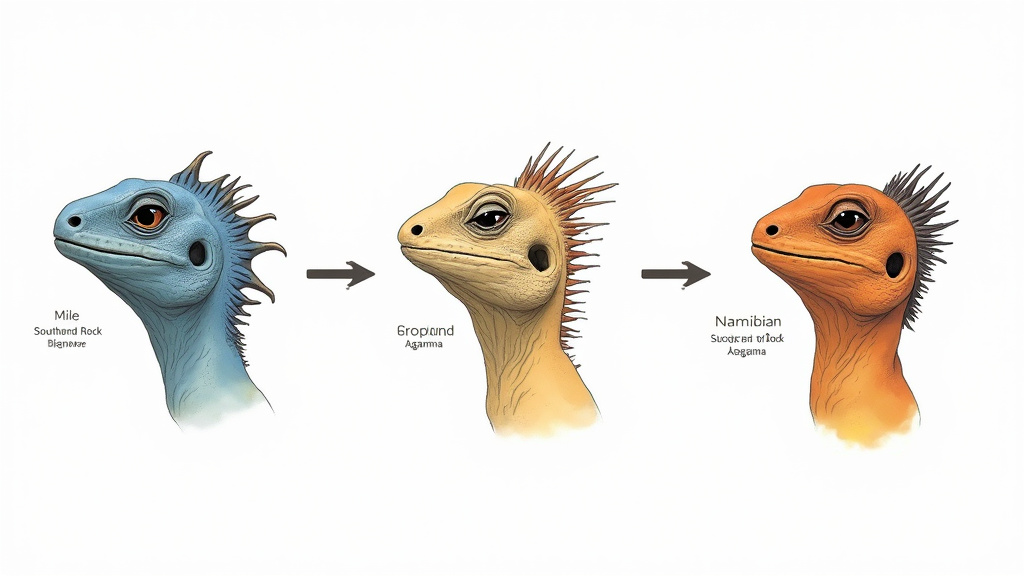
Not every agama with color is a Southern Rock Agama. Two close relatives, the Ground Agama (Agama aculeata) and the Namibian Rock Agama (Agama planiceps), illustrate how predation shapes behavior. A 2020 research article in The Conversation on predator-shaped lizard survival strategies highlighted this difference. A. aculeata lives in open, high-predation areas and matures fast, reproducing quickly. A. planiceps lives in safer rocky areas, grows slower, and invests more in fewer offspring.
The Southern Rock Agama (A. atra) fits the planiceps model. Its rocky home offers some safety, allowing for the social, colony-based life you see. Confusing them can lead to incorrect care assumptions.
| Species | Primary Habitat | Key Identification | Survival Strategy |
|---|---|---|---|
| Southern Rock Agama (A. atra) | Rocky outcrops, mountains, walls | Male: blue head; female: gray-brown | Social, colony-living, slower maturity |
| Ground Agama (A. aculeata) | Open sandy ground | Spiny scales, less vivid coloration | Solitary, fast-maturing, high reproduction rate |
| Namibian Rock Agama (A. planiceps) | Desert rock piles | Flattened body, elaborate male colors | Slower growth, higher investment in fewer young |
What Do Southern Rock Agamas Eat?
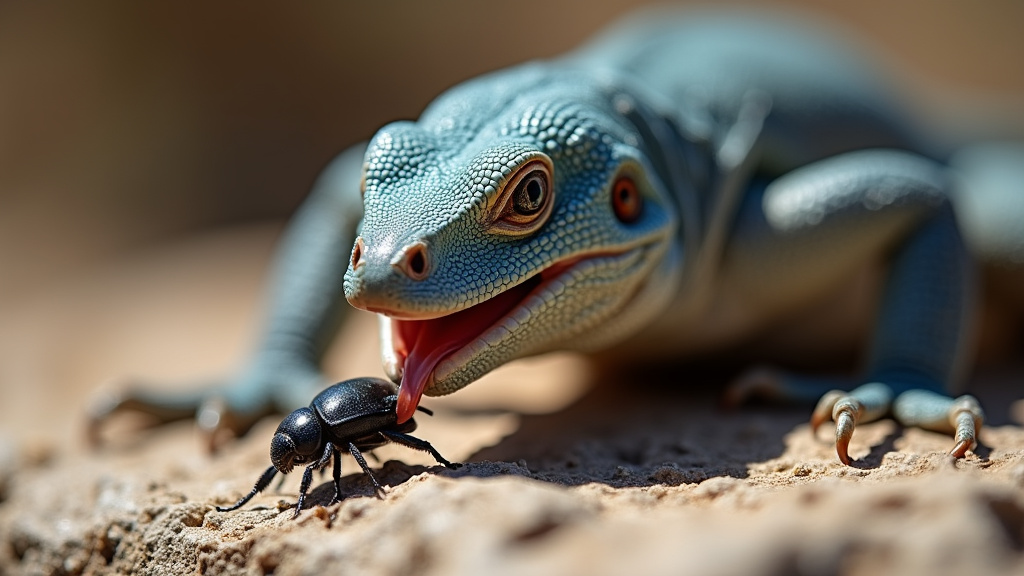
Their menu is almost exclusively insects. They are sit-and-wait predators, perched on a sunny rock until an ant, termite, or beetle wanders too close. Then they strike with a quick dart. This diet is protein-rich but low in fat, which suits their high-metabolism, active lifestyle.
In captivity, this means a varied insect diet is non-negotiable. Crickets, dubia roaches, and black soldier fly larvae are good staples. You must dust them with a calcium supplement containing D3, as these lizards synthesize vitamin D3 from UVB light just like Bearded Dragons. Without proper UVB lighting for lizards, they cannot metabolize that calcium, leading to metabolic bone disease.
They rarely eat plant matter. Don’t offer them fruits or vegetables; they’ll likely ignore them.
The 3 Things That Decide if This Lizard is Right for You
Keeping a Southern Rock Agama is a specific commitment. It is fundamentally different from keeping a Bearded Dragon. Ask yourself these three questions.
First, can you provide a vertical, rocky habitat? This is not a desert-floor lizard. Your enclosure needs height, at least 90 centimeters tall, with stacked slate, secure rock piles, and cork bark to create climbing surfaces and hiding crevices. The reptile husbandry basics of heat, light, and hygiene apply, but the layout is opposite of a bearded dragon’s long, low tank.
Second, are you okay with a “look, don’t touch” pet? This is the biggest point. Southern Rock Agamas are lightning fast and profoundly skittish. They do not tolerate handling. The stress of being grabbed can cause them to shed their tail (autotomy) or refuse to eat. If you want a lizard you can hold, get a Bearded Dragon. This agama is for observation only.
Third, can you manage precise heating and lighting? They need a strong basking spot reaching 38-40°C (100-104°F) on the highest rock, with a cooler end around 26°C (79°F). More critical is intense, full-spectrum UVB lighting covering most of the enclosure. Their reptile UV light types and placement are critical; a weak UVB bulb over a screen top won’t cut it. They need to synthesize D3 to live.
I won’t recommend a Southern Rock Agama for a first-time reptile keeper. The setup cost is high, the handling reward is zero, and a single error in temperature gradient for lizards or UVB can lead to a slow, preventable death. A bearded dragon is far more forgiving.
What Kills Southern Rock Agamas?
In the wild, their predators are classic: birds of prey, snakes, and larger lizards. The fiscal shrike, or “butcher bird,” is a notorious hunter, often impaling agamas on thorns. But the most impactful modern predator isn’t native.
Domestic cats. In suburban areas where agamas adapt to garden walls, free-roaming cats wreak havoc. A 2015 study in a South African suburb noted a direct correlation between cat density and local agama population decline. Cats don’t always kill to eat; they maim and leave. A lizard with a cat bite usually dies from infection within days.
This is a man-made problem with a simple solution: keep your cat indoors. It protects the cat from cars and disease, and it protects native species like the agama.
Their other major threat is habitat loss. Quarrying and urban development destroy the rocky outcrops they call home.
Are They Poisonous or Dangerous?
This is a persistent myth. No. The Southern Rock Agama is not poisonous, venomous, or dangerous to humans. The “koggelmander” name might have fueled old wives’ tales about them being sinister or toxic, but they are harmless.
Their only defense is speed and hiding. They will bite if grabbed and cornered, but their small teeth might not even break human skin. The bite is a pressure pinch, nothing more. The real risk is to the lizard, you could injure it or cause fatal stress.
Frequently Asked Questions
How long do Southern Rock Agamas live?
In the wild, their average lifespan is 5-8 years due to predation. In captivity, with perfect care, they can live 10-15 years. Their longevity is a direct reflection of their reptile hygiene practices and stable environment.
Can you keep a Bloukop Koggelmander with a Bearded Dragon?
Absolutely not. This is a terrible idea. They have different environmental needs (vertical rock vs. horizontal desert), different temperaments (skittish vs. docile), and would stress each other to death. They could also transmit parasites. Never house different reptile species together.
How often do they eat?
Adults eat 4-6 appropriately sized insects every other day. Juveniles may eat daily. Offer food in the morning when they are basking and most active. Remove any uneaten insects after 15 minutes.
Why is my pet agama always hiding?
Because you’re looking at it. This is normal behavior for a prey animal. If it’s hiding constantly and not coming out to bask or eat, check your temperatures and lighting. Chronic hiding is a primary sign of a healthy lizard being under stress from incorrect husbandry.
Where can I buy one?
They are not commonly bred in captivity like Bearded Dragons. Most available are wild-caught, which comes with stress, parasites, and ethical concerns. If you are determined, seek a specialty breeder who can provide a captive-bred animal. Expect to pay a premium and wait.
The Bottom Line
The Southern Rock Agama, the Bloukop Koggelmander, is a fascinating window into lizard society. Its blue-headed displays and head-bobbing colonies are a spectacle of nature best observed in the wild or in a meticulously built enclosure. It is not a pet for handling.
Respect it as a wild animal adapted to a specific niche. If you want a lizard companion, the docile, interactive Bearded Dragon remains the champion. But if you want to create a slice of Southern African cliffside in your home and watch a master of rock and sun, the agama demands your attention, and your distance.