
Why Bearded Dragons Need UV Lighting: The Essential Guide
This post contains affiliate links. As an Amazon Associate, we earn from qualifying purchases.
Bearded dragons need UVB lighting to synthesize vitamin D3 in their skin, which is the essential biological trigger for intestinal calcium absorption. Without this specific wavelength of light (290-320nm), dietary calcium cannot be used, leading directly to Metabolic Bone Disease—a painful, crippling, and often fatal condition.
The universal mistake is treating UVB as an optional “extra” light. It’s not supplemental. It’s the non-negotiable mechanism that lets your dragon process the food you give it. A tank with perfect heat but no UVB is a death sentence delivered on a delay.
This guide breaks down the exact biological chain reaction, shows you the only lighting setups that work, and explains the measurable consequences of getting it wrong. We’ll cover Ferguson Zones, UVI targets, bulb degradation, and why those compact coil bulbs are reptile junk.
Key Takeaways
- UVB light (290-320nm) triggers vitamin D3 synthesis in the skin, which is mandatory for calcium absorption. No UVB means no usable calcium, regardless of diet.
- Bearded dragons require Ferguson Zone 3-4 lighting, the highest tier for captive reptiles. This translates to a basking zone UV Index (UVI) of 4.0–6.0.
- The only reliable setup is a linear T5 High Output fluorescent tube (e.g., Arcadia ProT5 14% or Zoo Med ReptiSun T5 HO 10.0) with a reflector, placed 10–16 inches from the basking spot.
- UVB and heat must overlap completely. A dragon must bask in both simultaneously to properly regulate D3 synthesis and body temperature.
- UVB bulbs degrade long before they burn out. Replace T5 HO tubes every 12 months, T8 tubes every 6 months, without exception.
The Biological Process: From Sunlight to Strong Bones
This isn’t about warmth or visibility. It’s a locked biochemical sequence. In the wild, a bearded dragon basks under the Australian sun. The ultraviolet B radiation penetrates its skin.
This UVB photon energy converts a cholesterol derivative (7-dehydrocholesterol) in the skin into pre-vitamin D3, which then isomerizes into active vitamin D3 (cholecalciferol). This hormone travels to the liver and kidneys, becoming calcitriol.
The Technical Snippet: Ultraviolet B radiation between 290–320 nanometers penetrates the epidermis of heliothermic reptiles. Photons of this wavelength isomerize 7-dehydrocholesterol to pre-vitamin D3. Subsequent thermal isomerization produces vitamin D3 (cholecalciferol), the precursor hormone required for active intestinal calcium transport via calcium-binding proteins.
That final compound, calcitriol, is the key that unlocks calcium absorption in the small intestine. Without it, calcium in gut contents passes straight through undigested. The dragon’s body then leaches calcium from its own bones to maintain critical blood calcium levels for nerve and muscle function.
TL;DR: UVB light → skin makes vitamin D3 → liver/kidneys activate it → activated D3 lets gut absorb calcium. Break the first link, and the entire chain fails.
What Happens Without UVB? Metabolic Bone Disease
The result of a broken chain is Metabolic Bone Disease (MBD). It’s not a minor deficiency. It’s a systemic collapse.
The body prioritizes blood calcium over skeletal integrity. As it drains minerals from bones, they become soft, rubbery, and deformed. You’ll see the symptoms in a specific order. First, a slight tremor in the fingers or toes during handling. Within weeks, the jaw softens, leading to a permanent slack-mouthed appearance and difficulty eating. The spine may kink or curve. Long bones in the legs bow under the animal’s weight.
Advanced MBD causes pathological fractures—bones breaking under normal movement. The femoral bones are common sites. Kidney disease follows as the organs struggle to process the disrupted calcium-phosphorus balance. Once neurological symptoms like full-body tremors or seizures appear, the prognosis is poor.
I took in a rescue years ago with early MBD. The previous owner used a coil UVB bulb over a 40-gallon tank. The dragon had a slight head tremor and its front legs looked subtly bent. We switched to a proper UVB lighting setup with an Arcadia T5. After six months of correct lighting and liquid calcium, the tremor vanished and it could climb again. The bone bends were permanent.
Common mistake: Using a compact coil UVB bulb for a bearded dragon — the UV output is too weak and uneven, creating a “spot” of exposure that fails to cover the basking zone. MBD symptoms typically appear within 3–6 months.
Ferguson Zones and Your Dragon’s UV Index Needs
Not all reptiles need the same UVB dose. The Ferguson Zone system, developed by zoologist Dr. Gary Ferguson, classifies species based on their natural sun exposure behavior. Bearded dragons are solidly in Ferguson Zone 3-4.
| Ferguson Zone | Typical UVI in Habitat | Behavior | Example Species |
|---|---|---|---|
| Zone 1 (Shade) | 0–0.7 | Cryptic, shade dwellers | Crested gecko, many snakes |
| Zone 2 (Partial Sun) | 0.7–1.4 | Occasional baskers | Leopard gecko, blue-tongue skink |
| Zone 3 (Open Sun) | 1.4–3.0 | Regular baskers | Many iguanas, uromastyx |
| Zone 3-4 (Midday Sun) | 3.0–8.0+ | Heliothermic, prolonged baskers | Bearded dragon, many tortoises |
Zone 3-4 means your dragon evolved to bask under a UV Index of 4–6, sometimes spiking over 8. Your best UVB lighting goal is to recreate a basking spot UVI of 4.0–6.0. This is non-negotiable for bone health and immune function.
You can measure this with a Solarmeter 6.5, the only tool that reads the specific UVB wavelengths. Place the sensor where your dragon’s back will be while basking. Aim for that 4–6 range. If you hit 2.0, it’s insufficient. If you hit 8.0, it’s potentially harmful over the long term. This precise measurement is why guessing with hardware store bulbs fails.
The Gold Standard: Linear T5 HO Fixtures
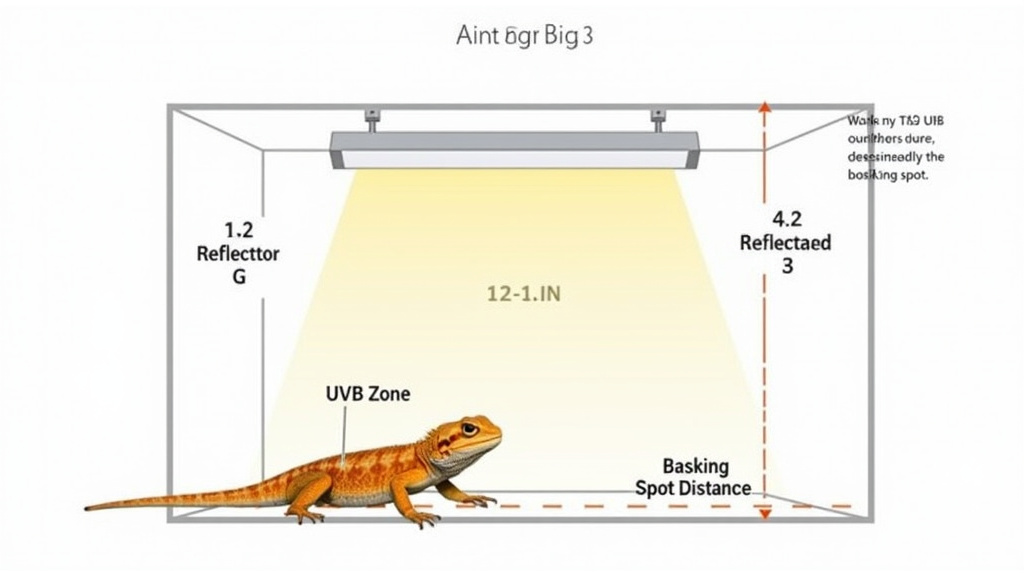
Your equipment choices are narrow. For an adult dragon in a standard 4x2x2 foot enclosure, you need a linear T5 High Output fluorescent tube. The “T5” refers to the tube diameter (5/8 inch), and “HO” means High Output.
The two dominant, tested brands are Arcadia and Zoo Med. An Arcadia ProT5 14% Dragon bulb or a Zoo Med ReptiSun T5 HO 10.0 bulb are the correct strengths. These are recommended UVB lights because their spectral output is engineered for Ferguson Zone 3-4 reptiles.
The fixture must include a reflector—a polished aluminum sheet behind the bulb. This simple accessory doubles effective UVB output by redirecting rays that would otherwise shine upward into the enclosure. Never run a T5 bulb without one.
Here’s how to position it:
1. The fixture should span 50-75% of the enclosure length. This creates a gradient, allowing the dragon to self-regulate exposure.
2. Mount it inside the screen top if possible. Standard mesh blocks 30-50% of UVB. If you must place it on top, use a wide-hole mesh or raise the basking spot closer.
3. The distance from the bulb to the basking surface is critical. For a T5 HO 10.0/12% bulb with a reflector, 12-14 inches is typical. For a 14% bulb, 16-18 inches. Always check the manufacturer’s distance chart.
4. This UVB zone must perfectly overlap the area heated by the basking lamp.
TL;DR: Buy a 24-inch or 34-inch T5 HO fixture with reflector and a Zone 3-4 bulb. Mount it inside the screen, 12-16 inches above the basking platform, directly over the heat lamp.
Common Setup Mistakes That Cause MBD
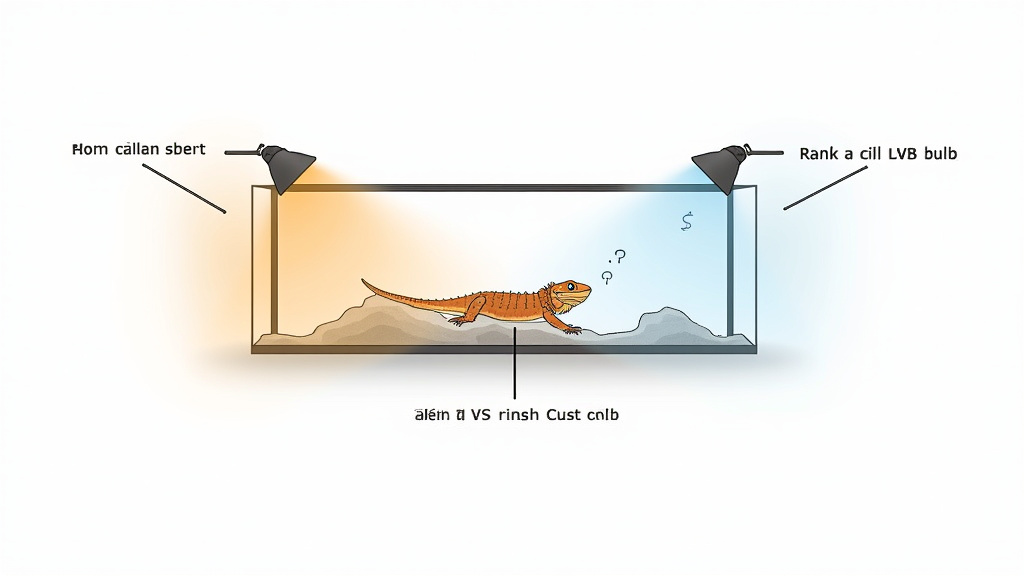
Most lighting failures aren’t from having no light, but from having the wrong configuration. These errors create invisible deficits.
| Mistake | Why It Fails | Visible Consequence Timeline |
|---|---|---|
| Using a compact coil/CFL UVB bulb | Output is too weak and covers a tiny area. UVI at basking spot rarely exceeds 1.0. | MBD symptoms in 3–6 months. |
| Placing UVB and heat lamps at opposite ends of tank | Dragon cannot synthesize D3 and thermoregulate at once. It must choose between warmth and “medicine.” | Poor digestion, weaker bones, lethargy within weeks. |
| Putting UVB on top of fine mesh | The mesh acts as a partial UVB filter, reducing effective UVI by up to 50%. | Chronic low-level calcium deficiency, slow-onset MBD over 12+ months. |
| Not using a reflector | Up to half the UVB radiates away from the enclosure, wasting the bulb’s output. | Effectively halves your UVB dose, leading to insufficiency. |
| Never replacing the bulb | UVB output decays exponentially. A 12-month-old T5 HO may emit only 40% of its original UVB. | Gradual return of MBD risk after the bulb’s effective lifespan ends. |
The most dangerous error is the coil bulb. It produces a narrow, intense beam directly under it that falls off sharply a few inches away. Your dragon would have to sit in one exact spot for hours. It never works.
The second-worst is separating heat and UVB. The biological processes of thermoregulation and D3 synthesis are linked. A cold dragon cannot efficiently convert pre-vitamin D3. The lighting setup must allow for simultaneous exposure.
Common mistake: Keeping a UVB bulb for two years because it still lights up — the UV-emitting phosphors degrade steadily. After 12 months, a T5 HO bulb may not produce enough UVB to meet Zone 3-4 requirements, silently putting your dragon back at risk.
UVB Bulb Lifespan and Replacement Schedule
The light you see is irrelevant. UVB output declines on a separate curve from visible light. You cannot see, smell, or sense this decay.
A brand-new T5 HO bulb might produce a UVI of 6.0 at 12 inches. After 6 months, that could drop to 4.5. After 12 months, it might be at 3.0—below the threshold for a bearded dragon. The bulb still glows brightly.
This is why you must replace on schedule, not on failure:
– T5 HO Bulbs (Arcadia, Zoo Med): Replace every 12 months.
– T8 Bulbs (older technology): Replace every 6 months.
Mark the installation date on the fixture with a paint pen or set a calendar reminder. This is cheaper than treating MBD. When you swap the bulb, you’re not just changing a light; you’re resetting a medical device. For a deep dive on specific products, our best UVB bulbs guide compares longevity and output charts.
The Risks of Artificial UVB: Photokeratitis and Beyond
While essential, artificial UVB isn’t risk-free. It’s a concentrated, point-source imitation of sunlight. Two documented issues are photokeratitis and squamous cell carcinoma.
Photokeratitis is a painful inflammation of the cornea, essentially a “sunburn of the eye.” It’s caused by overexposure to UVB, often from a bulb placed too close or without a gradient for escape. Symptoms include squinting, eye-rubbing, and swelling. The fix is immediate: turn off the UVB light for 48 hours and increase the distance permanently. It usually resolves without permanent damage.
Squamous cell carcinoma (SCC) is a skin cancer linked to UV exposure in reptiles, including bearded dragons. The risk appears higher with inconsistent, high-intensity exposure from artificial sources versus gradual, full-spectrum sunlight. It often presents as a non-healing sore or raised lesion, typically on areas with less scale coverage.
Specific Warning: A 2023 evidence review in the Journal of Herpetological Medicine and Surgery noted that while UVB prevents MBD, chronic exposure to high levels from single-point sources may elevate SCC risk in some species. Providing a proper gradient (UVI 4-6 at the peak, tapering to 0-1 on the cool side) allows natural self-regulation and is the best mitigation.
This isn’t a reason to avoid UVB. It’s a reason to install it correctly. Your dragon’s essential lighting equipment must include a gradient so it can move away from the UVB source, just as it would retreat to shade in the wild.
Can Supplements or Sunlight Replace a UVB Bulb?
This is the perennial hope: a cheaper, easier fix. The answer is nuanced.
Oral Vitamin D3 Supplements: These can be a safety net, but not a replacement. They bypass the skin’s regulatory mechanism. It’s possible to overdose on oral D3, causing hypercalcemia (dangerously high blood calcium), which damages kidneys and soft tissues. UVB exposure allows for self-regulation; the skin stops producing D3 when sufficient levels are reached. Use supplements only as directed by a vet for specific cases, not as your primary UVB lamp requirement.
Natural Sunlight: Direct, unfiltered sunlight is the best UVB source. A secure outdoor enclosure for 30-60 minutes a few times a week is fantastic. But glass and plastic block all UVB. A tank by a window does nothing. Weather, season, and safety (predators, temperature spikes) make sunlight an unreliable sole source. It’s a supplement, not a solution.
The bulb is the consistent, controllable cornerstone. Pair it with occasional supervised sunbathing for the best results.
Frequently Asked Questions
Can a bearded dragon live without a UVB light?
No. A bearded dragon will develop Metabolic Bone Disease without UVB lighting. Survival time varies, but irreversible bone damage begins within a few months. It is an absolute physiological requirement, not an optional comfort.
How many hours a day does a bearded dragon need UVB?
They need a consistent photoperiod that mimics a natural day. Run the UVB light for 12-14 hours during summer months and 10-12 hours in winter. This supports their circadian rhythm and calcium metabolism. Use a digital timer to automate this daily light cycle.
What is the difference between UVA and UVB for bearded dragons?
UVB (290-320nm) is for vitamin D3 synthesis and calcium metabolism. UVA (320-400nm) is visible to reptiles and influences behavior, appetite, and breeding activity. A proper lighting setup requires both. The basking lamp provides UVA and heat; the dedicated UVB tube provides the critical UVB wavelengths.
Do I turn the UVB light off at night?
Yes. Complete darkness is required at night. Bearded dragons need a clear day/night cycle. Turning off all lights, including UVB, allows for proper sleep and temperature drop. If supplemental heat is needed at night, use a non-light-emitting ceramic heat emitter or deep heat projector.
How do I know if my UVB bulb is still good?
You don’t, without a Solarmeter 6.5. The visible light gives no indication. Adhere to the manufacturer’s replacement schedule: 12 months for T5 HO, 6 months for T8. Guessing based on the bulb’s age is more reliable than guessing based on its glow.
Can I use a mercury vapor bulb for UVB?
Mercury vapor bulbs (MVB) produce both heat and UVB from a single point. They can work but are less ideal. Their UVB output is intense and decays unpredictably. They also create a very hot basking spot with less gradient control. A separate heat lamp and T5 HO UVB tube offers more consistent, adjustable, and safer coverage for most keepers.
The Bottom Line
UVB lighting is the biochemical engine of your bearded dragon’s health. It converts food into bone. Skipping it or cheaping out on a coil bulb guarantees a slow, painful decline into Metabolic Bone Disease.
Invest in a linear T5 HO fixture with a Zone 3-4 bulb and a reflector. Mount it 10-16 inches above the basking spot, directly over the heat lamp. Set it on a timer for a 12-hour day. Replace the bulb every 12 months, on the calendar.
That’s the regimen. It’s not complicated, but it’s non-negotiable. Your dragon’s skeleton depends on photons you cannot see. Get the light right, and everything else follows.