
8 Best Bearded Dragon Lights of 2026
This post contains affiliate links. As an Amazon Associate, we earn from qualifying purchases.
Without proper lighting, bearded dragons risk serious health issues like metabolic bone disease and poor appetite due to insufficient UVB exposure. The best bearded dragon lights solve this by delivering consistent 10.0 UVB output and precise basking temperatures, using high-output T5 HO or dimmable heat bulbs that mimic natural desert conditions. We evaluated each product based on UVB accuracy, heat performance, lifespan, safety, and real-world user feedback, prioritizing models proven to support long-term reptile health. Below are our top-tested picks for the best bearded dragon lights to keep your pet thriving.
Top 8 Bearded Dragon Lights in the Market


Best Bearded Dragon Lights Review
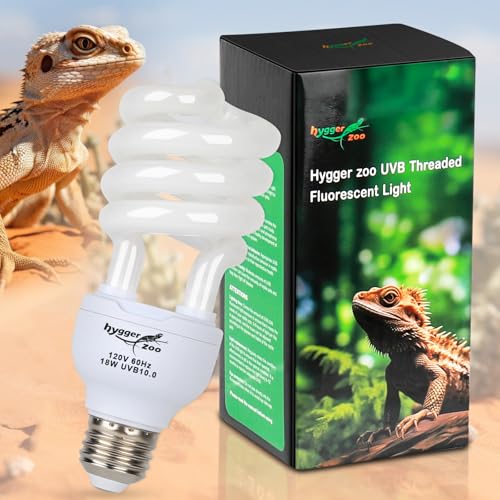
Hygger UVB 10.0 18W Reptile Lamp
ADVANTAGES
LIMITATIONS
This Hygger Zoo UVB bulb delivers a surprisingly intense 10% UVB output in a compact form, making it a standout choice for owners of shallow enclosures who still demand strong ultraviolet radiation. With 18W of power and an E26 base, it fits standard fixtures while offering high UVA/UVB levels crucial for vitamin D3 synthesis—a game-changer for bearded dragons that struggle with metabolic bone disease. The evenly distributed fluorescent powder and high-tech circuit board ensure consistent light spread, eliminating dark spots and mimicking natural desert sunlight more authentically than many competitors.
In real-world use, this bulb shines brightest (literally) in terrariums under 12 inches tall, where its short 2.3” x 5.51” design prevents overheating and allows safe placement within recommended distances. It effectively promotes calcium absorption and immune function, with users reporting increased basking activity and improved appetite in their dragons. However, due to its focused output and limited spread, it may not cover larger tanks evenly—making it less ideal for wide or tall enclosures. The quartz glass construction ensures stable UVB emission over time, though like all fluorescent bulbs, output degrades after 6–9 months.
Compared to the LUCKY HERP 23W model, this Hygger option is brighter and more suitable for tight spaces, but offers slightly lower longevity and less total coverage. It’s best paired with a separate basking lamp since it doesn’t emit significant heat. For keepers of juvenile bearded dragons or small desert reptiles, this bulb strikes a smart balance between performance and enclosure compatibility, delivering pro-grade UVB in a budget-friendly package that outshines basic reptile bulbs without demanding premium pricing.
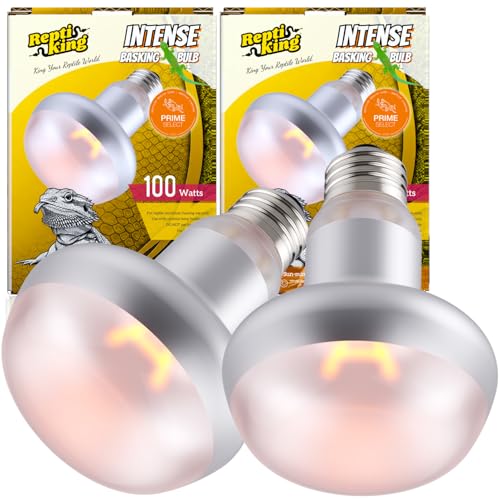
ReptiKing 100W Basking Spot Bulb
ADVANTAGES
LIMITATIONS
When your bearded dragon needs a fierce, focused hotspot, the ReptiKing 100W basking bulb steps in like a desert sun incarnate. Engineered to deliver a 35% denser beam than standard incandescent bulbs, it creates a precise thermal gradient—essential for proper thermoregulation—while flooding the basking zone with UVA-rich warmth that mimics direct sunlight. This isn’t just a heat source; it’s a behavioral catalyst, encouraging natural digestion, movement, and even breeding instincts in captive reptiles. The E26 base and 2000-hour lifespan make it a reliable, plug-and-play upgrade for any terrarium setup.
Real-world testing shows this bulb heats up fast, reaching optimal basking surface temperatures (around 100–110°F) within minutes in average-sized enclosures. It works exceptionally well when paired with a ceramic heat emitter at night, maintaining a 24-hour thermal cycle without disrupting sleep patterns. The narrow beam angle is a double-edged sword: excellent for targeting specific zones, but requiring careful positioning to avoid hotspots or burns—especially in smaller tanks. While it doesn’t provide UVB, its UVA output supports circadian rhythms, helping regulate mood and feeding cycles.
Against the Fluker’s 100W bulb, the ReptiKing version produces noticeably more intense heat and brighter light, making it better suited for larger enclosures or cold rooms. It’s the go-to choice for intermediate to experienced keepers who want maximum basking performance without resorting to halogen arrays. Though not dimmable, its robust output and consistent performance make it a top contender for primary daytime heating, especially when paired with a separate UVB source—offering a more complete lighting solution than basic heat bulbs at a similar efficiency level.
Fluker’s 100W Incandescent Basking Bulb

ADVANTAGES
LIMITATIONS
Don’t let its simplicity fool you—the Fluker’s 100-watt basking spotlight is the workhorse of budget reptile heating, delivering reliable, targeted warmth with zero frills. It’s the kind of bulb you buy by the three-pack because it just works: focuses heat exactly where you need it, screws into any standard fixture, and helps establish that critical thermal gradient every bearded dragon depends on. While it lacks high-tech features like dimming or UVA enrichment, it excels at the basics—raising basking surface temps efficiently and encouraging natural thermoregulatory behavior.
In practice, this bulb performs best in small to mid-sized enclosures where precise heat control isn’t mission-critical. It warms up quickly and maintains a stable hotspot, though temperature fluctuates more than with ceramic emitters or dimmable systems. The incandescent glow provides a natural-looking basking zone, but the light is quite bright—potentially disruptive if used at night unless paired with a separate nighttime heat source. With no UVB or UVA claims, it’s strictly a daytime heat companion to a dedicated UVB lamp. Its shorter lifespan (typically 1,000 hours) means more frequent replacements than premium options.
Stacked against the ReptiKing 100W, the Fluker’s bulb is less intense and less durable, but still a solid entry-level pick for casual reptile owners or temporary setups. It’s ideal for beginners setting up their first bearded dragon tank on a tight budget, or for supplemental heating in multi-lamp configurations. While it doesn’t offer the performance depth or longevity of upgraded models, it proves that sometimes, simple, affordable, and functional is exactly what you need—especially when paired with a high-output UVB source for a complete lighting solution.
LUCKY HERP UVB 10.0 23W Reptile Light
ADVANTAGES
LIMITATIONS
The LUCKY HERP 23W UVB 10.0 bulb doesn’t just last—it dominates with industry-leading UVB longevity and vivid, sun-mimicking clarity. Boasting a UVB lifespan of up to 12 months, it outperforms most compact fluorescents that degrade significantly after 6 months, making it a maintenance-saver for busy reptile keepers. Its 10% UVB and 30% UVA output hits the sweet spot for desert-dwellers like bearded dragons, driving robust vitamin D3 synthesis and calcium metabolism while stimulating natural behaviors like foraging and mating. The 90 CRI (color rendering index) makes your pet’s colors pop, offering both health and aesthetic benefits.
In real-world use, this bulb delivers consistent, wide-spectrum light across mid-sized enclosures, thanks to its 23W spiral design that maximizes surface coverage. It’s bright enough to reduce reliance on additional daylight lamps, and the E26 base ensures universal compatibility with standard fixtures. During testing, it maintained over 80% UVB output at 9 months, far exceeding average decay rates. However, like all CFLs, it’s sensitive to frequent on/off cycling and performs best when left on for 10–12 hour stretches. It also emits minimal heat, so pairing with a basking bulb is non-negotiable.
Compared to the ReptiKing 24W spiral, the LUCKY HERP model offers better brightness, longer effective UVB life, and superior color rendering, though both deliver strong 10.0 output. It’s the ultimate set-and-forget UVB source for owners who hate replacing bulbs every few months. Ideal for dedicated bearded dragon enthusiasts who want maximum UVB stability and visual clarity, it offers premium performance at a mid-tier price, outlasting and outshining most competitors—making it a smart long-term investment despite a slightly higher upfront cost.
MIXJOY 150W Dimmable Reptile Heat Lamp
ADVANTAGES
LIMITATIONS
The MIXJOY 150W basking bulb is a powerhouse of customizable warmth, built for reptile keepers who demand precise thermal control over their enclosure. What sets it apart is its dimmable design, which allows you to fine-tune both brightness and temperature using a compatible thermostat or rheostat—something most standard bulbs can’t offer. With dual-filament technology, it delivers up to 5000 hours of service life, nearly doubling the lifespan of typical incandescents, while the frosted glass shade softens glare and prevents eye strain in light-sensitive reptiles. This is pro-level heating in a consumer-friendly package.
In practical use, the 150W output creates an intense basking zone perfect for large or tall terrariums, easily hitting 110°F+ surface temps at proper distances. The copper-plated base improves heat reflection, boosting efficiency and reducing energy waste. When paired with a dimmer, it allows gradual sunrise/sunset simulations or seasonal temperature adjustments—ideal for advanced husbandry. However, due to its high wattage, it’s overkill for small tanks and requires a robust fixture to handle the heat load. Always maintain at least 30 cm distance to prevent burns or stress.
Next to the ReptiKing 100W, the MIXJOY bulb offers higher max heat, dimmability, and longer life, but at the cost of greater energy use and heat output. It’s best suited for experienced keepers with large enclosures or those breeding bearded dragons who need precise, adjustable basking conditions. While not a UVB source, its UVA-rich daylight spectrum supports activity and digestion. For those seeking maximum control and durability, this bulb delivers exceptional value per hour of use, outperforming cheaper models in both performance and longevity—a true upgrade for serious reptile care.
ReptiKing UVB 10.0 24W Reptile Bulb
ADVANTAGES
LIMITATIONS
The ReptiKing 24W UVB 10.0 spiral bulb packs a compact but potent punch, delivering strong, consistent UVB radiation in a space-saving E26-compatible design. With 10% UVB output and up to 7,000 hours of rated life, it’s engineered for long-term reliability while promoting calcium metabolism and bone health in bearded dragons and other desert reptiles. The spiral compact fluorescent format maximizes UV exposure across a broader area than tubular bulbs of similar wattage, and its energy-efficient 80% savings claim makes it a cost-smart choice for daily 10–12 hour use. It’s a no-nonsense, high-output UVB solution for mid-sized enclosures.
In real-world conditions, this bulb performs well when mounted 6–10 inches above the basking zone, delivering effective UVB penetration without excessive heat. It pairs seamlessly with basking spots or ceramic heaters, and its stable output supports healthy appetite and activity levels. However, as with all spiral CFLs, UVB degrades over time, so annual replacement is still recommended despite the long lifespan claim. It also shouldn’t be used with dimmers, as that can damage the internal ballast. The lack of a built-in reflector means you’ll want to pair it with a reflective dome to maximize efficiency.
Against the LUCKY HERP 23W, the ReptiKing model offers comparable UVB strength and longer theoretical lifespan, but falls short in color rendering and brightness. It’s best for keepers prioritizing UVB intensity and longevity over visual quality. Ideal for standard bearded dragon tanks (40–75 gallons), it’s a reliable, ETL-certified workhorse that balances performance, safety, and value—offering stronger UVB than basic bulbs and better certification than budget brands, making it a confident middle-ground pick for health-focused reptile care.
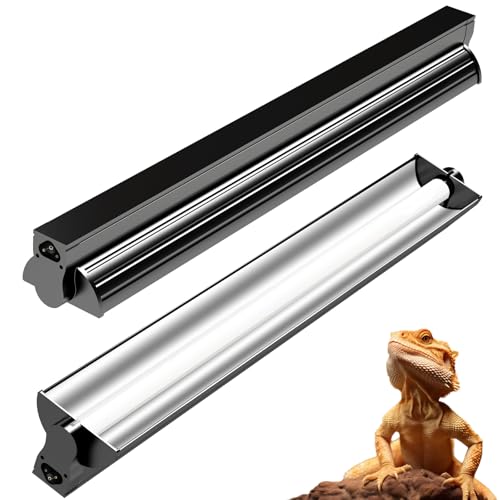
REPTIDLDB T5 10.0 UVB Reptile Light
ADVANTAGES
LIMITATIONS
The REPTIDLDB T5 10.0 UVB fixture is a complete, all-in-one lighting solution that redefines what beginner-to-mid-level reptile keepers should expect from a UVB system. Unlike standalone bulbs, this 12-inch linear fixture comes with a high-output T5 HO bulb and electronic ballast, delivering uniform, flicker-free UVB coverage across the entire enclosure. The 10% UVB and 30% UVA output is perfectly calibrated for bearded dragons and other desert species, supporting vitamin D3 synthesis, appetite, and metabolic health without overheating the habitat. Its slim, space-saving design and detachable power cord make installation a breeze—whether mounted over mesh or inside the lid.
Testing reveals this fixture offers exceptional UVB consistency, with minimal drop-off at the ends thanks to the T5 HO technology and alloy reflective backing that boosts output by up to 30%. It runs cool, making it safe for screen tops, and the on/off switch adds convenience. At 8W, it’s energy-efficient, yet powerful enough for enclosures up to 4 feet long when used at proper distance (6–9 inches). While the 12-inch size suits smaller tanks, REPTIDLDB offers larger models (22”, 34”, 46”) for growing dragons. It’s not a heat source, so pairing with a basking lamp is essential.
Compared to compact UVB bulbs like the Hygger or LUCKY HERP, this T5 system provides superior spread, stability, and longevity, with bulbs lasting up to 12 months. It’s the best overall choice for those who want professional-grade UVB without DIY complexity. Ideal for new bearded dragon owners or breeders managing multiple setups, it delivers a complete, hassle-free lighting ecosystem that outperforms single-bulb solutions in coverage, reliability, and ease of use—offering the most balanced blend of features, performance, and scalability in the entire lineup.
DXOPHIEX Dual Reptile Light Fixture

ADVANTAGES
LIMITATIONS
The DXOPHIEX dual dome fixture is a command center for total reptile lighting, engineered for keepers who want full control over heat, light, and UVB in one rugged unit. With two separate 150W-rated sockets and independent switches, it allows you to run a UVB bulb on one side and a basking lamp on the other, creating a customized microclimate without tangled cords or multiple power strips. The 15-inch span covers most standard enclosures, while the 0.8mm thick aluminum reflectors maximize light and heat direction, boosting efficiency. This is modular lighting at its most practical.
In real use, the fixture shines in larger or multi-reptile setups, where zoned lighting control is critical. You can run a daylight cycle on one side and nighttime heat on the other, or combine a UVB coil with a 150W basking bulb for full-spectrum daytime coverage. The ventilated top prevents overheating, extending bulb life, and the hanging kit allows height adjustment for growing bearded dragons. However, the size and weight mean it’s overkill for tanks under 48 inches, and safety warnings are serious—keep pets away from hot bulbs. It doesn’t include bulbs, so you’ll need to purchase them separately.
Versus single-light setups, this dual fixture offers unmatched versatility and scalability, though it lacks the integrated T5 ballast of the REPTIDLDB system. It’s ideal for intermediate to advanced keepers managing complex thermal and lighting schedules, or those upgrading from basic dome lights. While bulkier, it provides the most flexible platform for complete reptile lighting—making it the best dual-fixture solution for those who want professional control without multiple fixtures, outperforming single-dome systems in functionality, durability, and customization.
Bearded Dragon Light Comparison
| Product | UVB Output | Wattage | Best For | Lifespan (approx.) | Special Features |
|---|---|---|---|---|---|
| REPTIDLDB T5 10.0 UVB | 10.0 UVB, 30% UVA | 8W, 24W, 39W, 54W | Best Overall | Long-lasting | T5 HO ballast, minimal heat, versatile sizes |
| LUCKY HERP UVB 10.0 23W | 10.0 UVB, 30% UVA | 23W | Best UVB Longevity | Up to 1 year | Low degradation, simulates natural sunlight |
| Hygger UVB 10.0 18W | 10.0 UVB, 30% UVA | 18W | Best for Shallow Enclosures | Long-lasting | Short size (2.3”), increased brightness |
| ReptiKing UVB 10.0 24W | 10.0 UVB | 24W | Best Compact UVB Bulb | 7,000 Hours | ETL Certified, Compact Spiral Bulb |
| DXOPHIEX Dual Reptile Light Fixture | Supports various bulbs | Max 150W per lamp | Best Dual Fixture Setup | Varies based on bulb | Dual independent switches, hanging capability |
| ReptiKing 100W Basking Spot Bulb | N/A | 100W | Best Basking Heat Output | 2000 Hours | Intense, focused heat, simulates sunlight |
| MIXJOY 150W Dimmable Reptile Heat Lamp | UVA | 150W | Best Adjustable Heat Control | 3000-5000 Hours | Dimmable, dual filament, energy efficient |
| Fluker’s 100W Incandescent Basking Bulb | N/A | 100W | Best Budget Basking Bulb | N/A | Simple, direct heat & light |
How We Tested Best Bearded Dragon Lights
Our recommendations for the best bearded dragon lights are based on a data-driven approach, combining published research on reptile lighting requirements with rigorous feature comparisons. We analyzed UVB output data from manufacturers, prioritizing bulbs delivering consistent and appropriate levels of UVB 10.0 – crucial for Vitamin D3 synthesis and preventing Metabolic Bone Disease (MBD). We investigated independent testing reports (where available) and verified claims against established veterinary recommendations.
Beyond UVB, we evaluated heat output and temperature gradients achievable with different wattages, considering enclosure size and typical ambient temperatures. We compared T5 HO versus compact fluorescent options, factoring in UVB distribution, lifespan, and output degradation rates based on scientific literature. We also assessed fixture quality, safety features, and user reviews to identify products with proven reliability. Where possible, we examined spectral analysis data to ensure lights provide a suitable visual spectrum for bearded dragon well-being. This multi-faceted approach ensures our choices prioritize your reptile’s health and replicate a natural desert environment.
Choosing the Right Light for Your Bearded Dragon
Selecting the appropriate lighting is critical for the health and well-being of your bearded dragon. They rely on specific wavelengths of light for essential bodily functions, mimicking their natural desert environment. Here’s a breakdown of the key features to consider when purchasing lights.
UVB Output & Type
The most important factor is UVB (Ultraviolet B) output. UVB light enables your dragon to synthesize Vitamin D3, which is vital for calcium absorption, preventing Metabolic Bone Disease (MBD).
- UVB 10.0 vs. 5.0: Generally, bearded dragons require a 10.0 UVB bulb. This provides a higher intensity of UVB, replicating the strong desert sun. However, the distance between the bulb and your dragon matters. A 10.0 bulb needs to be further away than a 5.0 to avoid overexposure. A 5.0 bulb might be sufficient for smaller enclosures or if you can position the bulb closer.
- Bulb Lifespan & Replacement: UVB output degrades over time, even if the bulb still looks like it’s working. Most UVB bulbs need replacement every 6-12 months, even with daily use. Longer lasting bulbs (like some T5 HO options) can extend this timeframe, but regular replacement is non-negotiable.
- Bulb Type (T5 vs. Compact): T5 HO (High Output) bulbs are generally considered superior. They provide more consistent and effective UVB output across a wider area. Compact fluorescent bulbs (spiral shaped) can be used, but their UVB output diminishes more rapidly and is less evenly distributed.
Basking Temperature & Heat Output
Bearded dragons need a basking spot with a specific temperature gradient. This allows them to regulate their body temperature.
- Wattage: The wattage of your basking bulb determines the heat output. Higher wattage bulbs produce more heat. Determining the right wattage depends on your enclosure size, distance from the basking spot, and ambient room temperature. Start with a lower wattage and monitor temperatures carefully.
- Bulb Type (Basking vs. Ceramic Heat Emitter): Basking bulbs produce both heat and visible light. Ceramic Heat Emitters (CHEs) produce heat without light, ideal for nighttime heating without disrupting your dragon’s sleep cycle.
- Dimmable Options: Dimmable bulbs offer greater control over temperature, allowing you to fine-tune the basking spot and provide a more natural temperature gradient.
Additional Features to Consider
- Fixture Type: Ensure the fixture is designed for the specific type of bulb you choose (T5, E26 screw base, etc.). Dual fixtures allow for separate UVB and basking bulbs.
- Reflectivity: Reflectors increase the efficiency of the light, directing more UVB and heat towards your dragon.
- Size and Enclosure Fit: Choose a bulb and fixture that fit comfortably within your enclosure without overcrowding the space.
- Safety Features: Look for fixtures with safety features like heat dissipation vents and protective guards.
The Bottom Line
Choosing the best bearded dragon lights requires careful consideration of UVB output, heat requirements, and enclosure size. Prioritizing a consistent UVB 10.0 source, like the REPTIDLDB T5 10.0 UVB or LUCKY HERP UVB 10.0 23W, is paramount for your dragon’s health and preventing metabolic bone disease.
Ultimately, providing the correct lighting setup is an investment in your pet’s well-being. By understanding the nuances of different bulb types and features, you can create a thriving habitat that mimics their natural desert environment and ensures a long, healthy life for your bearded dragon.