
How to Take Care of a Baby Bearded Dragon: Essential Guide
This post contains affiliate links. As an Amazon Associate, we earn from qualifying purchases.
To take care of a baby bearded dragon from 0 to 6 months, you need a habitat that provides a basking surface temperature of 105-110°F measured with a digital infrared thermometer, a T5 HO tube UVB lamp positioned 6-8 inches above that spot, and a feeding schedule of three 10-15 minute sessions per day offering as many appropriately-sized insects as it can eat. The enclosure must be fully set up and running for 48 hours before the dragon arrives.
Most people measure the air under the basking bulb and call it good. That misses the point. The rock itself needs to be hot enough for the dragon’s belly to reach digestion temperature. An air thermometer reads 90°F while the slate stays at 80°F. The dragon sits there for an hour, gets nothing, and its food sits undigested in its gut. That’s the mistake.
This guide covers the five non-negotiable rules, the exact equipment specs that prevent metabolic bone disease, and the feeding math that keeps a hatchling growing at the right pace. We’ll also walk through what to do when it refuses to eat and how to spot the early signs of a problem before it becomes a vet visit.
Key Takeaways
- The basking surface temperature, not the air temperature, must hit 105-110°F. Use a digital infrared thermometer pointed at the rock.
- A T5 HO tube UVB lamp (Arcadia 12% or Zoo Med ReptiSun 10.0) is mandatory. Coil bulbs and all-in-one mercury vapor bulbs do not provide the necessary UVB intensity for a growing dragon.
- Feed hatchlings three times daily for 10-15 minutes per session. They can eat 15-30 small crickets in one sitting. Stop when they stop actively hunting.
- Never use loose substrate like sand or crushed walnut for a baby dragon. Slate tile, reptile carpet, or paper towels prevent impaction.
- Wait at least 48 hours after the dragon arrives before attempting to handle it. Handling too soon or within 48 hours of a meal can cause stress and regurgitation.
The 5 Essential Rules for Baby Bearded Dragon Care
You can follow every step in order and still fail if you miss one of these five rules. They are not tips. They are the foundation.
Rule 1: The enclosure must be complete and stable for 48 hours before the dragon arrives. Plug everything in, set the temperatures, and let the system run for two full days. This eliminates the stress of a dragon arriving in a cold, dark box while you fiddle with a thermostat. The humidity settles, the heat gradient stabilizes, and the UVB lamp reaches its output plateau. A dragon introduced to a stable environment eats within hours. One dropped into a chaotic setup hides for days.
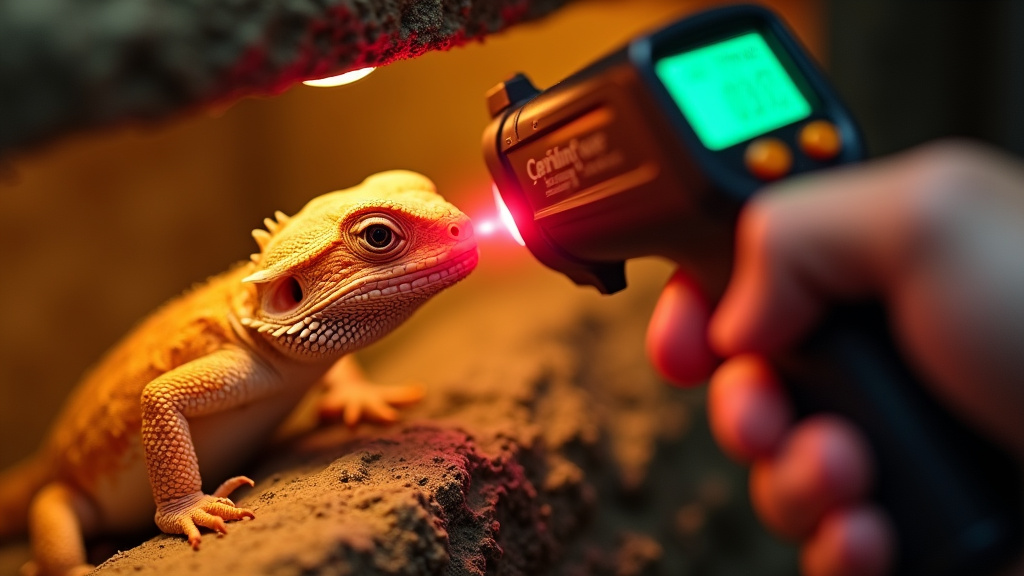
Rule 2: Measure the basking surface with a digital infrared thermometer, not an air probe. Place the thermometer’s laser dot directly on the rock or branch under the bulb. Wait for the reading. If it’s below 105°F, raise the bulb or swap to a higher wattage. If it’s above 115°F, lower the bulb or add a dimmer. The difference between surface and air temperature is often 15-20 degrees. That gap decides whether your dragon digests its food or develops a gut impaction.
Common mistake: Measuring air temperature under the basking bulb — the rock stays 20°F cooler and the dragon cannot reach its core digestion temperature. Food sits undigested for 12 hours, then passes through as waste without nutrient absorption.
Rule 3: UVB comes from a T5 HO tube, never a coil bulb or all-in-one unit. The Arcadia 12% T5 HO 24-inch lamp for a 40-gallon tank, or the 14% for a 4x2x2 enclosure, is the standard. A coil bulb emits UVB in a narrow cone that misses most of the enclosure. A mercury vapor bulb provides inconsistent output and burns out faster. The tube must be 6-8 inches above the basking spot, with no glass or mesh between the bulb and the dragon. UVB output degrades after 6-8 months even if the bulb still lights up. Replace it on schedule.
Rule 4: Feed by the “space between the eyes” rule and the “stop hunting” rule. The insect must be smaller than the distance between the dragon’s eyes. A hatchling’s eye gap is about 1/4 inch. That means a 1/4-inch cricket or a pinhead Dubia roach. Offer as many as it will eat in a 10-15 minute session, three times a day. When it stops actively pursuing bugs, stop the session. A healthy hatchling can eat 15-30 small crickets per sitting. If it leaves 5, that’s fine. If it leaves 20, you’re offering too many or the insects are too large.
Rule 5: No handling for 48 hours post-arrival, and no handling within 48 hours of a meal. The first two days are for settling. The dragon needs to find its basking spot, its water, and its hiding place without your hands in the enclosure. After that, keep sessions under 10 minutes. Support all four legs and the tail from below. Never pick it up from above — that triggers a predator response. Handling right after a meal risks regurgitation because the physical pressure on a full stomach forces food back up.
TL;DR: Set up the tank two days early, measure rock temperature not air, use a T5 HO UVB tube, feed insects smaller than the eye gap until the dragon stops hunting, and don’t handle for the first 48 hours.
The Basking Spot That Stops Metabolic Bone Disease
Metabolic bone disease (MBD) in baby bearded dragons is a softening of the bones from inadequate calcium absorption. The cause is almost always incorrect UVB placement or intensity, combined with a basking spot that’s too cool. The dragon can’t produce vitamin D3 without strong UVB, and it can’t absorb calcium without that D3. The bones weaken. You see it in a wobbly walk, a softened jaw, and eventually fractures.
The fix is two specific pieces of equipment placed in a specific relationship.
First, the basking bulb. A 50-75 watt halogen or incandescent flood lamp works. The wattage depends on your room’s ambient temperature and the enclosure’s height. You’ll know it’s correct when the infrared thermometer reads 105-110°F on the rock’s surface. That surface is where the dragon’s ventral abdomen heats up to drive digestion. The warm side ambient air should be 85-90°F, and the cool side 80-85°F.
Second, the UVB tube. For a 40-gallon breeder tank, the Arcadia 12% T5 HO 24-inch lamp is the benchmark. For a 4x2x2 (120-gallon) enclosure, use the Arcadia 14% T5 HO. Mount it 6-8 inches above the basking spot. This distance creates a UV Index (UVI) of 4.0-6.0 in that zone, which is the range needed for a bearded dragon to synthesize D3. The Washington State University Veterinary Teaching Hospital husbandry guide states that improper UVB exposure is the leading preventable cause of MBD in captive reptiles.
A T5 HO tube UVB lamp (Arcadia 12% or Zoo Med ReptiSun 10.0) must be positioned 6-8 inches above the basking surface, with no glass or plastic cover between the bulb and the animal. The UVB output decays after 6-8 months of continuous use; replace the bulb on schedule even if it still produces visible light. This placement provides a UV Index of 4.0-6.0, which enables vitamin D3 synthesis for calcium absorption.
The relationship is fixed. The UVB lamp must shine directly on the same spot the basking bulb heats. If the UVB is over the cool side, the dragon gets light but no heat synergy. If the heat is on one side and the UVB on the other, the dragon chooses heat and misses the UVB. They always choose heat.
TL;DR: Mount a T5 HO UVB tube 6-8 inches above the basking rock. Pair it with a basking bulb that makes that rock 105-110°F. The dragon needs both in the same spot to prevent metabolic bone disease.
Feeding Math: How Much and How Often for 0-6 Months
A baby bearded dragon’s growth rate is determined by how many calories it can digest. Underfeeding stunts growth. Overfeeding leads to obesity by adulthood. The balance is a schedule of three daily feeding sessions, each 10-15 minutes long, where you offer as many appropriately-sized insects as the dragon will eat.
The “appropriately-sized” rule is physical. The insect cannot be wider than the space between the dragon’s eyes. For a hatchling, that’s a 1/4-inch cricket or a pinhead Dubia roach. At two months, the gap widens to about 3/8 inch. By four to five months, it can handle a 1/2-inch cricket. This prevents choking and gut impaction.
The quantity is behavioral. You offer insects until the dragon stops actively hunting. That moment is obvious. It will look at a cricket, maybe twitch, but not chase. Some hatchlings eat 15 crickets in a session and stop. Others eat 30. The number varies by individual and by day. Leave the uneaten insects in the enclosure for an hour, then remove them. Live crickets left overnight can bite a sleeping dragon.
Here’s the weekly schedule breakdown for the first six months.
| Age (Months) | Insect Size | Daily Sessions | Session Duration | Greens Introduced |
|---|---|---|---|---|
| 0–2 | 1/4 inch | 3 | 10–15 minutes | Small dish daily |
| 2–4 | 3/8 inch | 3 | 10–15 minutes | Increased portion |
| 4–6 | 1/2 inch | 2 | 10–15 minutes | 50% of diet |
The shift from three sessions to two sessions around month four coincides with the dragon’s growth slowing. Its total insect intake per day might stay the same, but it eats more in each sitting. By month six, the diet should be shifting toward 50% vegetables, 50% insects.
Gut-load your feeder insects 24-48 hours before feeding. This means feeding the crickets or roaches a nutritious diet (commercial gut-load formula or fresh vegetables) so they pass those nutrients to your dragon. Dust the insects with a calcium powder without D3 at every feeding for the first four months. The dragon is producing its own D3 from the UVB lamp; adding supplemental D3 risks overloading its system. Use a multivitamin powder once or twice a week.
I used a calcium powder with D3 for the first month with a hatchling because the label said “for reptiles.” The dragon started refusing food by week three. A vet check showed elevated blood calcium levels. We switched to calcium without D3, and the appetite returned within four days. Now I use Rep-Cal Calcium without D3 for daily dusting and Rep-Cal Herptivite multivitamin once weekly.
TL;DR: Feed insects smaller than the eye gap three times a day for 10-15 minutes per session until the dragon stops hunting. Remove uneaten bugs after an hour. Dust with calcium without D3 daily.
What to Do When Your Baby Dragon Refuses Food
A hatchling that won’t eat is the first panic moment for new owners. The list of causes is short, and the fix is usually in the habitat.
First, check the basking surface temperature with the infrared thermometer. If it’s below 105°F, the dragon cannot raise its core temperature enough to digest. It will refuse food because eating would sit in its stomach undigested. Raise the bulb wattage or lower the bulb height.
Second, verify the UVB lamp is a T5 HO tube and it’s 6-8 inches above the basking spot. A coil bulb or an old tube that’s past its 6-month replacement window provides insufficient UVB. The dragon cannot produce D3, so it cannot absorb calcium from its food. It will stop eating because the nutritional pathway is broken. Replace the bulb with an Arcadia 12% T5 HO.
Third, look at the insect size. If you’ve upgraded to 3/8-inch crickets but the dragon’s eye gap is still 1/4 inch, the prey is too large. It will hesitate, then ignore. Go back to 1/4-inch crickets for another week.
Fourth, assess stress. Did you handle it within 48 hours of arrival? Did you move the enclosure or change the lighting schedule? Stress suppresses appetite. Leave the dragon completely alone for two full days—no handling, no rearranging furniture in the tank. Offer food at the usual times, but don’t hover.
Fifth, consider illness. If temperature, UVB, prey size, and stress are all correct, and the refusal lasts more than three days, consult an exotic animal veterinarian. Baby dragons can succumb to parasites or bacterial infections quickly. A vet visit is the next step.
The sequence matters. Jumping to “it’s sick” before verifying the basking surface temperature wastes time and money. The surface temperature is the most common fix.
The Right Tank, Substrate, and Accessories from Day One
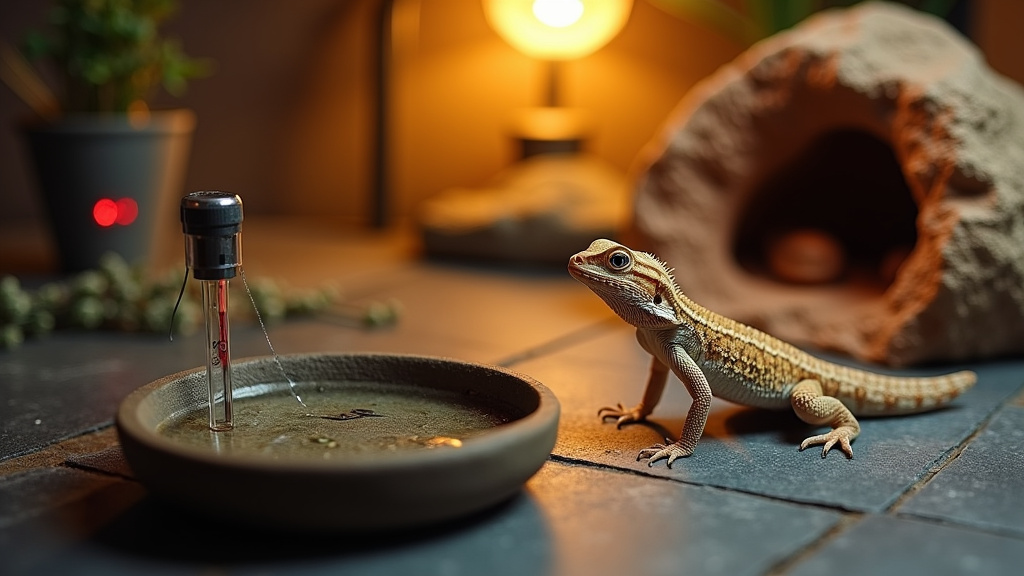
A 20-gallon tank is acceptable for a hatchling for about two months. A 40-gallon breeder tank is better from the start because it gives you room to establish a proper heat gradient. The 120-gallon 4x2x2 enclosure is the adult minimum, and you can start a baby in it if you clutter the space with hides and branches so it doesn’t feel exposed. The bigger tank means less upgrading later.
The substrate choice is non-negotiable: no loose material. Sand, crushed walnut shell, and wood chips can be ingested and cause a fatal gut impaction. Use slate tile, ceramic tile, reptile carpet, or paper towels. Slate tile holds heat from the basking bulb and helps wear down the dragon’s nails naturally. It’s also easy to clean.
Accessories are about function, not decoration. You need:
– A basking rock or branch under the heat bulb.
– A hide on the cool side.
– A shallow water dish big enough for the dragon to sit in but not deep enough to drown.
– A digital hygrometer to monitor humidity (keep it between 30-40%).
– A timer for the lights to maintain a 12-14 hour photoperiod.
The hide should be tight enough that the dragon feels enclosed. A half-log is too open. A reptile cave with one entrance works. The water dish should be ceramic or heavy plastic so it doesn’t tip. Change the water daily.
Common mistake: Using a loose substrate like sand for aesthetic reasons — a baby dragon ingests it while hunting crickets. The sand accumulates in the gut, mixes with undigested food, and forms a blockage. The first symptom is refusal to eat; the last is a distended abdomen that requires surgery.
Here’s a comparison of the two common starter enclosure paths.
| Enclosure Type | Pros | Cons | Best For |
|---|---|---|---|
| 40-gallon breeder | Affordable, easy heat gradient, fits T5 24″ UVB | Requires upgrade to 120-gallon by 12 months | Owners who want a mid-size starter tank |
| 120-gallon 4x2x2 | No future upgrades, better long-term space | Higher initial cost, requires more clutter | Owners committed to a permanent adult setup |
TL;DR: Start with a 40-gallon breeder tank or a 120-gallon 4x2x2. Use slate tile or reptile carpet as substrate. Include a basking rock, a tight hide, a shallow water dish, and a hygrometer.
Bathing, Handling, and Spotting Health Problems
Bathing a baby bearded dragon 2-3 times a week in lukewarm water (90-95°F) helps with hydration and shedding. The water should be elbow-deep for the dragon—about an inch or two. Soak for 10 minutes. Do not bathe daily; that raises the enclosure’s humidity and can lead to respiratory infections. After the bath, pat the dragon dry with a soft towel before returning it to the warm tank.
Handling requires patience. Wait 48 hours after arrival. Approach from the side, not from above. Scoop from below, supporting all four legs and the tail. Keep early sessions under 10 minutes in a quiet room. Do not handle within 48 hours of a meal—the physical pressure can cause regurgitation.
Health problems show up in specific, observable ways.
– Lethargy and refusal to eat: Check basking surface temperature and UVB lamp first.
– Swollen or soft jaw, wobbly walk: Likely metabolic bone disease from insufficient UVB or calcium.
– Runny or discolored stools: Possible parasite infection. Requires a vet fecal test.
– Puffy eyes or mucus around nostrils: Respiratory infection from high humidity or cold temperatures.
– Stuck shed on toes or tail: Increase bathing frequency to 3 times weekly for a week.
When you spot a problem, act on the first two items (temperature and UVB) immediately. If those are correct and the symptom persists for 48 hours, contact an exotic veterinarian. Do not wait. Baby dragons deteriorate fast.
Finding a vet who specializes in reptiles is part of pre-arrival planning. Search for “exotic animal veterinarian” or “reptile vet” in your area before you buy the dragon. Have their contact information saved. The bearded dragon husbandry principles you follow daily are the best prevention, but a vet is your backup when prevention fails.
TL;DR: Bathe 2-3 times weekly in 90-95°F water for 10 minutes. Handle after a 48-hour settling period, from the side, supporting legs and tail. Spot health issues by checking temperature and UVB first, then call a reptile vet if symptoms persist.
Frequently Asked Questions
How often should I feed my baby bearded dragon?
Feed hatchlings three times daily, each session lasting 10-15 minutes. Offer as many appropriately-sized insects (no larger than the space between its eyes) as it will eat until it stops actively hunting. This usually means 15-30 small crickets per session. Remove uneaten insects after an hour.
What is the best UVB light for a baby bearded dragon?
Use a T5 HO tube UVB lamp. For a 40-gallon tank, the Arcadia 12% T5 HO 24-inch bulb is ideal. For a 120-gallon 4x2x2 enclosure, use the Arcadia 14% T5 HO. Position it 6-8 inches above the basking spot with no glass or mesh blocking the rays. Replace the bulb every 6-8 months.
Can I use sand as substrate for a baby bearded dragon?
No. Loose substrates like sand, crushed walnut shell, or wood chips pose a high risk of impaction. A baby dragon can ingest these materials while hunting, leading to a fatal gut blockage. Use slate tile, ceramic tile, reptile carpet, or paper towels instead.
How do I know if my baby bearded dragon is getting enough heat?
Measure the surface temperature of the basking rock or branch with a digital infrared thermometer. The spot under the heat bulb should read 105-110°F. The ambient air temperature on the warm side should be 85-90°F. If the surface is below 105°F, the dragon cannot digest its food properly.
What should I do if my baby bearded dragon won’t eat?
First, verify the basking surface temperature is 105-110°F. Second, ensure the UVB lamp is a T5 HO tube placed correctly. Third, check that the insect size matches the space between the dragon’s eyes. Fourth, eliminate stress by not handling for 48 hours. If all these are correct and the refusal persists beyond three days, consult an exotic veterinarian.
How long should I wait before handling my new baby bearded dragon?
Wait at least 48 hours after the dragon arrives in its new enclosure. Allow it to settle, find its basking spot, and start eating regularly. When you begin handling, approach from the side, support all four legs and the tail, and keep sessions under 10 minutes in a calm room.
Before You Go
Set the tank up two days before the dragon arrives. Point an infrared thermometer at the basking rock and get it to 105-110°F. Install a T5 HO UVB tube 6-8 inches above that rock. Feed insects smaller than the eye gap three times a day until the dragon stops hunting. Never use loose substrate. Wait 48 hours before handling.
Those five rules prevent 90% of the problems new owners face. The other 10% is a vet visit. Have an exotic veterinarian’s contact ready before you need it. Baby bearded dragons are not fragile, but their tolerance for setup errors is narrow. Get the setup right from day one, and the dragon grows into a robust, interactive adult.