How Big Do Bearded Dragons Get? The Complete Size Guide
This post contains affiliate links. As an Amazon Associate, we earn from qualifying purchases.
A healthy adult bearded dragon (Pogona vitticeps) reaches 18 to 24 inches in length and weighs between 350 and 550 grams. Males typically hit the upper end of that range, while females often top out around 16 to 22 inches. They achieve most of this growth in their first 12 to 15 months, with proper diet, lighting, and enclosure size being the non-negotiable factors that determine if they reach their full genetic potential.
Most new owners underestimate two things: the speed of the growth and the final size of the animal. You bring home a 4-inch hatchling that fits in a palm, and within a year you’re looking at a foot and a half of heavy-bodied lizard needing a small room’s worth of real estate. The gap between a stunted, sickly dragon and a robust, full-sized adult is almost entirely about the care you provide in that first critical year.
This guide breaks down the exact growth timeline, explains the factors that control size, and shows you how to spot, and avoid, the common husbandry mistakes that permanently limit a dragon’s growth.
Key Takeaways
- Bearded dragons experience their most rapid growth rate in the first 6-8 months, often gaining 1-2 inches per month.
- A final adult enclosure should be at least 48″L x 24″W x 24″H (a 120-gallon tank). Smaller spaces directly contribute to stress and can stunt development.
- Inadequate UVB lighting doesn’t just cause metabolic bone disease (MBD); it silently halts calcium-driven bone growth long before visible deformities appear.
- German Giant and other “giant” morphs are real but rare; most dragons sold as “giants” are just well-fed normals. True giants have distinct genetic lines.
- A healthy weight isn’t just a number. Look for a plump, rounded tail base, full cheeks, and a body that is wide but not sagging.
The Bearded Dragon Growth Timeline: Hatchling to Adult
Forget vague estimates. Their growth follows a predictable, measurable pattern when their care is correct. This timeline is for the standard Inland or Central Bearded Dragon (Pogona vitticeps).
From hatching to approximately 18 months, a bearded dragon’s skeletal growth is primarily driven by the availability of dietary calcium and the metabolic processes enabled by UVB radiation. Without adequate UVB (specifically UVB wavelengths between 290-315 nm), the lizard cannot synthesize vitamin D3, which is required to absorb calcium from the gut for bone mineralization and elongation.
Hatchling (0-2 Months): 3 to 6 inches, 5 to 40 grams.
They hatch at about 3-4 inches. Growth is explosive if fed properly, think 2-3 appropriately sized insects 3x daily. Their tails are disproportionately long and skinny. A 20-gallon tank is fine for now, but you’ll need a bigger one soon.
Juvenile (3-11 Months): 8 to 18 inches, 40 to 400 grams.
This is the make-or-break phase. They can grow over an inch per month. Their bodies start to widen, and their heads become more triangular. Their appetite is insatiable. This is when most cases of stunting occur, usually due to a tank that’s too small or incorrect lighting. By 8 months, a healthy dragon should be nearing 16 inches.
Sub-Adult to Adult (12-18 Months): 16 to 24 inches, 300 to 600 grams.
Length growth slows dramatically around the one-year mark. They’re now filling out, gaining muscle mass and healthy fat stores. Males develop larger heads, darker beards, and more prominent femoral pores. A dragon is considered fully grown between 11-15 months, though some continue adding subtle length and significant weight until 24 months.
| Life Stage | Typical Length Range | Key Developmental Focus | Risk If Care is Lacking |
|---|---|---|---|
| Hatchling | 3–6 inches | Rapid skeletal foundation | Failure to thrive; weak bones from day one |
| Juvenile | 8–18 inches | Maximum longitudinal growth | Permanent stunting; metabolic bone disease (MBD) |
| Adult | 18–24 inches | Muscle and mass development | Obesity; calcium depletion from eggs (females) |
TL;DR: Measure monthly. If your juvenile isn’t gaining at least half an inch per month, check your UVB light’s age and your tank’s dimensions first.
What Factors Control How Big a Bearded Dragon Gets?
Genetics loads the gun, but environment pulls the trigger. A dragon from large parents has the blueprint to be big, but you provide the building materials.
Genetics and Morphs
This is the ceiling. The common Pogona vitticeps has that 18-24 inch range. True “German Giant” morphs are a specific, selectively bred line that can consistently hit 24-26 inches or more. They are uncommon. Most pet-store “giants” are not this morph, they’re just healthy normals. Other species, like the Dwarf Bearded Dragon (Pogona minor), have a much lower ceiling, maxing out around 10-12 inches.
Sex
Males are generally, but not always, larger. They tend to have broader skulls and longer bodies. A well-cared-for female can absolutely match or exceed a poorly cared-for male in size. The difference is often just an inch or two on average.
Common mistake: Assuming a smaller dragon is female, size is a terrible way to sex a bearded dragon. You must look at femoral pore size and hemipenal bulges.
The real action happens with the factors you control.
The Three Husbandry Pillars That Dictate Size
If genetics set the destination, these three pillars are the vehicle. One fails, the journey stops.
1. Nutrition: The Building Blocks
You can’t build a 24-inch lizard with poor materials.
Juveniles (0-12 months): Their diet should be 80% live insects, 20% chopped greens. They need that protein for rapid tissue growth. Offer insects 2-3 times daily, as many as they’ll eat in a 10-minute window. Staple feeders are dubia roaches, discoid roaches, and black soldier fly larvae. Dust with calcium powder 5x a week and a multivitamin 2x a week.
Adults (12+ months): Flip the ratio. Diet should be 80% vegetables, 20% insects. This prevents obesity and fatty liver disease while maintaining mass. Protein overload in adults strains the kidneys and leads to unhealthy weight gain, not healthy growth.
I once rescued a 14-month-old dragon that was fed only mealworms and iceberg lettuce. He was 13 inches long and weighed 190 grams, severely stunted and obese. After six months on a proper diet of collard greens, squash, and dubia roaches, he added two inches in length and his weight redistributed into muscle. His growth plates had already closed, though. Those lost inches were permanent.
2. UVB Lighting: The Non-Negotiable Catalyst
This is the most misunderstood element. UVB light allows your dragon to produce vitamin D3, which is required to absorb calcium. No UVB = no calcium absorption = no bone growth.
You need a linear fluorescent tube (like Arcadia’s 12% or Zoo Med’s ReptiSun 10.0 T5) that spans 2/3 of the enclosure’s length. The dragon should be able to get within 12-15 inches of it. Compact coil bulbs are worthless for this purpose. The bulb must be replaced every 6-12 months, as UVB output decays long before the light burns out.
Common mistake: Using a UVB bulb that’s over a year old, the dragon seems fine, but growth has silently plateaued because the usable UVB spectrum faded months ago.
3. Tank Size: The Most Common Growth Limiter
A cramped enclosure causes chronic stress. Stress suppresses appetite and releases hormones that can directly inhibit growth. It also limits exercise, leading to poor muscle development.
Here’s the minimum space required at each stage:
– Hatchlings: 20-40 gallon tank (fine for 2-3 months max).
– Juveniles: 40-75 gallon tank. This is where many owners stall, trying to keep a 16-inch dragon in a 40-gallon breeder.
– Adults: 75-125+ gallons. The gold standard is 48″ L x 24″ W x 24″ H. This is a 120-gallon footprint. It allows for a proper thermal gradient, space to explore, and reduces stress.
A too-small tank doesn’t just make them sedentary. It tells their body there aren’t enough resources to support getting bigger.
How to Tell If Your Bearded Dragon Is a Healthy Size
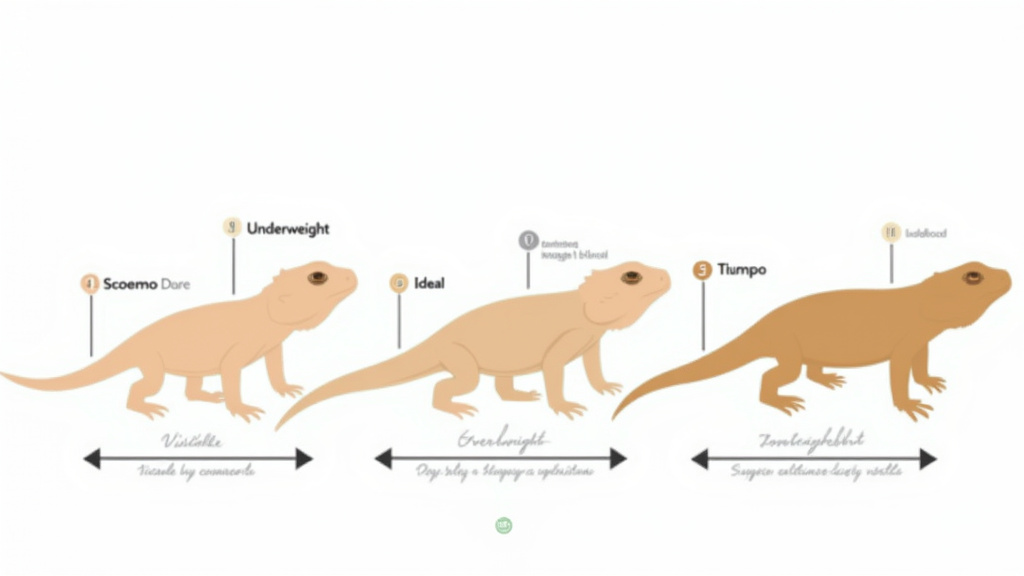
Don’t just look at the tape measure. Assess their condition.
Visual Body Condition Score:
- Underweight: Hip bones and ribs are visible. The tail is bony and thin. The head appears too large for the body.
- Ideal: Body is full and rounded like a torpedo. The tail base is plump and circular. Fat pads on the head are slightly rounded, not sunken. You cannot see individual ribs or vertebrae.
- Overweight: Body is sagging, particularly the abdomen. There are pronounced rolls around the legs. The fat pads on the head are bulging. Movement seems sluggish.
Weight vs. Length:
Use this rough guide. A 16-inch dragon should weigh between 250-400 grams. A 20-inch dragon should be in the 400-550 gram range. If a dragon is 20 inches long but only 300 grams, it’s underweight and likely under-muscled. If it’s 16 inches and 500 grams, it’s obese.
Regular tracking is part of essential health monitoring. A sudden stop in growth or weight loss is your first sign to seek veterinary care.
When Should You Worry? Stunting and Health Issues
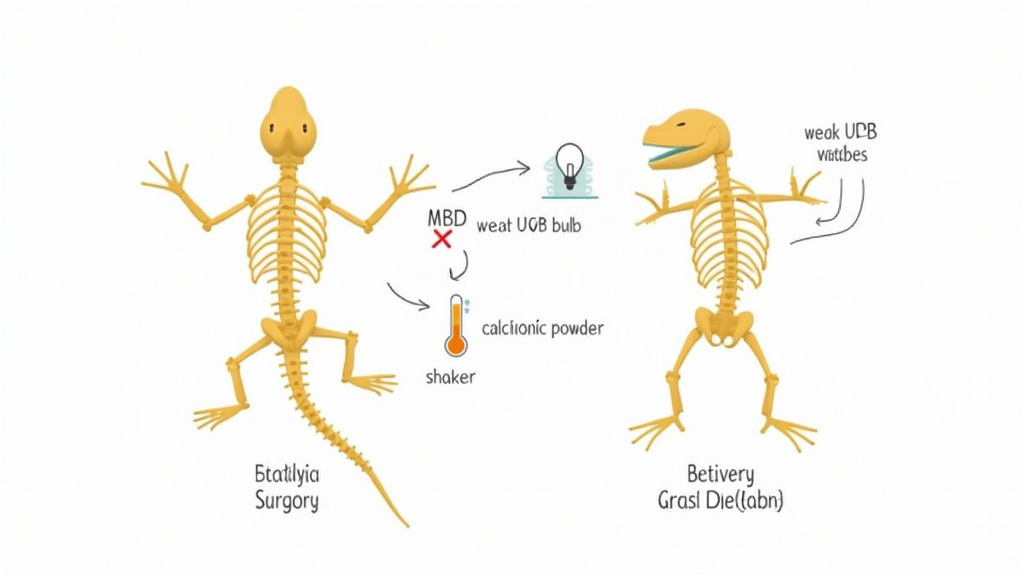
Stunting isn’t just “being small.” It’s a permanent state resulting from chronic malnutrition or poor husbandry during the growth phase. The growth plates in the bones close, and lengthening stops for good.
Causes of Stunting:
- Chronic Calcium Deficiency: From no UVB or no calcium dusting. Leads to Metabolic Bone Disease (MBD), soft, rubbery bones that bend and fracture.
- General Malnutrition: Feeding only one type of insect (like mealworms) or never offering greens.
- Parasitic Load: A heavy intestinal parasite burden steals nutrients. This requires a vet diagnosis and treatment.
- Incorrect Temperatures: If the basking spot isn’t hot enough (below 95°F), they cannot properly digest food to extract nutrients.
The long-term health implications are serious. Stunted dragons often have weaker immune systems, are more prone to reproductive issues (like egg-binding in females), and may have organ damage from nutritional deficits.
If your dragon’s growth rate has flatlined for over two months and they’re under 12 months old, it’s a red flag. Review your habitat setup immediately.
Giant Bearded Dragons: Myth vs. Reality
You’ve seen the videos of the 28-inch “absolute unit” dragons. They exist, but they’re the exception.
True “German Giants” are a specific lineage with genetics for larger size. They are not simply overfed dragons. Most dragons marketed as giants will fall into the normal 24-inch range. A dragon over 24 inches is notable; over 26 inches is exceptionally rare.
Selective breeding for size can sometimes come with trade-offs, like a slightly shorter average lifespan or unknown genetic health issues. The pursuit of extreme size should never outweigh the pursuit of health.
TL;DR: Don’t buy a dragon promising “giant” size. Buy a healthy dragon from a reputable breeder and focus on perfect husbandry. If it hits 24 inches, celebrate. If it stays at 20, you still have a healthy pet.
Frequently Asked Questions
Can a bearded dragon’s growth be stunted permanently?
Yes. If a dragon experiences prolonged poor nutrition, incorrect UVB lighting, or chronic stress during its first 12 months of life, its skeletal growth can be permanently halted. Once the growth plates fuse, additional length cannot be achieved, though weight and muscle mass can still improve with proper care.
How can I estimate how big my baby bearded dragon will get?
Look at the parents if possible, genetics are the best predictor. Otherwise, ensure perfect husbandry and monitor their monthly progress against a standard growth chart. If they are consistently at the 75th percentile for length each month, they are trending toward the larger end of their genetic potential.
Does handling a bearded dragon affect its growth?
Excessive or stressful handling, especially in juveniles, can cause enough stress to suppress appetite and indirectly affect growth. Brief, gentle handling a few times a week is fine and helps build a bond that supports their friendly nature. The key is to read their body language and never force interaction.
What is the biggest bearded dragon ever recorded?
The largest reliably measured bearded dragon was 28 inches long. These record sizes usually come from specific “giant” genetic lines, not typical pet stock. Most verified giants are in the 24- to 26-inch range.
My bearded dragon stopped growing at 14 inches. What happened?
This is classic stunting. The most likely culprits are an undersized tank (upgrade to a 120-gallon immediately), an expired UVB bulb (replace it), or a diet too low in protein during their juvenile stage. While you can’t regain lost length, correcting these issues will improve their overall health and body condition.
The Bottom Line
A bearded dragon’s size is a direct report card on its care. Hitting that 18- to 24-inch window means you provided the right fuel, the right light, and the right space during the critical first year. It means you understood their natural habitat needs and replicated them.
Chasing maximum size is less important than ensuring robust health. A compact, muscular 20-inch dragon with a plump tail and clear eyes is a far greater success than a lethargic 24-inch dragon carrying unhealthy fat. Your goal isn’t to break records; it’s to raise an animal that lives a full, active life within its genetic blueprint. Measure, weigh, and adjust. Their size will tell you everything you need to know.